
Family mental health history is information about mental health conditions and relevant patterns of care among biological relatives. It can provide context for a conversation with a health professional. It is not a prediction of your future, a diagnosis of you, or permission to assign diagnoses to relatives from family stories.
What belongs in a family history
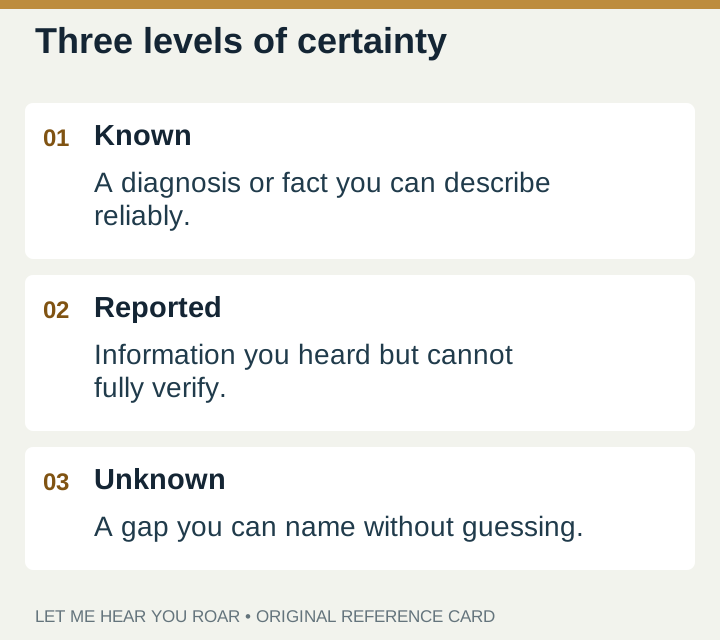
A useful history distinguishes a known diagnosis from an observation or a story. “A relative told me they were diagnosed with depression” conveys different information from “People said they were difficult.” If you know that a professional made a diagnosis, you can say so. If you do not know, retain that uncertainty rather than filling it in.
Other details may be relevant depending on the clinical question, such as approximately when a condition appeared or what care the relative received. Ask the professional what information would actually help. You do not need to create an exhaustive family archive before seeking advice about your own concern.
Keep the purpose in view. A family history is useful when it helps a qualified professional understand context, ask better questions, or discuss appropriate care. It should not become a competition to identify the largest number of problems or a catalogue of relatives’ private experiences for public sharing.
Why family history is context rather than destiny
NIMH explains that common mental disorders can involve genetic variation, environment, and life experiences together. Having relevant family history does not by itself determine whether you will develop a condition. NIMH also cautions that current genetic tests cannot accurately predict an individual’s risk of developing a mental disorder.
The practical implication is modest: bring relevant information to a professional without converting it into a verdict. “Could this family history matter to my current concern?” is a useful question. “This happened to my parent, so it will happen to me” goes beyond what the family story can establish.
Likewise, a lack of known family history cannot settle every question about your own mental health. Information may be incomplete, private, unavailable, or described in language that does not identify a condition. If you are concerned about your present experience, you can seek care without proving that someone else had the same difficulty.
Three parts of a careful note
First, record the information you believe is known. Use the level of detail that is relevant to your appointment and avoid unnecessary identifying information in a casual planning document. A relationship such as parent or sibling may be enough for initial preparation; a clinician can tell you what more is needed.
Second, record the source of the information. Did the person tell you directly, did another relative mention it, or did you read it in a document you are entitled to access? The purpose is not to investigate people. It is to avoid presenting hearsay as established medical information.
Third, record uncertainty. “I do not know the diagnosis,” “I do not know when it began,” and “I have no contact with that part of the family” are legitimate entries. A clear limit is more useful than a confident guess. You can discuss what the missing information means with the professional.
Examples of description without diagnosis
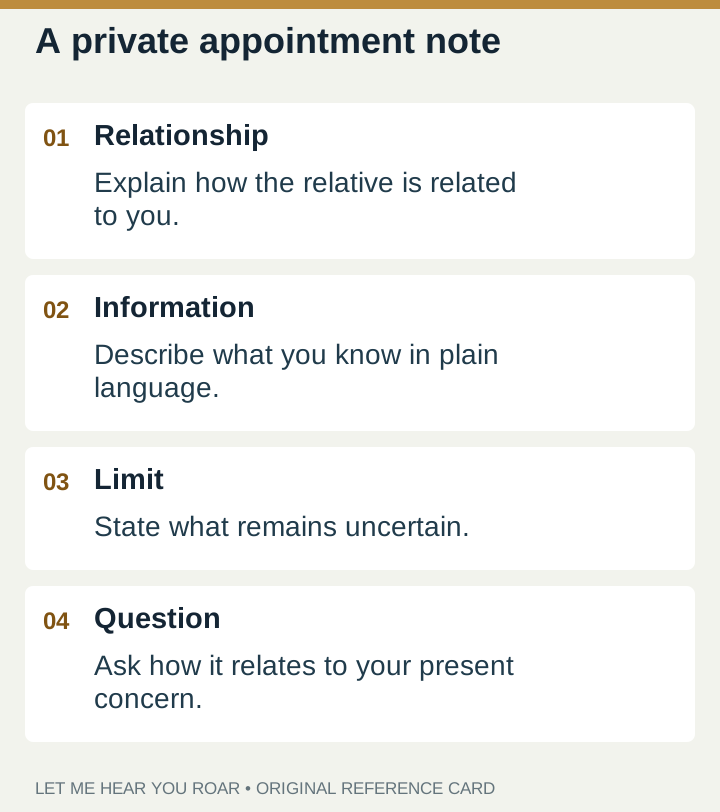
An original illustrative note might say: “My sibling told me they received treatment for an anxiety disorder; I do not know further details.” That states the relationship, the reported condition, and the boundary of your knowledge. It does not require copying your sibling’s private account into your own records.
Another could say: “There are family stories about a relative having long periods of distress, but I do not know whether they had a diagnosis.” The observation is kept separate from a label. A clinician may ask more questions, but you are not responsible for inventing a diagnosis that makes the story feel complete.
A third could say: “I am adopted and have limited information about biological relatives.” That describes a relevant information gap without making you responsible for resolving it. The same principle applies when contact is unavailable or unsafe. Your own concerns still deserve to be heard.
Family history is different from shared experience
Biological relationships are relevant to questions about inherited influences, while household and social experiences can matter for other reasons. A person who raised you may have shaped your environment even if you are not biologically related. Be clear about which relationship you are describing so the professional can interpret the context appropriately.
Do not use the distinction to rank whose influence is real. It simply helps separate different questions. A clinician may want to understand both biological history and important experiences in your life. You can share what is relevant to your own care without claiming that one piece explains everything.
Family history is also different from a personality resemblance. Sharing a relative’s quietness, strong opinions, or preferred hobbies is not enough to infer a shared mental health diagnosis. If a trait interests you, describe it as a trait. Diagnosis requires a different kind of assessment.
Privacy and consent still matter
Ask relatives for information only if doing so is appropriate and sufficiently safe. Explain why you are asking and allow them to decline. An illustrative question is: “I am preparing for a health appointment. Is there any family mental health information you would be comfortable sharing that might be relevant?” It is an invitation, not a demand for disclosure.
Avoid surprise group messages or public family trees containing sensitive health details. Keep your own preparation in an appropriate private place and ask the healthcare service how to share relevant information securely. A relative’s willingness to tell you something does not automatically mean they want it circulated more widely.
If family contact is threatening, coercive, or destabilising, tell your clinician that the information is unavailable. You do not need to expose yourself to harm to complete a history exercise. An incomplete record is a limitation to work with, not a failure of responsibility.
Use the definition for one next question
Prepare a short note containing what you know, how you know it, and what remains uncertain. Add your present concern and one question you want answered. If writing is difficult, dictate the note or ask a trusted helper to record your words and check the result with you.
Family mental health history is context about relatives’ health that may inform your care. It is not a diagnosis, a certainty about the future, or an obligation to uncover every private story. Use it to support an informed conversation about you, while respecting the people whose information forms part of that context.
Connect the ideas
Family context does not define all of who you are. These ways to see yourself beyond a diagnosis offer prompts for keeping the wider picture in view.
If you choose to discuss family experiences, telling your story without oversharing can help you decide what stays private.
What to take with you
- Separate confirmed information, reported information, and uncertainty.
- Family history can inform care without determining an individual outcome.
- You can seek help with incomplete history and without contacting unsafe relatives.
Questions readers ask
Do I need relatives’ medical records?
Not necessarily. Begin by telling your clinician what you know and ask what would be useful. Do not obtain or share another person’s records without appropriate permission.
What if I know almost nothing about my biological family?
Say that clearly. A professional can consider your current concerns and available information without expecting you to reconstruct inaccessible history.
Can a family history questionnaire diagnose me?
No. A questionnaire may organise information for discussion, but diagnosis requires an appropriate professional assessment.
PUT ONE IDEA INTO PRACTICE
Your next step
Find appropriate care for questions about your own mental health.
Understand care and coaching options ↗Sources & further reading
AI-assisted educational writing based on Joshua’s project direction. How this content is created. Original coaching reflection. Examples are illustrative unless identified as Joshua’s personal story. This article is not a clinical assessment or individualized treatment advice. Research and Scripture are linked for context; no independent clinical review is claimed.

Father, Marine Corps veteran, Christian counselor, coach, and the founder of Let Me Hear You Roar.
Read the story behind the project ↗