
Gut health and mental health evidence is research about possible relationships between digestive processes, microorganisms, and mental health outcomes. A relationship is not automatically a treatment recommendation. To judge a claim, you need to know what was studied, in whom, and which outcome changed.
This guide helps you read a promise more carefully and prepare a useful conversation with a health professional. It does not recommend a supplement, prescribe a diet, or suggest that digestive products can release trauma. Your practical question may be about a symptom, a purchase, or simply a confusing headline.
Start with the exact claim
“Supports wellbeing” and “treats depression” are very different statements, even when they appear beside the same product photo. Before searching for evidence, write the claim in a complete sentence. Include the proposed action and the promised result. If you cannot tell what would count as success, the promise may be too vague to evaluate.
For an invented example, consider an advertisement saying a daily powder will “reset your inner balance.” Ask what balance means here. Is the seller referring to a laboratory measurement, a digestive symptom, a questionnaire score, or a feeling described in a testimonial? You cannot compare a result with your needs until the result is named.
Keep the question narrow enough to answer. “Is the gut important?” is much broader than “Has this particular product been shown to help the problem I want to address?” A general story about the body does not fill in the missing evidence for an individual purchase.
Know what the existing caution means
NCCIH’s consumer guidance explains that probiotic research leaves important questions about usefulness, safety, appropriate organisms, and who may benefit. Findings should not be assumed to apply equally to every product or condition. That guidance is a reason to ask specific questions, not a recommendation to start a product.
The practical reading habit is to keep the research and the promise side by side. If a study concerns one digestive outcome, it does not by itself establish an effect on anxiety or trauma. If the participants differ substantially from you, ask a professional how relevant the findings are rather than assuming that any positive result transfers unchanged.
Uncertainty does not mean that all research is worthless. It means the answer may be narrower than the advertisement. “This was studied for this outcome in these participants” can be useful information even when it does not supply a universal wellness rule.
Understand four kinds of evidence language
A proposed mechanism explains how something might work. An observed association shows that two things occurred together in the data. A controlled trial tests an intervention under specified conditions. A personal account describes what someone believes happened in their own life. These forms of information answer different questions.
A mechanism can make a research question plausible without showing that a commercial product delivers the promised benefit. An association may leave unanswered which factor came first or what else contributed. A trial still needs attention to its methods, participants, comparison group, and outcomes. A moving testimonial cannot tell you what would have happened without the product.
You do not need to become a research specialist before asking for help. When the distinction is unclear, write the uncertainty down: “Is this a theory, an observational finding, or a trial of this exact product?” That is a useful question for a clinician or pharmacist and a useful pause before spending money.
Check the match between the study and the sale
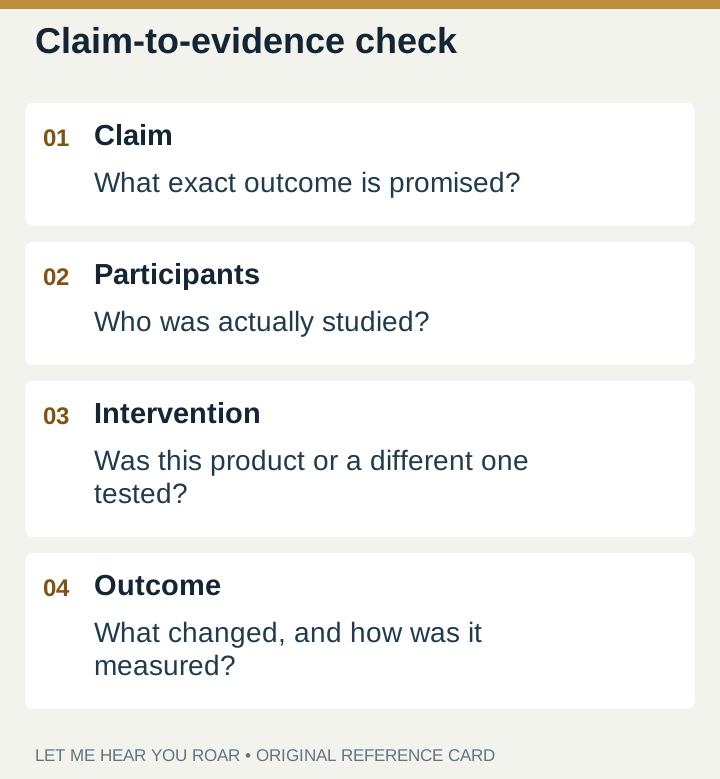
Compare the name of the studied intervention with the thing being sold. Look for whether the seller cites a complete study or only an impressive phrase. Then compare the people studied, the duration, and the measured outcome. Differences do not automatically make the study irrelevant, but they need explanation.
An original hypothetical example: a webpage cites an adult digestive-symptom study while advertising emotional transformation to everyone. The mismatch is the issue. Even if the cited study is sound, it does not automatically support the larger promise. You can ask the seller where the evidence for that specific emotional outcome is located.
Also separate evidence about an ingredient from evidence about a finished product. A blend, formulation, or use pattern may differ from what researchers tested. If you cannot establish the connection, keep it as an unanswered question rather than doing the seller’s reasoning on their behalf.
Put your own concern into ordinary words
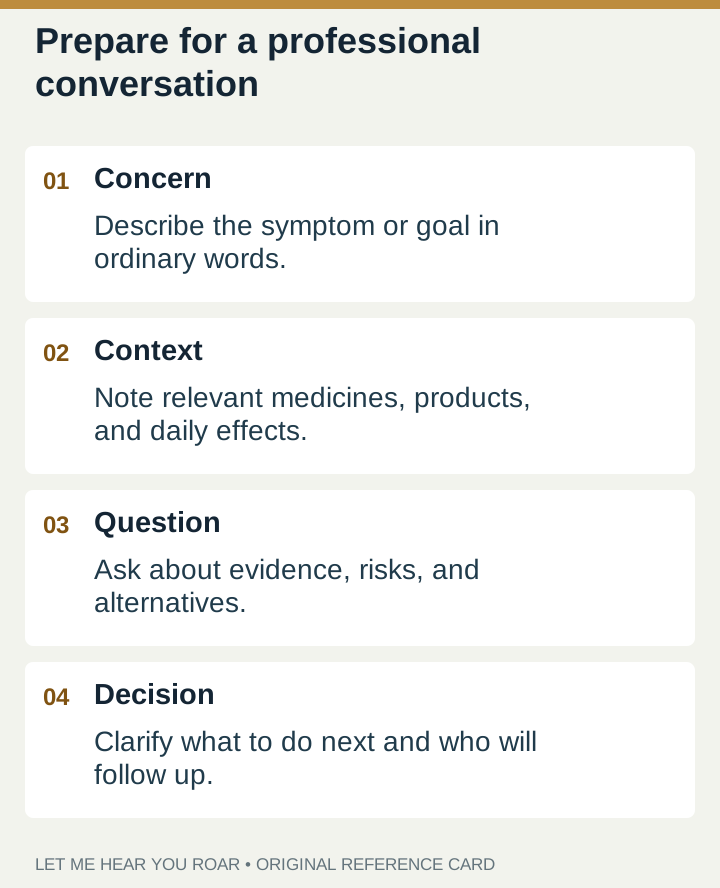
Before an appointment, describe what is bothering you, when you noticed it, and how it affects daily life. You do not need to name a mechanism. “This digestive problem is making it hard to get through work” gives a professional a starting point without declaring that your microbiome is the cause.
If mental health is the concern, describe that concern directly too. A person can have digestive symptoms and emotional distress without a website being able to determine their relationship. Bring both to appropriate care instead of trying to make one explain the other before you ask for help.
A short note may be enough. Avoid turning preparation into constant monitoring if that makes the task burdensome or distressing. Ask the professional what information would be useful to collect. They can help distinguish a practical history from an unsupported attempt to diagnose yourself through patterns.
Prepare a question set before buying
Ask what evidence is relevant to your particular goal, what risks or interactions matter, and whether other approaches deserve consideration. Bring the product name or label if a specific purchase prompted the conversation. Include any medications and supplements you already use so the professional has relevant context.
NCCIH notes that dietary supplements can pose risks and interact with medicines; “natural” is not a guarantee of safety. This is why a personalised professional review matters more than reassurance from a sales page.
You can ask what the professional would need to know before advising you. You can also ask them to explain uncertainty plainly. A responsible answer may be that evidence is limited, the product does not match your goal, or the symptom deserves assessment before a product decision is made.
Troubleshoot common reading traps
If the headline sounds stronger than the article, return to the actual outcome reported. If the article cites many studies, check whether those studies support the same claim rather than treating the number of links as proof. If every possible symptom is attributed to one hidden imbalance, ask what evidence distinguishes that explanation from alternatives.
If you feel ashamed for wanting relief, pause that judgment. A compelling promise can attract attention precisely because the underlying problem matters. You can take the concern seriously while declining to buy an explanation that has not been demonstrated.
If research feels overwhelming, save one claim and one source for discussion. You do not need to evaluate the entire field in an evening. Persistent or concerning symptoms deserve professional assessment; do not wait until you have solved the scientific debate online before seeking care.
Take a useful next step
Write the question you actually want answered: “What might be causing this symptom?”, “What support is available for my mental health?”, or “Does this product have evidence relevant to me?” Choose the appropriate professional conversation from there.
You are allowed to leave a purchase undecided. Understanding gut health and mental health evidence begins with accurate questions and reasonable boundaries around what a study can show. The next step can be seeking care, asking for clarification, or closing the advertisement without making your uncertainty a personal failure.
Connect the ideas
Before acting on a supplement claim, prepare these questions about supplements and stress for a health professional.
Food is one part of the picture. The whole-person wellbeing guide also considers rest, movement, and support.
What to take with you
- A biological explanation is not the same as evidence for a particular product.
- Match the study’s participants, intervention, and outcome to the advertised claim.
- Bring symptoms and product questions to a qualified health professional without assigning yourself a cause.
Questions readers ask
Does a gut–brain connection prove a supplement will improve mental health?
No. A specific product and outcome need relevant evidence. A general connection does not establish an individual treatment effect.
Should I stop prescribed treatment while exploring gut health?
Do not change prescribed treatment based on a wellness article or advertisement. Discuss treatment questions with the prescribing professional.
What if I only have a vague concern?
Describe the concern in your own words and ask what information would help clarify it. You do not need a self-diagnosis before seeking advice.
PUT ONE IDEA INTO PRACTICE
Your next step
Explore appropriate care for a health question or persistent concern.
Understand care and coaching options ↗Sources & further reading
AI-assisted educational writing based on Joshua’s project direction. How this content is created. Original coaching reflection. Examples are illustrative unless identified as Joshua’s personal story. This article is not a clinical assessment or individualized treatment advice. Research and Scripture are linked for context; no independent clinical review is claimed.

Father, Marine Corps veteran, Christian counselor, coach, and the founder of Let Me Hear You Roar.
Read the story behind the project ↗