
A supportive routine is a repeatable arrangement that makes an important part of life easier to manage. When life feels overwhelming, begin with one need and one workable action. A routine should reduce the work of deciding what happens next, not become another demanding project.
This is a practical planning process, not a treatment for overwhelm or a substitute for healthcare. You can use it privately, with a trusted helper, or in a coaching conversation. Adapt the examples to your circumstances and leave out any step that adds burden without helping.
Before you begin: gather very little
You need a way to record one idea and a brief view of your actual week. Paper, a voice note, a phone reminder, an accessible calendar, or supported communication can all work. Choose a method you already know how to use. Learning a new system is not a prerequisite for making one arrangement.
If a health concern is persistent, worsening, or interfering with daily life, contact an appropriate professional. NIMH’s self-care guidance includes seeking professional help when needed; a routine is not a diagnostic or treatment tool.
Give yourself a narrow planning question: “What is one part of tomorrow that could use more support?” You do not need to optimise food, sleep, work, relationships, and household tasks at the same time. A single clearer next action may be a more realistic place to start.
Step 1: choose a need rather than an ideal image
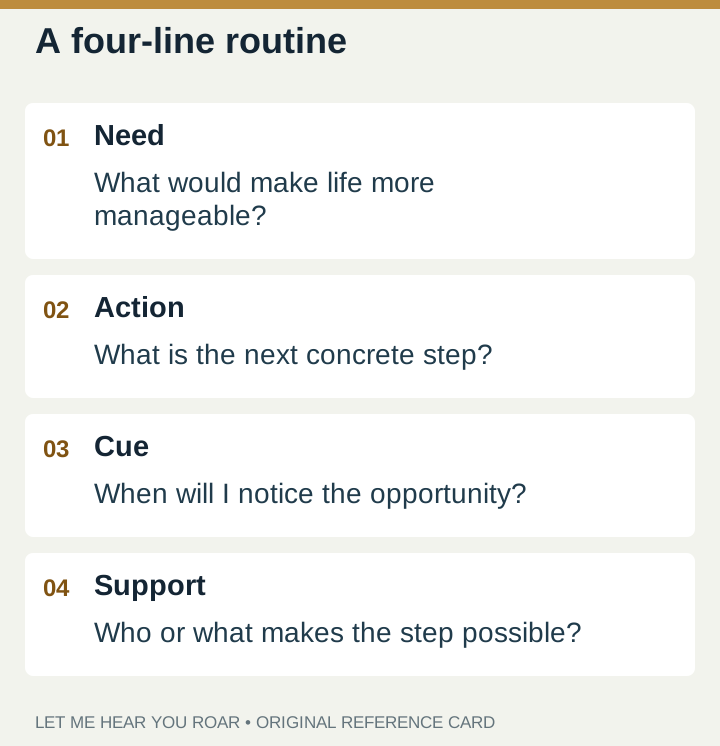
Name the need in plain language. “I need a usable way to prepare for appointments” is more specific than “I need to get my life together.” “I need help making an evening meal possible” is more useful than a picture of a perfect kitchen. The goal should describe what would matter in your actual circumstances.
Ask why this area matters now. Perhaps an appointment is approaching, a recurring task causes conflict, or you are spending energy repeatedly deciding the same thing. Choose a need you can explain in one or two sentences. If the issue requires professional assessment, make arranging that assessment the practical goal rather than trying to solve the symptoms yourself.
Step 2: locate the obstacle
Walk through the task as it currently happens. Where does it stop or become difficult? Is information missing? Are supplies inaccessible? Is another person’s decision required? Is the task larger than the time available? The answer determines what kind of change is worth trying.
For an original example, imagine someone who repeatedly misses the chance to ask a question at an appointment because the question remains in a notebook at home. The obstacle is access to the note at the relevant moment. Creating a longer journal would not necessarily help. Keeping a brief question in a place they can bring may address the actual problem.
Step 3: choose the smallest useful action
A small action is useful when it moves the real task forward. Saving the clinic number, choosing where to keep a question, or asking who can help with transport may be enough. “Think positively” is not a concrete next action; “write the question I want answered” is.
Avoid making smallness a moral rule. Some needs require substantial support. A person may need assistance with daily activities, an accessible service, or a clinical appointment rather than a miniature habit. The small action can be requesting that help. It does not have to pretend that a large barrier is easily solved alone.
Step 4: attach the action to a realistic cue
Choose a moment or event you can reasonably notice. You might check your appointment question when collecting the items you will take, or review a shared task when both household members are available. A cue should fit the way your day works, including variable work hours or caring responsibilities.
If timed reminders are easy to miss or unpleasant, try another arrangement. A visible note, an agreed message from a helper, or keeping related items together may be more usable. Do not assume that increasing the number of alerts will solve a problem with how alerts are received. Choose the least complicated cue that makes sense to you.
Step 5: ask for the help the plan requires
List any part you cannot do alone or cannot sustainably keep doing alone. Then make a specific request. An illustrative version is: “Could you help me compare the transport options for this appointment?” Another is: “Can we agree who handles this task on the days I work late?” These phrases are optional examples, not guaranteed safe in every relationship.
If the needed support is outside your personal network, identify an appropriate service or professional. The routine might include contacting them once, not repeatedly compensating for the absence of support. Be clear about what the helper will do and what remains your decision, especially if they assist with communication or appointments.
Step 6: create a fallback that preserves the purpose
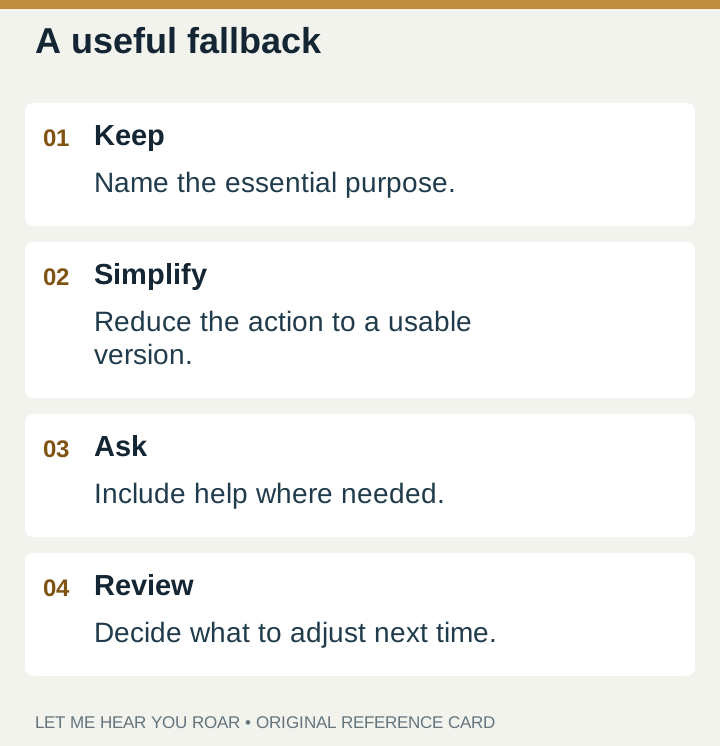
A fallback is a simpler or differently supported route for a difficult day. If your usual plan is writing three appointment questions, the fallback might be bringing one question or asking someone to help record it. If a planned task cannot happen, the fallback may be rescheduling it through a clear process rather than silently abandoning it.
Keep the fallback connected to the original need. It is not a punishment or a lower grade. It acknowledges that time, access, health, and support can vary. A plan with room for variation is often more usable than one that assumes the same conditions every day.
Step 7: decide when and how to review
After a few relevant opportunities, ask whether the arrangement helped. Did you notice the cue? Was the next action clear? Did you have the resources? Was the action still worth doing? You do not need a perfect streak to answer those questions.
Change the part that failed to fit. If the reminder arrived during work, choose another cue. If the task required money you did not have, explore support or another approach rather than increasing reminders. If the need has changed, change the plan. A routine serves the person; the person does not exist to maintain the routine.
Alternatives for low energy or limited access
Use a spoken note if writing is difficult, or ask a helper to read options aloud if a screen is inaccessible. Use a single page if navigating several apps adds work. If you share a device, consider what information is appropriate to store there. Privacy and access are part of the plan, not optional finishing touches.
You can also plan by events rather than dates. “Before the next appointment” may be clearer than a daily habit that has no daily purpose. If your circumstances are unpredictable, define what to do when an opportunity appears instead of insisting on a fixed hour. Keep the arrangement understandable enough that you can explain it to someone who is helping.
Troubleshoot without blaming yourself
If you keep avoiding the task, ask what is difficult about it. You may need missing information, help with a conversation, a smaller first action, or professional support for distress. The answer is not automatically a stronger commitment. Curiosity about the obstacle is more useful than repeating a rule that already failed to fit.
If someone else repeatedly prevents the arrangement, distinguish a coordination problem from a pattern of control or intimidation. A shared calendar may help the former; it cannot guarantee safety in the latter. Seek appropriate individual support rather than assuming that better organisation will resolve threatening behaviour.
Make one arrangement today
Complete four short lines: the need, the next action, the cue, and the help or fallback. You can stop after the first line if the rest is not clear. Bring the unfinished plan to someone who can help clarify the obstacle rather than treating uncertainty as a reason to abandon it.
Choose a routine that gives something back: a clearer question, a shared responsibility, an easier handover, or access to care. Its value is the support it provides in real life. It does not need to resemble anyone else’s schedule to be worth keeping.
Connect the ideas
A realistic routine may require declining one more demand; these ways to say no clearly offer language to adapt.
For the wider picture, connect the small routine to food, rest, movement, and support.
What to take with you
- Choose one practical need and identify the actual obstacle.
- A useful routine can include shared responsibility or professional support.
- A fallback and a review help the plan fit changing circumstances.
Questions readers ask
What if I miss the routine for several days?
Return to the underlying need. Check whether the cue, resources, and action still fit. You can revise the arrangement without trying to make up a streak.
Should I track everything?
No. Track only what helps you make a useful decision. If recording becomes burdensome, simplify or discuss another approach with someone supporting you.
Can a routine treat anxiety or depression?
This planning exercise is not a treatment. If you have symptoms or treatment questions, speak with an appropriately qualified health professional.
PUT ONE IDEA INTO PRACTICE
Your next step
Choose one manageable practical goal for a coaching conversation.
Explore coaching with Joshua ↗Sources & further reading
AI-assisted educational writing based on Joshua’s project direction. How this content is created. Original coaching reflection. Examples are illustrative unless identified as Joshua’s personal story. This article is not a clinical assessment or individualized treatment advice. Research and Scripture are linked for context; no independent clinical review is claimed.

Father, Marine Corps veteran, Christian counselor, coach, and the founder of Let Me Hear You Roar.
Read the story behind the project ↗