
You can tell a true story without telling every part of it. Choosing a level of detail is an editorial decision and a personal boundary. It does not make your experience less real, and it does not require you to present pain in a way that satisfies an audience.
These seven options can help you prepare a private conversation, a support request, or a public piece of writing. They are original planning suggestions, not a clinical disclosure protocol. Use the ones that fit your purpose, and leave room to decide that this is not the moment to share.
1. Give the story a purpose before giving it details
Ask what you want the sharing to accomplish. Are you requesting an accommodation, explaining a change in plans, seeking emotional support, or creating a public reflection? Each purpose calls for a different amount of information.
For an illustrative practical request, “I am dealing with a difficult family situation and need to reschedule” may do the job. A listener does not necessarily need names, dates, or a complete account to understand the request. Begin with the minimum information that serves the purpose; more can remain optional.
If your purpose is simply to be known by someone you trust, say that too. “I want you to understand something about me” gives the conversation a shape. You can ask for listening without promising an exhaustive history.
2. Choose a level of detail in advance
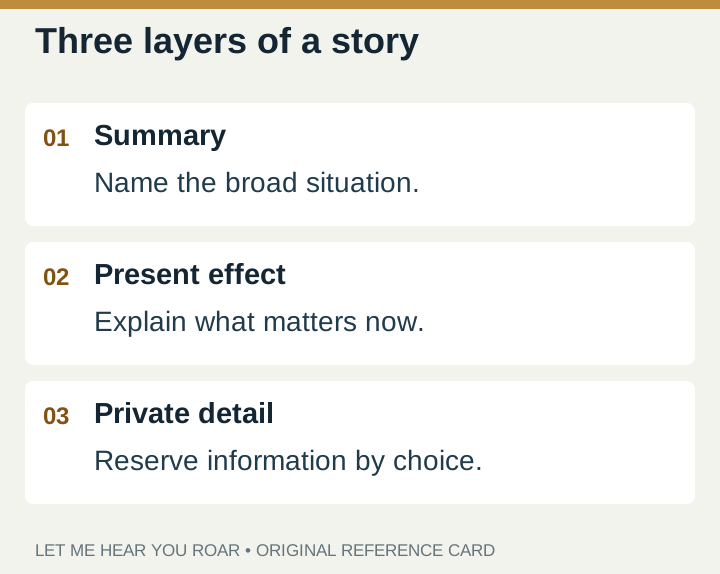
Imagine three layers: a broad summary, the present effect, and the private details. A broad summary might be, “That relationship was difficult.” The present effect might be, “I need time before discussing similar situations.” The private details may belong only with a selected confidant or professional.
Write the layer you intend to share at the top of your draft. This can help when a question pulls you toward more detail than you planned. You can answer at the same level rather than following the listener into a deeper one.
You may change your choice, but pause before doing so. Ask whether the extra detail serves your purpose or merely responds to the pressure of an awkward silence. Silence in the room does not create an obligation to fill it with private information.
3. Select the listener by behavior
Consider how the person handles other people’s stories. Do they ask before passing information on? Do they accept limits? Do they let someone correct a misunderstanding? A caring label is less informative than repeated behavior.
The VA’s coping guidance recommends choosing support people carefully. That modest principle matters here: the same story can land very differently with different audiences. You can choose a listener for one task without making them the keeper of every part of your experience.
If you are unsure, begin with a small, non-sensitive request and observe the response. Do not disclose something highly personal merely to test whether someone can be trusted. Trust can be explored through ordinary interactions.
4. Agree on the kind of conversation
A short opening can establish what you need. Illustrative examples include, “I would like you to listen before offering ideas,” and, “I can talk for ten minutes, but I do not want questions about names.” These are invitations to a clearer conversation, not guarantees that the person will respond well.
If privacy matters, discuss it directly. Ask what the listener can agree to keep private rather than assuming that the word “personal” means the same thing to everyone. Professionals may have specific confidentiality rules and exceptions; ask them to explain those before you rely on them.
The listener also has capacity limits. Asking, “Is this a workable time for a difficult topic?” gives both people a choice. A postponed conversation can be more respectful than a rushed disclosure to someone who cannot be present.
5. Prepare an exit sentence
An ending gives you a way to stop without inventing words under pressure. You might choose, “That is all I want to share today,” or, “I am going to pause here.” You can write the sentence on the same page as your opening.
If the person keeps asking, you may repeat the limit once, change the subject, or leave when that is appropriate. You do not have to produce a new explanation for every repeated question. In a threatening or coercive situation, prioritize specialist safety support over trying to enforce a script.
Practice the ending privately if it feels unfamiliar. The point is not to deliver it perfectly. It is to remember that starting a story does not remove your ability to stop it.
6. Make a separate decision about public sharing
A public post, recorded talk, or group testimony has a different audience from a private conversation. Consider who might encounter it later, whether other people are identifiable, and whether you would still want the same details available after your immediate feelings change.
You can create a full private draft and then make a separate public version. Remove details that do not serve the message. Avoid assuming that a compelling story requires the most intimate scene. A clear reflection about what you learned can be meaningful without exposing every event.
If Christian testimony is part of your purpose, faith does not require maximum disclosure. You can speak about hope, lament, or support without making private experiences public. Consider the dignity and privacy of other people as well as your own.
7. Decide what happens after the telling
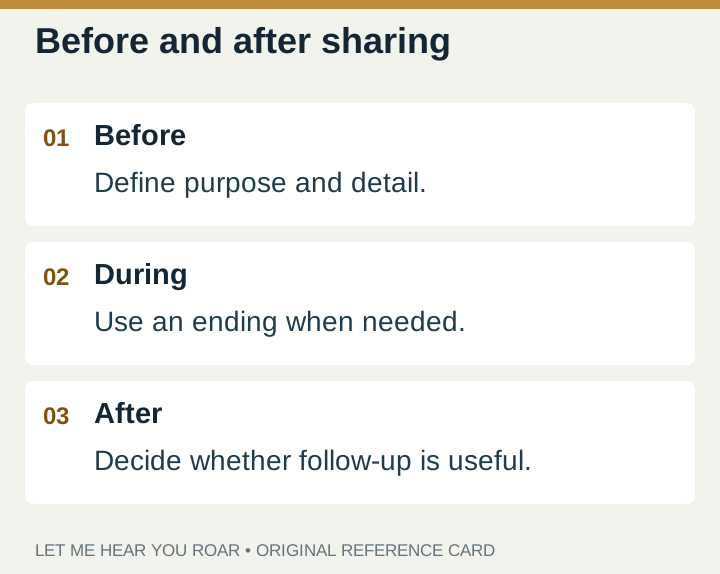
Plan a simple transition back into the rest of your day. You might take a short break, do an ordinary task, or check in with a trusted person. This is practical scheduling, not a promise that a particular activity will regulate your nervous system.
Then review the boundaries rather than grading the performance. Did you share what you intended? Was anything unclear? Do you want to ask the listener not to revisit the topic without permission? You can make a follow-up request even if the first conversation felt clumsy.
If you shared more than you wanted, avoid treating that as a permanent failure. You may be unable to retract what was heard, but you can decide what happens next and adjust future boundaries. Seek qualified support if the experience leaves you persistently distressed.
Bonus: make a private story map
Draw three headings on a page: available to share, ask me first, and private for now. Place topics beneath them without writing the full story. The categories can change over time and can differ by audience. This is a planning tool, not a contract that locks you into an earlier decision.
For your next step, choose one possible audience and one purpose. Draft an opening and an ending at the same level of detail. Keep the draft private until you decide the conversation is appropriate. Your story remains yours even when you choose not to tell it today.
Connect the ideas
Choosing a listener matters as much as choosing words. Learn what listening without fixing can look like before deciding who to trust with a story.
If a question goes further than you want, a short boundary statement can help you end or redirect that part of the conversation.
What to take with you
- Purpose determines useful detail; curiosity does not create entitlement.
- Choose the listener and the boundaries before the disclosure.
- Public sharing deserves a separate decision from private conversation.
Questions readers ask
Is leaving out details dishonest?
A truthful summary can be selective. You can state that you are keeping some details private rather than implying that you have told everything.
What if I already shared too much?
Consider a clear follow-up request about privacy or future discussion, then adjust your plan for the next conversation. Professional support may help if distress persists.
PUT ONE IDEA INTO PRACTICE
Your next step
Prepare an opening and an ending for a story you may choose to share.
Explore gentle voice practices ↗Sources & further reading
AI-assisted educational writing based on Joshua’s project direction. How this content is created. Original coaching reflection. Examples are illustrative unless identified as Joshua’s personal story. This article is not a clinical assessment or individualized treatment advice. Research and Scripture are linked for context; no independent clinical review is claimed.

Father, Marine Corps veteran, Christian counselor, coach, and the founder of Let Me Hear You Roar.
Read the story behind the project ↗