
Whole-person wellbeing means considering the person’s daily life and support together: food access, rest, movement that fits their circumstances, relationships, practical resources, meaning, and appropriate healthcare. It is a way to ask broader questions, not a promise that one routine will prevent or cure illness.
A useful check-in should reveal what would help, not create another standard you must meet. This guide offers original planning prompts for ordinary life, with boundaries around medical claims. Choose one area at a time and adapt the format to your energy, access needs, and available support.
Begin with a realistic picture of the week
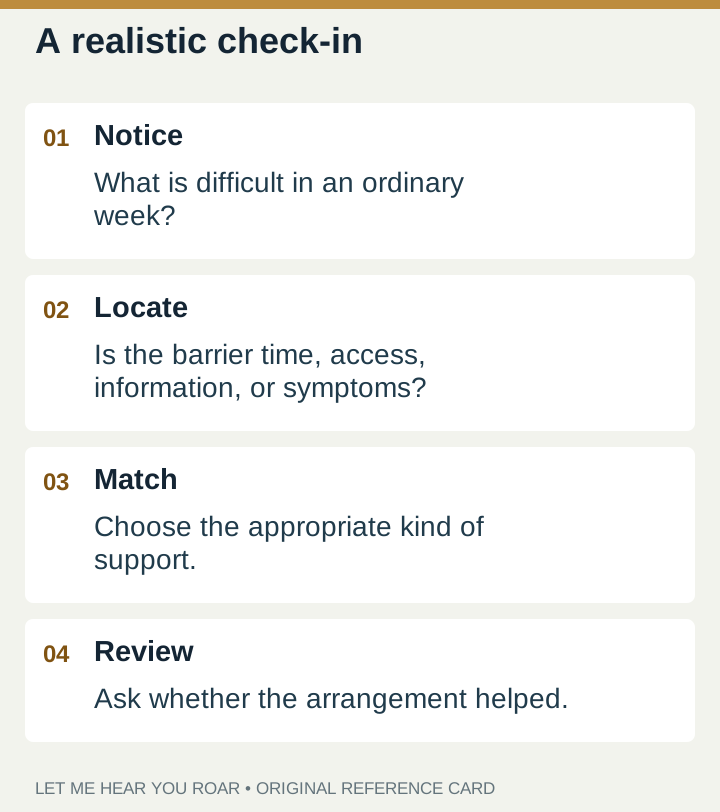
Describe a typical week before designing an ideal one. Include travel, paid work, unpaid care, appointments, household tasks, and periods when your energy or access changes. A routine copied from someone with different resources may demand time and money that your week does not contain.
Ask where the pressure actually gathers. Is the difficult point buying food, preparing it, finding time to eat, or deciding what is possible with the equipment available? Is rest interrupted by work hours, caring responsibilities, noise, symptoms, or worry? Naming the constraint helps distinguish a planning question from something that needs practical assistance or professional care.
Do not score each area out of ten unless numbers genuinely help you. Words such as “working,” “needs support,” and “not sure” may be sufficient. A check-in is useful when it changes the next conversation or decision. It does not need to become a permanent record of everything you do.
Use three levels of support
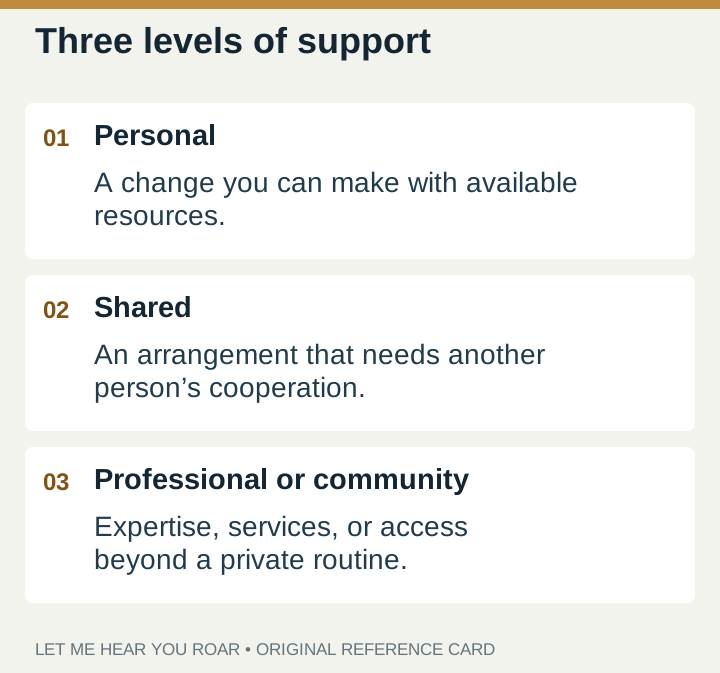
Consider what you can change yourself, what requires cooperation, and what needs professional or community support. This prevents every difficulty from being translated into a private discipline problem. The distinction is practical: it helps identify who or what needs to be involved.
An individual action might be keeping an appointment question in an accessible place. A shared arrangement might be agreeing who handles a recurring household task. Outside support might involve a healthcare appointment, a benefits adviser, a community food service, or an accessibility conversation. These are different kinds of action, and none is automatically more virtuous than the others.
If the only proposed solution adds work to the person who is already overwhelmed, review the plan. Ask what can be removed, simplified, shared, delayed, or supported. Sometimes a useful wellbeing decision is ending an unnecessary commitment rather than adding another practice to the day.
A change within your reach
Name one action you can take with resources already available. Keep the decision small enough that it clarifies what happens next. If the action relies on money, access, or time you do not have, move it to a different level of support.
An arrangement to make together
Identify who needs to participate in the change and what decision you need from them. A shared arrangement works best when responsibilities are explicit. Ask each person what is realistic before treating their availability as part of the plan.
Expertise or resources beyond the household
Name the kind of outside help required before choosing a service. A health assessment, transport assistance, and advice about available benefits have different purposes. If you are unsure where to begin, ask a relevant professional or local service which contact handles that need.
Food: examine access before judging effort
Begin with practical questions. Can you obtain food you can eat? Do you have a usable kitchen, storage, enough time, and assistance if needed? Are cost, transport, sensory preferences, disability, cultural needs, or a prescribed eating plan relevant? A generic instruction to “eat better” does not resolve these details.
An original planning example is someone whose evening meal becomes difficult because grocery shopping depends on an unreliable lift. Their first useful step may be discussing transport, delivery access, or local assistance. A new recipe collection would not address the central barrier. The plan should follow the obstacle rather than assume the person lacks information.
Keep food discussion free from moral labels. You can identify what is available and manageable without classifying yourself as good or bad. If eating or dietary restriction is causing distress, or a medical condition affects what you can eat, seek appropriate professional guidance. This guide does not prescribe exclusions, supplements, or a weight-focused plan.
Rest: distinguish opportunity from outcome
Ask whether your week offers a realistic opportunity for rest. This is different from commanding yourself to sleep well. You may be able to discuss noise, household responsibilities, or the timing of an optional task; other obstacles may require an employer, a care arrangement, or a health professional.
NIMH includes sleep, physical activity, connection, and professional help when needed in its general mental-health self-care guidance. Those are broad areas to consider, not proof that a particular routine will treat an individual condition.
For planning purposes, identify one avoidable demand near a period when you hope to rest. Could a nonessential message wait? Could tomorrow’s decision be made earlier? Could someone else handle a task? These questions concern logistics. Persistent sleep difficulties or symptoms deserve clinical attention rather than a conclusion that you have failed at a bedtime routine.
Movement: ask what fits this body and this day
Begin with access and preference, not comparison. What movement is available, comfortable, meaningful, or already part of your day? What limits or clinician guidance need to be respected? A person’s circumstances may make a common suggestion unsuitable. Do not use another person’s activity as a test of your commitment.
You might want support to access an activity you already enjoy, or you might decide that this is not the first area to change. A practical conversation could concern transport to an accessible venue, a companion, appropriate equipment, or permission to take a break from a prolonged task. These are examples of planning, not an exercise prescription.
If a proposed activity causes concerning symptoms or conflicts with medical advice, seek appropriate guidance. Whole-person reflection should not turn movement into a requirement to push through pain or prove resilience. The useful question is what support fits your situation, including the choice to focus elsewhere today.
Relationships: define the help you are asking for
Support becomes easier to discuss when its job is clear. Do you want someone to listen, help solve a practical problem, accompany you to an appointment, or check a piece of information? These requests differ. A well-intentioned helper may offer advice when you wanted company, so naming the task can reduce avoidable mismatch.
An illustrative request is: “Could you sit with me while I make this call? I want to speak for myself, but I would appreciate company.” Another is: “I would like ten minutes of listening before we consider solutions.” These are optional scripts, not guarantees about another person’s reaction or availability.
A support network does not have to be large. It can include different people or services for different purposes. Avoid placing every need on one relationship when alternatives are available. Also respect the helper’s limits; agreeing on a specific task and time can protect both people from assumptions that neither intended.
Meaning and faith: make participation voluntary
Some people want prayer, Christian community, or Scripture reflection within their wellbeing routines. Others do not. If faith matters to you, ask what practice feels honest and supportive in the present season. It might be quiet prayer, a written lament, a conversation with a trusted faith leader, or simply choosing not to explain your feelings publicly.
Spiritual participation should not require a particular emotional display. A quiet person is not less sincere, and professional healthcare need not be treated as a failure of faith. If a community response leaves you pressured to deny symptoms, discontinue treatment, or blame yourself for suffering, seek a more appropriate source of support.
You can include meaning without creating another scheduled task. Ask what you want a small decision to express: care, truthfulness, patience, fairness, or connection. Preparing an honest question or declining an unsustainable commitment can be consistent with a meaningful life even when it is not dramatic.
Gut-health claims: keep the question specific
NCCIH cautions that probiotic usefulness and safety depend on details, and important questions remain about which approaches help which people and conditions. A general wellness narrative should not be treated as proof for a specific mental-health promise.
When a claim catches your attention, write down the exact outcome it promises. Then ask whether the cited evidence studies that outcome, the advertised intervention, and a relevant group of people. If the answer is unclear, take the question to an appropriate professional rather than filling in the missing link yourself.
You can be interested in research while declining a purchase. You can also bring a digestive symptom to care without first deciding that it comes from stress, trauma, or a microbiome problem. The symptom deserves attention on its own terms, and an online explanation should not delay an appropriate assessment.
Supplements: prepare a conversation, not a shopping list
NCCIH notes that supplements can have adverse effects and interact with medicines. An attractive label or a natural origin does not settle whether a product is suitable for an individual.
If you want professional advice about a product, bring its exact name or label, your reason for considering it, and relevant information about medicines and other products you use. Ask what evidence matches your goal, which risks matter in your circumstances, and what alternatives deserve consideration. This guide does not recommend an ingredient or dose.
Be alert to a conversation that begins with a predetermined sale. A useful consultation should allow you to ask questions, hear uncertainty, and leave without buying. If you do not understand the recommendation, ask for a plain-language explanation and a written summary you can review later.
Family history: hold information without assigning destiny
NIMH explains that common mental disorders reflect a combination of genetic variation, environment, and life experiences. Family history can inform a clinical conversation, but it cannot determine an individual’s future by itself.
For your own notes, separate what you know, what you were told, and what is uncertain. A relative’s confirmed diagnosis and a family nickname such as “the anxious one” are different kinds of information. You do not need to turn stories into diagnoses or fill every gap before asking a professional whether the history is relevant.
Protect other people’s privacy. Share only relevant information through an appropriate channel, and avoid public family charts that expose someone else’s health story without permission. If you have little access to family information, say so. Missing history is a limit to describe, not an obligation to contact someone who is unsafe for you.
Create a minimum version of support
Choose one area and define a small action that remains possible on a difficult day. The minimum version is not a cure or a productivity trick; it is a way to make the plan realistic. It might be saving a phone number, placing a question by the door, or asking someone to help arrange an appointment.
Then define a supported version for times when more help is available. For example, the minimum could be identifying a food-access problem, while the supported version could be asking a service or trusted person to help explore options. Both versions address the same need at different levels of available capacity.
Finally, decide what does not need to happen. You may not need a new app, a detailed daily journal, or a complete routine overhaul. Removing unnecessary requirements can make the important action easier to see. Keep the plan small enough that you can explain it without consulting a complicated system.
Review without turning life into a scorecard
Choose a reasonable moment to ask whether the support helped. What became easier? What remained difficult? Was the original assumption correct? If the plan depended on resources you did not have, revise the resources rather than concluding that your motivation was defective.
Distinguish a planning review from monitoring symptoms that need care. A checklist cannot evaluate a medical condition. If a concern persists, worsens, or interferes with daily life, contact an appropriate health professional. The review can help you describe what is happening, but it does not supply a diagnosis or treatment decision.
You can stop an experiment that is burdensome without declaring the entire topic hopeless. Keep the useful observation. Perhaps you learned that shared tasks need clearer ownership, that reminders are inaccessible, or that you need professional input before choosing a next step.
Explore the four focused guides
For help with a research claim, read Gut Health and Mental Health: A Beginner’s Guide to Reading the Evidence. It explains how to compare a promise with the actual study and prepare a professional question.
For private history reflection, read What Is Family Mental Health History? Context Without Self-Diagnosis. For an ordered plan, use How to Build a Supportive Routine When Life Feels Overwhelming. For a product conversation, read 7 Questions to Ask a Health Professional About Supplements and Stress.
Each guide has a distinct job. You do not need to complete all of them before taking a useful action. Select the topic that matches your current concern, and return to the others only when they serve a real question.
Choose the support your week actually needs
Finish this prompt: “One part of my week would be more manageable with…” Name help, information, time, access, or a concrete arrangement rather than a judgment about yourself. Identify who could help make that support available and what you need to ask them.
A whole-person approach respects the difference between a daily planning problem, a resource constraint, a relationship question, and a clinical concern. You do not need to solve all four with the same routine. Begin with one honest description and a next step that matches it.
Connect the ideas
To turn a broad intention into something smaller, try building a routine when life feels overwhelming.
Some routines become more workable with support; explore making a specific support request with ADHD when that topic fits your experience.
What to take with you
- Review resources and constraints before adding personal rules.
- Different needs call for practical, relational, community, or clinical support.
- Health claims and family history require careful interpretation rather than self-diagnosis.
Questions readers ask
Does whole-person wellbeing replace healthcare?
No. Everyday support can coexist with healthcare. Symptoms and treatment decisions belong with appropriately qualified professionals.
Where should I start when several areas feel difficult?
Choose the area where one concrete support could make the next day more manageable. If a health concern is pressing, seek appropriate care first.
Do I need a complete morning and evening routine?
No. A single useful arrangement may be enough. A routine should serve your circumstances rather than become a standard you must perform.
Can faith be part of this approach?
Yes, if you want it. Prayer and Christian community can be optional parts of meaning and support, alongside appropriate healthcare.
PUT ONE IDEA INTO PRACTICE
Your next step
Use a private reflection to identify one support your week needs.
Take the private voice reflection ↗Sources & further reading
AI-assisted educational writing based on Joshua’s project direction. How this content is created. Original coaching reflection. Examples are illustrative unless identified as Joshua’s personal story. This article is not a clinical assessment or individualized treatment advice. Research and Scripture are linked for context; no independent clinical review is claimed.

Father, Marine Corps veteran, Christian counselor, coach, and the founder of Let Me Hear You Roar.
Read the story behind the project ↗