
A neurodivergence diagnosis can matter deeply without becoming the only fact that matters. These seven reflection options make room for useful information, mixed feelings, ordinary interests, and the right to decide what you share. Choose the ones that fit; this is not a sequence you must complete.
1. Give the diagnosis a place without making it explain everything
NIMH describes considerable variation in autistic people’s characteristics, strengths, and needs. A diagnostic category therefore cannot supply a complete portrait of an individual.
On a private page, write “This helps explain…” and “I am still unsure about…” A diagnosis may make a particular communication difficulty easier to name while leaving questions about a friendship or life decision unresolved. You do not need to choose between treating it as irrelevant and using it as an explanation for every event.
Keep uncertainty in ordinary language. “I want to understand why that situation was so tiring” is a question, not a conclusion. It can guide a conversation with an appropriate professional without requiring you to decide the answer first. Leave room for more than one influence on your experience.
2. Include ordinary things in your description of yourself
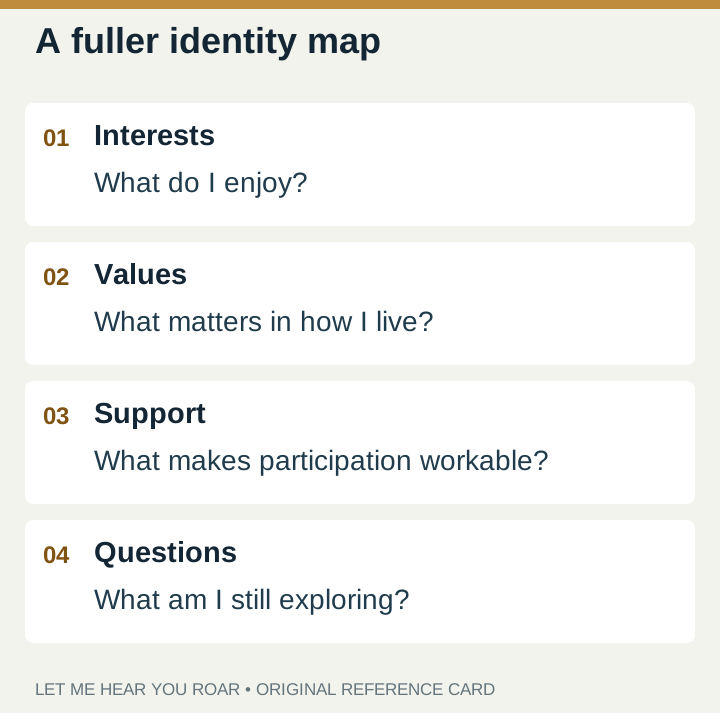
Make a list that would help someone choose a pleasant afternoon with you. Perhaps it includes a favourite kind of story, a quiet café, making something with your hands, or discussing a subject you love. You do not need exceptional talent or a dramatic life purpose for these details to count.
Then add values: what would you like to bring to a friendship, a project, or your community? Reliability, curiosity, fairness, humour, and care can mean different things in practice. Choose one and write what it looks like in an ordinary interaction. This shifts identity reflection from a label alone to the life you want to participate in.
If lists are difficult, collect a few pictures, record a brief note, or ask a trusted person to help you name interests you already enjoy. The result can stay private. It is a reminder for you, not a personal brand you must present to the world.
3. Choose your own pace for disclosure
Different audiences have different reasons to know about a diagnosis. A close friend, a healthcare professional, and a person organising a meeting do not automatically need the same information. Decide what you want from each conversation before deciding how much of your history to include.
An illustrative sentence is: “I am learning more about how I communicate, and I would like the questions in advance.” Another is: “This diagnosis matters to me, but I am not ready to discuss it widely.” Neither phrase guarantees a respectful response. Use your judgment about the person and setting, and seek support if disclosure could carry significant risk.
You can revise your decision later. Keeping something private today does not commit you to secrecy forever; sharing with one person does not create permission for everyone else. Ask clearly about onward sharing where it matters, while recognising that you cannot fully control another person’s behaviour.
4. Separate a need from a verdict about ability
“I need more processing time for this question” describes a condition. “I cannot contribute” makes a much larger claim. When possible, state the need precisely enough that an alternative can be considered. The available support may change what participation looks like.
For an invented example, someone who dislikes live brainstorming might contribute a written proposal before a group meets. That does not make writing the correct route for everyone. It shows why a task should be examined before concluding that one familiar format is the only legitimate way to take part.
Also allow yourself limits that cannot be solved by a small adjustment. Identity affirmation should not become pressure to demonstrate unlimited capability. You can value yourself while declining a task, asking for substantial support, or recognising that the current environment does not fit your needs.
5. Let community offer possibilities without becoming a rulebook
Finding people with related experiences may introduce useful language or practical ideas. It can also reveal differences. Someone else’s preferred terminology, work pattern, or approach to disclosure may not suit you. Shared labels do not make lives identical.
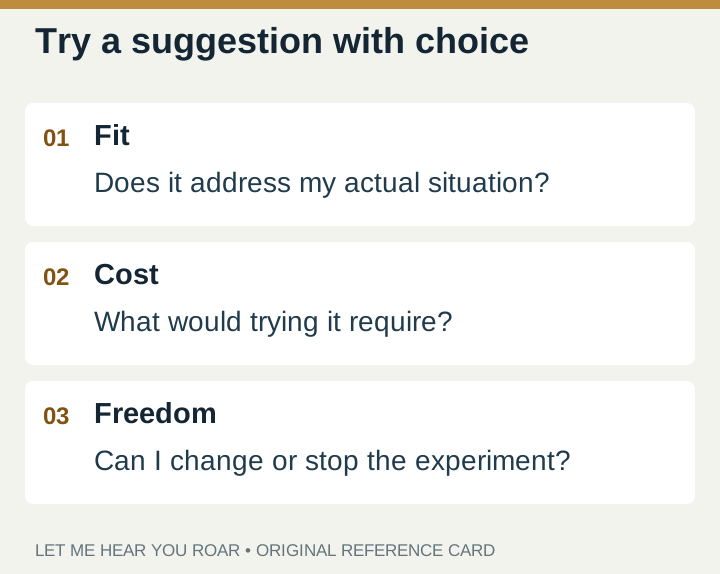
When you encounter a suggestion, ask three questions: does it address a situation I actually face, what would trying it require, and am I free to stop? This keeps advice connected to your circumstances. An online success story can be meaningful to its author without becoming an instruction for you.
Notice whether a community makes room for disagreement, accessibility, and different levels of support. You should not have to perform constant certainty or gratitude to participate. It is reasonable to step back from spaces that repeatedly leave you feeling pressured to fit another narrow version of who you should be.
6. Keep goals connected to what matters to you
A useful goal might be asking one question at an appointment, having a more workable weekly planning conversation, or making time for an interest. It need not be becoming more outgoing. Choose an outcome you value, then consider the conditions and support it requires.
An original reflection prompt is: “If nobody were grading how typical I look, what would I want this interaction to accomplish?” The answer might still involve learning a new skill. You can practise introductions or presentation structure because they serve your goals, while questioning demands that add effort without helping the task.
Make room for revision. A goal chosen immediately after diagnosis may feel different later. Changing it can reflect better information about your needs. It does not make the earlier effort wasted or mean that you failed to maintain a consistent identity.
7. Allow your story to stay unfinished
You may feel recognition, uncertainty, relief, sadness, or very little that you can name. There is no required emotional response to new diagnostic information. You do not owe others a coherent transformation story before you have had time to consider what the information means.
Try writing a sentence that begins “For now…” For now, you may be learning which meeting format works. For now, you may be keeping the diagnosis private. For now, you may want help separating practical questions from emotional ones. Temporary wording can give you room to move without dismissing what matters today.
If reflection becomes overwhelming or raises clinical questions, involve a suitably qualified professional. A coach can help organise a practical goal within scope; a diagnosis does not make every support need a coaching issue. You can choose different helpers for different parts of your life.
Bonus: make a one-line introduction for yourself
Try “I am someone who values ___, enjoys ___, and communicates best when ___.” This is an optional private exercise, not a complete definition of you. Use spoken words, writing, pictures, or another accessible method. Leave blanks if they are not clear yet.
Choose your next step
Select one item from this article and give it a small place in the coming week. You might save a privacy sentence, name one interest, or ask for one practical adjustment. You do not need to turn all seven ideas into a personal improvement project.
A diagnosis can help you find language and support while your relationships, history, values, interests, and choices remain part of the picture. Let the information help you build a life that fits, without making you prove that you represent a category correctly.
Connect the ideas
Family patterns can raise further questions; family mental health history provides context without turning a relative’s experience into your diagnosis.
For everyday application, the guide to your own communication style as a neurodivergent person keeps attention on access and preferences.
What to take with you
- A diagnosis can be important without explaining every experience.
- Privacy, language, and identity reflection can change over time.
- Goals should serve your values and access needs, not a demand to appear typical.
Questions readers ask
Is it wrong if the diagnosis feels central to my identity?
No. You decide its importance. The point is to preserve your freedom to understand yourself broadly, not to minimise something meaningful.
What if I feel almost nothing about it?
You do not owe anyone a particular reaction. Begin with practical questions if those are more useful than emotional reflection.
PUT ONE IDEA INTO PRACTICE
Your next step
Explore one preference or value in a private reflection.
Take the private voice reflection ↗Sources & further reading
AI-assisted educational writing based on Joshua’s project direction. How this content is created. Original coaching reflection. Examples are illustrative unless identified as Joshua’s personal story. This article is not a clinical assessment or individualized treatment advice. Research and Scripture are linked for context; no independent clinical review is claimed.

Father, Marine Corps veteran, Christian counselor, coach, and the founder of Let Me Hear You Roar.
Read the story behind the project ↗