
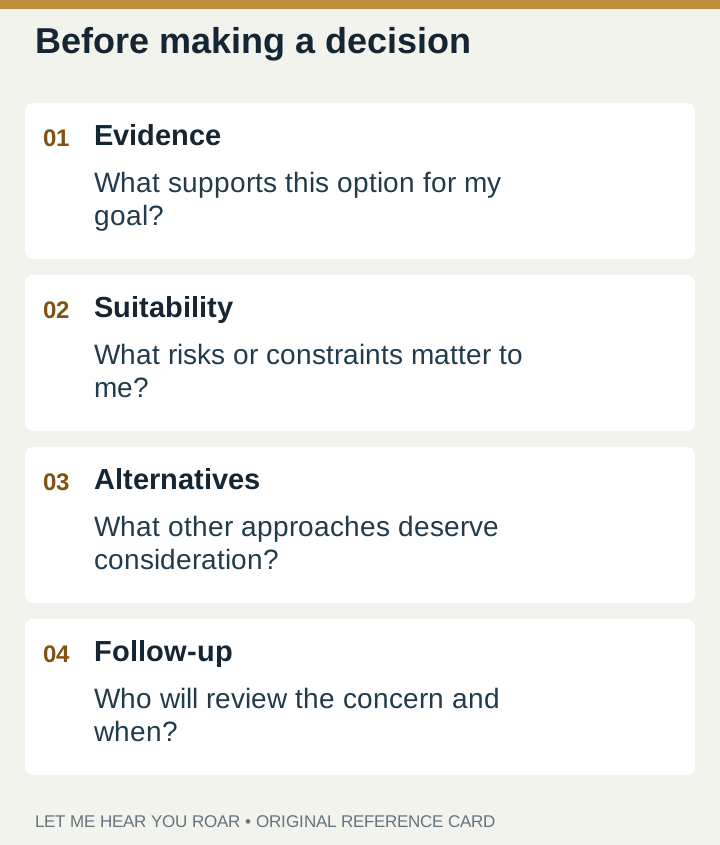
A supplement advertisement may offer a simple answer to a complicated concern. Before making a decision, bring the exact product and your actual goal to an appropriately qualified health professional, such as your clinician or pharmacist. These seven questions help organise that discussion; they do not recommend a product or dose.
1. What concern are we actually trying to address?
Begin with your experience rather than the product’s explanation. Perhaps you feel persistently worried, have trouble sleeping, or are struggling with a demanding situation. Describe what is happening and how it affects your day. You do not need to decide in advance whether the cause is nutritional, emotional, medical, or something else.
Ask whether the concern needs assessment before a supplement decision is useful. A product described as helping “stress” may use the word differently from you. Clarifying the goal prevents the conversation from treating a broad sales category as a precise health problem.
An illustrative opening is: “I saw this advertised for stress, but my main difficulty is getting through the day without feeling overwhelmed. What should we understand first?” This is a conversation aid, not a diagnostic statement. Let the professional ask the questions needed to interpret your concern.
2. What evidence matches this exact product and goal?
Ask whether the evidence concerns the advertised product, a particular ingredient, or a different formulation. Then ask what outcome was measured and who took part. The point is to establish the connection between the research and the claim, not to be impressed by the number of studies listed on a webpage.
NCCIH explains that evidence for supplements varies and that some products lack strong support for their advertised uses. It also cautions that products sold to consumers can differ from those studied.
You can ask for a plain-language explanation of what is known, what is uncertain, and what would make the professional’s recommendation change. “There is not enough relevant evidence” is a meaningful answer. You are allowed to leave the decision open rather than turning uncertainty into a reason to buy first and ask later.
3. What risks or interactions matter in my situation?
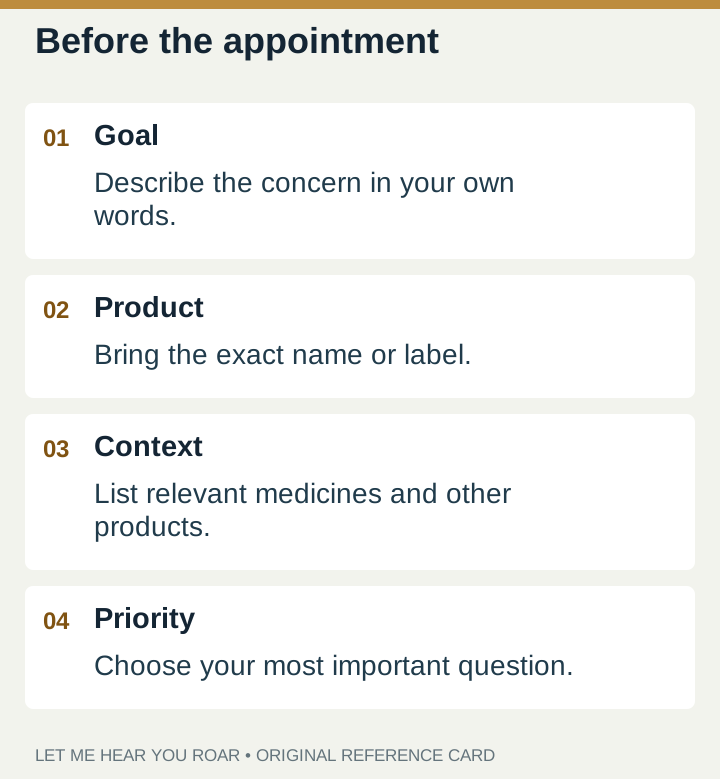
Bring an accurate list of medicines, supplements, and other relevant products you already use. If a label is complicated, bring the packaging or a clear picture of it. Tell the professional about relevant health conditions and upcoming procedures so they can decide which details affect their advice.
NCCIH warns that supplements may interact with medicines or pose risks in particular medical circumstances. Natural origin does not establish safety. The individual review matters because a general online statement cannot account for your full situation.
Ask the professional to explain any concern in terms you understand and to clarify whom to contact with further questions. Do not use this article to start, stop, or combine products. Its role is to help you prepare information for a personalised discussion, including if you are already taking something and are unsure about it.
4. What other approaches should we consider?
A product decision should leave room for alternatives. Ask whether your goal would be better addressed through assessment, an established treatment, a change in practical support, or another route appropriate to the concern. The answer depends on the problem; this article does not prescribe a substitute.
If the main pressure is an impossible workload or an unsupported caring responsibility, say so. The professional may still need to assess symptoms, but the conversation should not erase the circumstances around them. A purchase cannot independently redistribute household tasks or make a workplace agree on priorities.
Ask what can be considered without buying the advertised product. This question can help distinguish the desire for relief from attachment to one proposed solution. You can care deeply about improving your situation while remaining open to an answer that looks different from the advertisement.
5. What would count as a meaningful benefit, and who would review it?
If a professional recommends any approach, ask what outcome they are trying to achieve and how they would evaluate it. A vague promise of “balance” is difficult to assess. Clarify what change would matter in everyday life and which follow-up arrangements are appropriate.
Do not invent your own trial or dosage schedule from a marketing page. Instead, ask the professional what information they want, when they want to hear from you, and how to raise concerns. A discussion of monitoring should be part of individual advice, not a self-directed experiment suggested by a listicle.
You can also ask what a lack of benefit would mean. Would the concern need reassessment? Would another approach be considered? Knowing that a plan can be reviewed helps prevent a purchase from becoming an indefinite commitment simply because you have already invested time or money.
6. What is the full cost, including time and pressure?
Look beyond the first purchase price. Are there repeat orders, consultations, tests, delivery charges, or other required purchases? Ask which parts are necessary for the proposed care and which are optional. You deserve to understand the practical commitment before agreeing.
Consider what the expense would displace. Would it reduce money available for food, transport, appointments, or another form of support? This is a planning question, not a claim that expensive products are always ineffective or inexpensive ones are safe. The decision should fit your resources as well as the evidence.
Notice pressure to decide immediately. You can ask for written information and time to consider it. If the person advising you also sells the product, ask about that relationship and whether you can obtain an independent opinion. A clear answer should help you understand the recommendation rather than make ordinary questions feel disloyal.
7. What should I do next, and who is responsible for follow-up?
End with a concrete summary. Are you arranging an assessment, reviewing a label with a pharmacist, continuing an existing care plan, or deciding not to purchase? Ask who will contact whom and how you should raise new concerns. An appointment is more useful when you leave knowing the next action.
Repeat the plan in your own words or ask for an accessible written version. If you use a communication aid, interpreter, or supporter, include the time and format needed to check your understanding. Agreement should not depend on remembering a rapid explanation after the conversation has ended.
If you are uncertain, say which part remains unclear. “I understand that the evidence is limited, but I am not sure what to do about the symptom” is a useful follow-up. The underlying concern still deserves attention even when the product is not recommended.
Bonus: bring a one-page conversation note
Include the concern you want addressed, the exact product name or label, relevant medicines and products, and the question you most want answered. Keep unnecessary personal history out of a casual note and share sensitive information through the professional’s appropriate channel.
If a page is too much, bring a photograph of the label and one spoken question. Preparation should make the conversation more accessible, not become a requirement that prevents you from seeking help.
Choose your next step
Pick the question that would most change your decision and make it the first question you ask. You can use the remaining six as a checklist during the conversation or save them for follow-up. There is no requirement to purchase anything after asking.
A careful discussion keeps the focus on your actual concern, the relevant evidence, your circumstances, and an understandable plan. Relief is a reasonable thing to want. The purpose of these questions is to help you seek it through informed care rather than an unexplained promise.
Connect the ideas
For background on one common area of marketing, read the evidence guide to gut health, mental health, and probiotics.
If a clinician asks about family context, the guide to family mental health history without self-diagnosis can help you prepare questions.
What to take with you
- Define the concern before accepting the product’s explanation.
- Ask about relevant evidence, individual risks, alternatives, and total cost.
- Leave with an understandable next step and a clear follow-up contact.
Questions readers ask
Can a pharmacist help with supplement questions?
A pharmacist can help review medicines and potential interactions within their role. A clinician may also need to assess the symptom or health concern prompting the question.
What if I have already bought the product?
Bring the label and explain whether you have used it. Ask for individual advice rather than assuming the purchase means you should continue.
Does this guide recommend any supplement for stress?
No. It offers questions for a qualified health professional and does not recommend an ingredient, product, or dosage.
PUT ONE IDEA INTO PRACTICE
Your next step
Find an appropriate professional for a supplement or health concern.
Understand care and coaching options ↗Sources & further reading
AI-assisted educational writing based on Joshua’s project direction. How this content is created. Original coaching reflection. Examples are illustrative unless identified as Joshua’s personal story. This article is not a clinical assessment or individualized treatment advice. Research and Scripture are linked for context; no independent clinical review is claimed.

Father, Marine Corps veteran, Christian counselor, coach, and the founder of Let Me Hear You Roar.
Read the story behind the project ↗