
A Christian community can take its beliefs seriously and still make room for honest questions, different communication styles, and stories that are not neatly resolved. That room is created through practical choices: what leaders explain, how people are invited to participate, and what happens when someone says no.
This guide is for a person considering a community and for someone helping shape a gathering. You do not need to settle every theological question before asking how people will be treated. Use the steps as a reflection and planning tool, not as a certificate that a group is safe.
Before you begin: clarify your role and purpose
If you are looking for a community, identify what you hope to find: shared worship, Bible study, friendship, space to ask questions, or a particular form of service. Learn the group’s stated beliefs and purpose so that you can distinguish an honest difference in conviction from unclear expectations.
If you are organizing a gathering, identify what authority you actually have. Can you change the format, set participation agreements, or raise concerns with leaders? Do not promise changes you cannot make. Find the relevant policies for safeguarding, complaints, privacy, and support before inviting sensitive personal stories.
A faith gathering is not automatically a counseling setting. Be clear about who is qualified to provide what kind of support. Prayer, companionship, and pastoral care may be meaningful, but they do not replace appropriate clinical, legal, emergency, or specialist help when those needs arise.
1. Ask how questions are handled
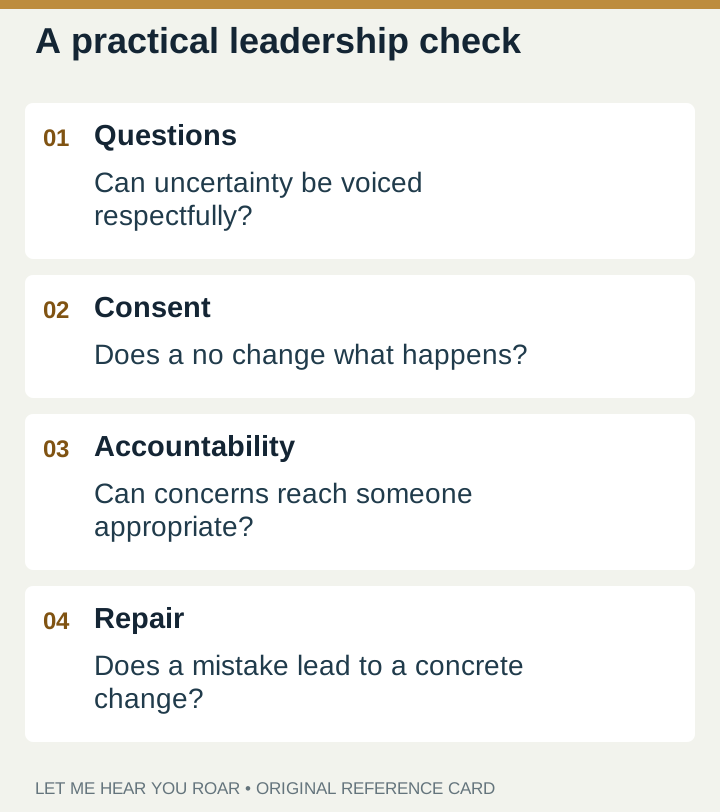
Choose a concrete question about the process: “If someone disagrees with an interpretation, how can they raise that?” or “Is there time for questions after the session?” The answer should tell you what actually happens, not only that the group is welcoming.
If you lead the gathering, explain the distinction between a question, a debate, and a personal disclosure. A person may ask what a passage means without wanting to discuss their private history. Another may share an experience without inviting the room to debate it. Naming the task helps you respond appropriately.
Illustrative wording for a facilitator is, “You can ask a question without explaining why it matters personally. If we cannot answer today, we will say so rather than put you on the spot.” Then follow through when a difficult question appears.
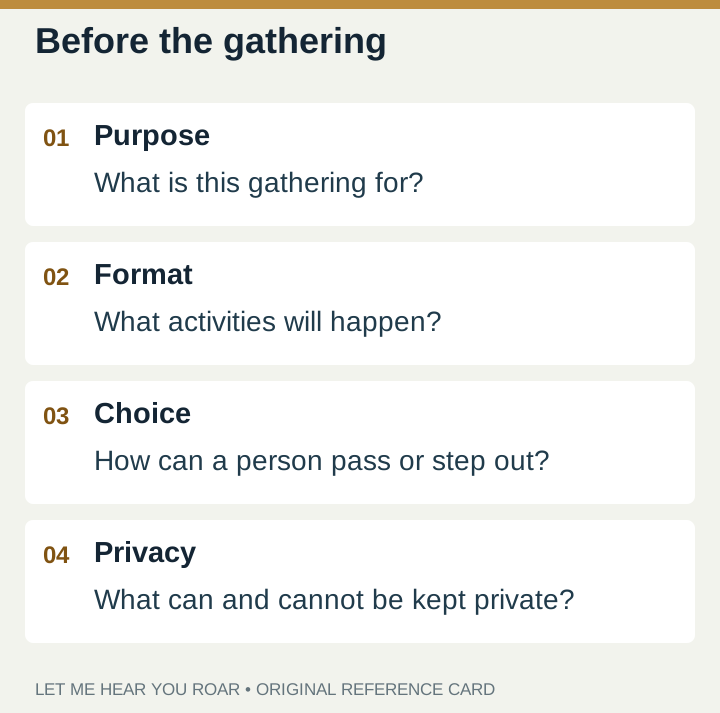
2. Make the format predictable
Before the gathering, describe the main activities and any invitations to participate. Say whether there will be pair discussion, public prayer, physical movement, testimony, or a quiet reflection. Explain whether people can attend without joining every activity and what alternative is available.
For a participant, ask about the part that matters to you: “Will anyone be asked to speak without volunteering?” or “Can I step out and return?” You do not need to give an intimate reason for wanting to know. The information helps you make an informed decision.
Predictability also includes time and practical access. Communicate start and finish times, location details, costs, and relevant access information. A warm invitation is more usable when people can work out whether attendance fits their circumstances.
3. Give people a genuine way to pass
A pass should not require an explanation or a public assessment of whether the reason is sufficient. A facilitator can say, “You can speak, write privately, or pass.” If everyone must eventually speak after passing once, the choice was only a delay; explain the actual format honestly.
Make prayer an invitation. Ask before praying directly with someone, placing a hand on them, or sharing their concern aloud. Christian community does not remove the need for consent. A person may welcome prayer in general and decline a particular form, setting, or moment.
Illustrative example: someone says, “I would rather not pray aloud.” A practical response is, “Of course; you can listen or step out if you prefer.” Avoid turning the refusal into a lesson about courage, trust, or spiritual maturity.
4. Set honest expectations about privacy
Tell participants what information will be recorded, shared, or passed to leaders, and explain relevant limits. Do not promise that nothing said in a group will ever leave it. You can ask members to respect privacy, but you cannot guarantee everyone’s behavior.
Before adding a story to a prayer list, newsletter, testimony, or social post, ask the person’s permission for the specific content and audience. Consent to tell one person is not consent to tell the congregation. Let the person review wording when their story is being shared with permission.
If your role carries reporting or safeguarding responsibilities, know the applicable requirements and process. Explain relevant limits before inviting disclosure where possible. Do not improvise legal assurances or treat an internal pastoral conversation as the only route for a serious concern.
5. Notice how leaders respond to correction
Observe whether a leader can say, “I do not know,” “I misunderstood,” or “We need to change that.” A leader’s confidence is not the same as their willingness to be accountable. Look for a clear way to raise concerns beyond the person whose behavior is in question.
If you are leading, invite feedback about a specific practice: “Did the discussion format leave enough time to think?” Specific feedback is easier to use than asking whether everyone felt welcomed. Offer a way to respond privately, since not everyone will want to critique the format in front of the group.
Avoid using spiritual status to close a practical question. Someone asking why a story was shared without consent deserves an answer about the sharing decision. They should not have to defend their faith before the concern can be addressed.
6. Make repair visible in changed practice
When a mistake happens, name it without demanding reassurance. “I asked you to share after you had passed. I’m sorry; I will respect the pass in future” identifies the action and the change. Ask whether any immediate repair would help, while accepting that the person may not want to discuss it.
If the issue affects the whole group, change the structure. You might explain the pass option at every meeting, stop recording personal sharing, or provide written questions in advance. A repeated problem needs more than another heartfelt apology.
Where there is abuse, coercion, or serious misconduct, ordinary group repair may be inappropriate. Do not pressure someone into reconciliation, mediation, forgiveness language, or renewed contact. Appropriate safeguarding, specialist, and independent support should guide the response.
Alternatives and troubleshooting
If a large gathering is overwhelming, consider a smaller activity or a conversation with a leader before attending. If the group’s stated beliefs do not fit your convictions, you can ask respectful questions and choose another setting. Belonging does not require pretending agreement.
If a community says questions are welcome but repeatedly shames questioners, take the pattern seriously. You may decide to limit disclosure, seek outside perspective, raise a concern through a suitable process, or step away. You do not have to keep exposing yourself to the same dynamic to prove goodwill.
If you lead a group with limited resources, start with changes you can sustain: clear format information, a genuine pass, consent before sharing, and an accessible feedback route. Do not advertise specialist care that the group is not equipped to provide.
Your next action: ask one observable question
As a participant, ask how the group handles passing, questions, or privacy, then observe the answer in practice. As a facilitator, choose one practice to clarify before the next gathering and one way to learn whether it worked.
A community that welcomes honest voices needs more than an inspiring message about courage. It needs ordinary arrangements that let people choose how they participate and a willingness to change when those arrangements fail.
Connect the ideas
A community that welcomes questions can also make space for praise, lament, and honest prayer.
For conversations across differences, explore speaking beliefs with compassionate conviction.
What to take with you
- Clear beliefs and open questions can coexist.
- Prayer, touch, testimony, and sharing require real choice.
- Privacy and safeguarding expectations should be explained honestly.
- Repair should change practice, not merely the mood.
Questions readers ask
Does welcoming questions mean a church cannot have clear beliefs?
No. A community can explain its beliefs and purpose while responding respectfully to questions and allowing people to choose whether it fits them.
Should people be encouraged to share painful stories publicly?
Only through a genuine invitation with clear information about the setting and audience. No one should have to disclose painful experiences to demonstrate faith, courage, or belonging.
What if a leader says forgiveness requires immediate contact?
Do not treat renewed contact as a required communication exercise. Consider safety, your choices, and appropriate independent or specialist support, particularly where abuse or coercion is involved.
PUT ONE IDEA INTO PRACTICE
Your next step
Explore optional Christian reflection on voice, choice, and community.
Explore faith and speaking life ↗AI-assisted educational writing based on Joshua’s project direction. How this content is created. Original coaching reflection. Examples are illustrative unless identified as Joshua’s personal story. This article is not a clinical assessment or individualized treatment advice. Research and Scripture are linked for context; no independent clinical review is claimed.

Father, Marine Corps veteran, Christian counselor, coach, and the founder of Let Me Hear You Roar.
Read the story behind the project ↗