
Listening without fixing means attending to another person’s account without automatically taking control of the problem, supplying advice, or deciding what their experience means. You aim to understand and respond to what they want from the conversation before proposing a solution.
It is not passive agreement, a therapy technique offered as treatment, or a rule against practical help. Advice and action can be useful when they are wanted. The distinction is whether you first make room for the person’s purpose and choices.
The main parts: attention, reflection, and permission
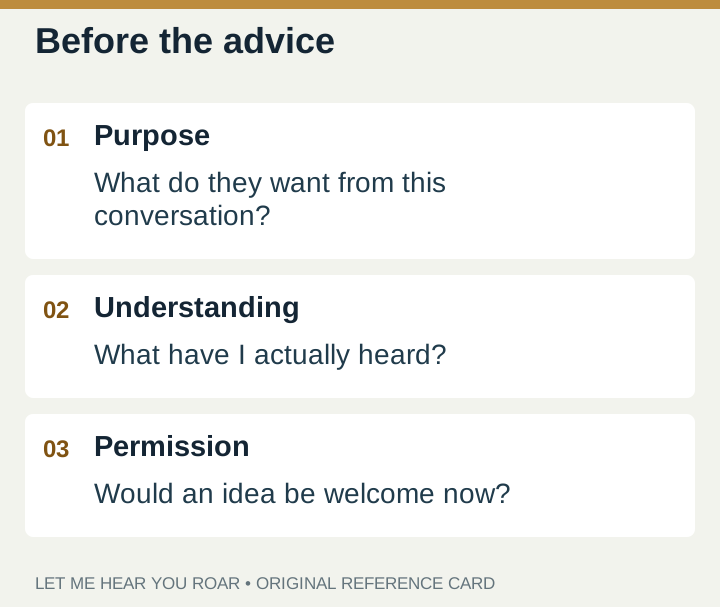
Attention means giving the conversation a realistic portion of your focus. Put aside avoidable interruptions when you can, and be honest about your capacity. “I want to hear this, and I have fifteen minutes” is clearer than appearing available while mentally preparing to leave. Attention can be offered through speech, writing, or another accessible form of communication.
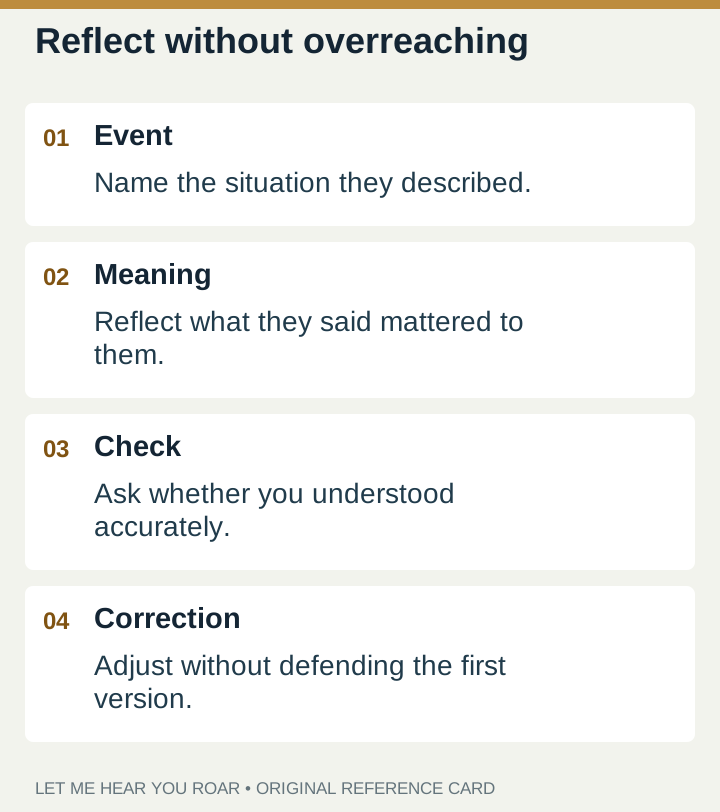
Reflection means briefly returning what you understood. “You were hoping they would ask before changing the plan” stays close to the speaker’s account. “You have always been abandoned” adds a sweeping interpretation. Keep a reflection modest enough that the person can correct it without having to dismantle a theory about their life.
Permission means checking before changing the task. “Would you like an idea, or would you rather keep talking?” is useful only if either answer is acceptable. If you ask and then give the advice despite a no, the question has not protected choice. You have simply announced what you intended to do.
An ordinary example of listening without fixing
Illustrative example: a friend says, “I shared an idea at the meeting, and everyone moved on. I felt invisible.” A fixing response might immediately recommend speaking louder, emailing the manager, or looking for another job. Those options may or may not be relevant, but the friend has not yet asked for them.
A listening response could be, “You wanted your contribution to be considered, and it felt as though no one noticed.” Then pause. The friend might say, “Exactly,” or clarify, “They noticed, but no one explained why they rejected it.” The correction gives you a more accurate understanding.
You could then ask, “Do you want to think about a next step, or did you mainly want someone to hear how it felt?” If the friend wants a next step, practical discussion now fits the request. Listening has not prevented action; it has helped you choose the right kind of action.
How it differs from agreement and reassurance
Listening does not require endorsing every claim. You can acknowledge that someone felt hurt without agreeing that another person intended harm. “That interaction was painful for you” and “They deliberately wanted to ruin your day” are different statements. The first reflects an experience; the second asserts a motive you may not know.
Reassurance tries to reduce concern: “It will all work out.” Sometimes reassurance is welcome, but a promise you cannot support may leave the person feeling brushed aside. More grounded language is, “I do not know how this will turn out, but I can help you think through the options.”
Listening also differs from silence without engagement. You can ask a relevant question, summarize, or check what would help. The aim is not to become so afraid of saying the wrong thing that the person receives no response at all. A small, accurate acknowledgment is often a workable place to begin.
How fixing can hide inside apparently helpful responses
Advice is not the only way to take over. You can turn the conversation toward your own similar experience, give an unsolicited spiritual explanation, diagnose the people involved, or insist on a positive lesson before the speaker has finished. Each response may move attention away from the account the person chose to share.
A personal story can be useful if invited. Ask whether a related experience would help, keep it brief, and return the focus. In a Christian relationship, prayer can also be offered with consent. “Would prayer be welcome?” is different from declaring why God allowed the event or treating spiritual language as the required conclusion.
Questions can take over too. A sequence of detailed questions may feel like an interview, especially if the answers are unnecessary for the person’s request. Before asking, consider whether the information will help you support their stated purpose or merely satisfy your curiosity.
What the skill does not ask you to do
You do not have to provide unlimited availability, keep promises of secrecy you cannot honor, or manage a crisis alone. State your limits in a way that does not blame the speaker: “I cannot talk longer tonight. Can we think about who else could support you?” If immediate safety is at risk, appropriate emergency or specialist help takes priority over an ordinary listening exercise.
You also do not have to accept verbal abuse as the price of being supportive. A limit might be, “I want to talk, but I will pause if I am being insulted.” Use direct boundary language only where it is reasonably safe, and seek suitable support where intimidation or coercion is involved.
Listening should leave room for both people’s humanity. The speaker can ask for a kind of support, and the listener can say what they can offer. Neither person needs to pretend that every need can be met in a single conversation.
Common misconceptions and a useful correction
A common misconception is that a good listener always knows the correct emotion word. You can ask rather than label: “How did that land for you?” Another is that every pause needs a prompt. Sometimes the speaker is choosing words, and an extra question would interrupt that process.
A third misconception is that listening guarantees the person will feel understood. It cannot guarantee that outcome. You can check, accept correction, and adjust. “I missed something; what would you like me to understand?” may be more useful than listing all the ways you tried to listen.
The most practical correction is to measure the skill by responsiveness. Did the person’s answer change what you did next? If they asked for company and you stopped offering solutions, their voice influenced the conversation. That is a more concrete sign than whether you used a polished phrase.
Your next action: replace one automatic response
Notice the response you tend to reach for first: advice, reassurance, a personal story, prayer, or a question. In one ordinary conversation, pause before using it and ask what kind of response would help. You do not need to announce that you are practicing a skill.
Listening without fixing is attentive, responsive conversation that checks before taking over. Keep that definition close: understand the purpose, reflect modestly, and let the other person’s choices shape what happens next.
Connect the ideas
When the conversation involves trauma, read the fuller guide to supporting someone finding their voice before asking for more detail.
If you have already interrupted or moved too quickly to advice, consider these ways to repair a conversation after someone felt unheard.
What to take with you
- Understand the purpose before offering a solution.
- Reflect the account without inventing motives or a diagnosis.
- Permission matters only when a no changes your response.
Questions readers ask
Can I still give advice?
Yes. Ask whether advice is wanted and what kind would help. Offer it as an option, stay within your knowledge, and leave the decision with the person.
What if I disagree with the speaker?
You can listen to their experience without endorsing every interpretation. Separate what they felt from claims about facts or motives, and choose an appropriate time to discuss the disagreement.
PUT ONE IDEA INTO PRACTICE
Your next step
Practice a short reflection and a permission question.
Explore gentle voice practices ↗AI-assisted educational writing based on Joshua’s project direction. How this content is created. Original coaching reflection. Examples are illustrative unless identified as Joshua’s personal story. This article is not a clinical assessment or individualized treatment advice. Research and Scripture are linked for context; no independent clinical review is claimed.

Father, Marine Corps veteran, Christian counselor, coach, and the founder of Let Me Hear You Roar.
Read the story behind the project ↗