
Christian prayer can contain gratitude, grief, questions, and hope. You do not have to choose one emotion and hide the others. This practice helps you make room for what is actually present, using Scripture as a companion and simple prompts as an invitation.
The steps are optional. You can use a page, a device, your preferred communication aid, or no writing tool at all. They are not a treatment protocol, a measure of spiritual maturity, or a way to force yourself into a better mood.
Before you begin
Choose a setting where you have some choice about privacy and interruption. Decide whether you want to reflect alone or with someone you trust. If another person joins you, agree that there will be no demand to explain your answers and no automatic advice. A few unhurried minutes are enough to try the process; there is no required duration.
You do not need music, a raised voice, a special posture, or a painful memory to get started. If a resource brings up more than you want to engage with, put it aside. Begin with an ordinary present concern, such as a decision, a tiring week, or something you appreciate. The aim is honest attention within your available capacity.
Step 1: Choose a passage without choosing your mood for yourself
You might read Psalm 13 for a prayer that includes complaint and trust, or Psalm 47 for an expression of joyful praise. Notice the difference between what the text says and what you feel. You can appreciate a joyful passage on a difficult day without pretending to be joyful.
Read a manageable portion in context. If a line interests you, ask what surrounds it rather than immediately making it a rule for yourself. Write one observation in plain language: 'This prayer contains a question,' for example. Then write your own response separately. That small separation keeps the passage from being replaced by your first impression.
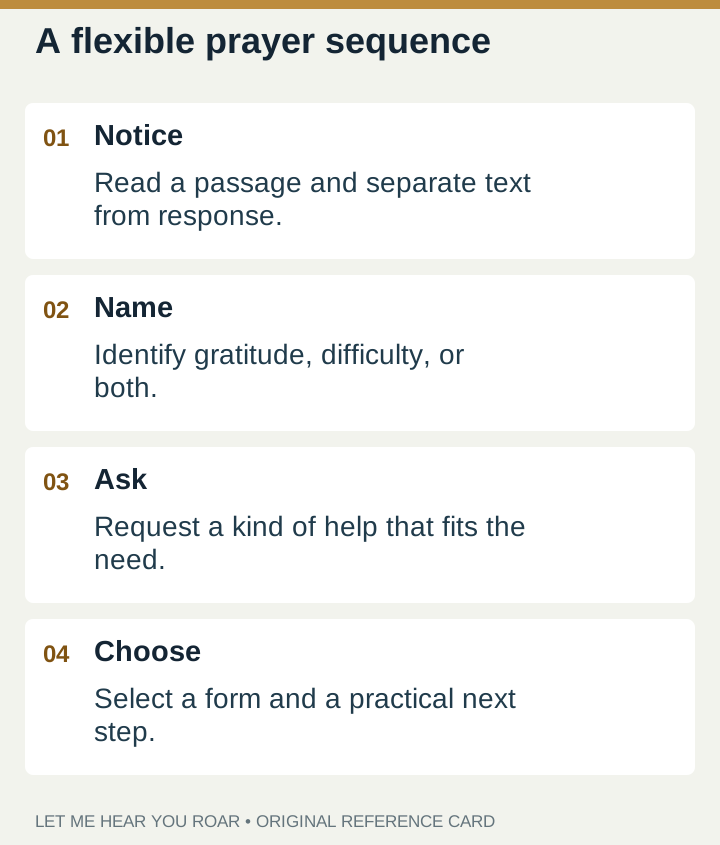
Step 2: Name what is present
Complete two sentences if you wish: 'Today I am thankful for…' and 'Today I am carrying…' The answers do not have to balance. A long list of difficulties does not require an equally long gratitude list before it is acceptable to God. You can leave either prompt blank.
Use concrete language where possible. 'I am worried about the conversation on Friday' may help more than 'Everything is wrong.' If a broad statement is all you have, start there without criticizing it. You can refine the wording later, or ask a trusted person to help you identify the question underneath it.
Step 3: Turn one observation into a request
Choose a request that corresponds to what you named. If the concern is uncertainty, you might ask for wisdom. If it is exhaustion, you might ask for rest and help rearranging commitments. If it is a relationship, you might ask for clarity about what is yours to say and what is outside your control.
Here is an original illustrative prayer: 'Lord Jesus, I am grateful for the people who care about me, and I am worried about this decision. Help me understand my options and receive good counsel. Give me words that are honest, and help me recognize when I need more time.' Adapt it to your beliefs and situation rather than treating it as required wording.
Step 4: Choose a form of expression
You may speak at an ordinary comfortable volume, write, sign, type, draw, or remain silent. Singing may be meaningful if you enjoy it, but it is not required. The form should serve your participation. If your voice feels sore or strained, choose another form instead of trying to demonstrate commitment through discomfort.
A person praying with you can ask, 'Would you like me to read something, sit quietly, or give you space?' That question is more useful than assuming you want hands placed on you, public attention, or a spoken interpretation. Agree before adding another activity. A practice remains an invitation only while you can choose how to participate.
Step 5: Leave the outcome open
You may feel relief, sadness, calm, frustration, or no obvious shift. None of those reactions is a complete spiritual assessment. Resist rewriting the experience into a success story before you know what it means to you. An honest account might simply be, 'I named something I had been avoiding.'
Acts 16 recounts prayer and hymns in prison followed by an earthquake. It is a narrative Christians may read with hope, not a repeatable instruction for securing an external result through sound. Your practice does not need a dramatic event to count as prayer.
Step 6: Choose one practical response
Look back at the need you named. Is there a small action that fits it? You might ask for information, schedule a conversation, decline an extra commitment, rest, or seek qualified support. If no action is clear, your next step may be gathering more information rather than making a decision immediately.
Keep the action separate from a promise about its outcome. 'I will ask whether someone can accompany me' is something you can attempt. 'Everyone will understand now' is outside your control. Prayer can sit beside that uncertainty without making you responsible for another person's choices.
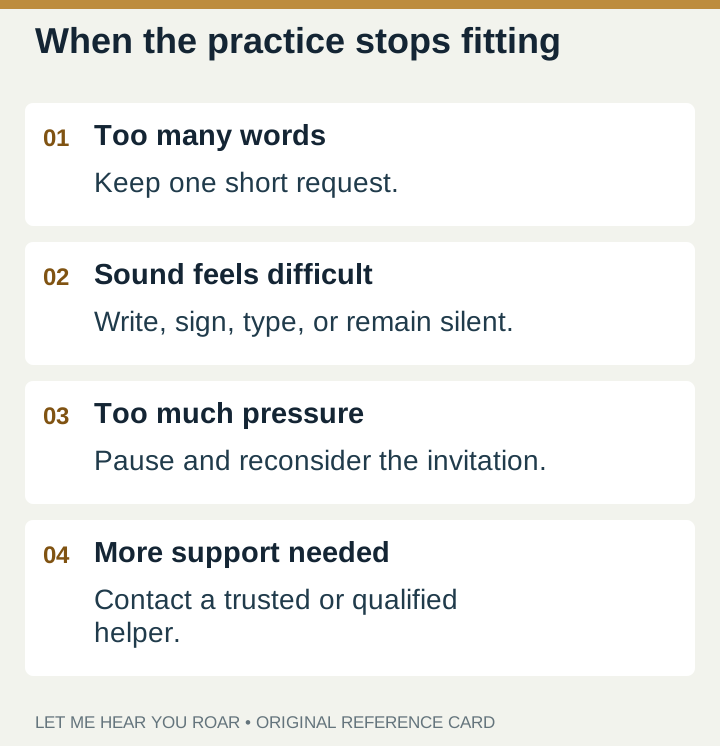
Alternatives for different settings
For a very short practice, use three words or phrases: thanks, difficulty, help. Supply one response to whichever prompt matters today. For a shared practice, invite each person to contribute or pass without explanation. For a written practice, create a private note and decide whether you want to keep it, delete it, or return later.
If faith language is difficult because of past experiences, you may choose the secular reflection question, 'What is true for me, and what support would help?' This site offers Christian resources without making them a condition of belonging. You can revisit spiritual questions at your own pace or with a trusted helper of your choosing.
Troubleshooting pressure and distraction
If your attention wanders, briefly name the distraction and decide whether it needs action. A practical task may need to go on a note so that you can return to it later. You do not need to turn ordinary distraction into evidence of spiritual failure or opposition.
If you feel pressure to finish with praise, pause. You can express a hope without claiming to feel it fully, or close with a request for companionship. If someone else insists that your grief shows inadequate faith, seek a setting where honest questions are welcomed. A devotional exercise should not require hiding an important part of your experience.
If the practice brings up distress that feels difficult to manage, stop and orient to what you need now. That might be a familiar activity, a trusted person, or qualified care. Do not force yourself to continue for the sake of completing the steps. The sequence is a resource you can set down.
Your next step: keep one line
Choose one line you want to carry into the day: a request, a thank-you, or a sentence naming what still needs care. You may keep it private. If it points toward a conversation, plan the setting and support before deciding to speak.
The goal is a prayer you can inhabit honestly. Make room for praise when it is real, lament when it is needed, and silence when words do not fit. You can return to the process without needing to repeat yesterday's emotion or produce a story of immediate transformation.
Connect the ideas
The people around you influence whether questions feel welcome; explore finding a faith community that makes room for honest questions.
For words directed toward other people, return to speaking life in everyday conversations.
What to take with you
- Begin with a manageable present concern and a freely chosen form.
- Let gratitude and grief coexist without forcing balance.
- Keep biblical narrative distinct from a promised result.
- Choose a practical response without trying to control its outcome.
Questions readers ask
How long should this practice take?
There is no required length. A single honest line may be enough, and you can stop whenever you choose.
Can a group use these steps?
Yes, if participation is optional, privacy is discussed realistically, and people may pass or choose another form without explaining why.
Do I have to end feeling hopeful?
No. You can finish with an unanswered question or a request for help. Do not manufacture an emotion to complete the exercise.
PUT ONE IDEA INTO PRACTICE
Your next step
Try a short, optional reflection in a form you choose.
Explore gentle voice practices ↗Sources & further reading
AI-assisted educational writing based on Joshua’s project direction. How this content is created. Original coaching reflection. Examples are illustrative unless identified as Joshua’s personal story. This article is not a clinical assessment or individualized treatment advice. Research and Scripture are linked for context; no independent clinical review is claimed.

Father, Marine Corps veteran, Christian counselor, coach, and the founder of Let Me Hear You Roar.
Read the story behind the project ↗