
You cannot undo an interruption, a dismissive remark, or advice that arrived before someone was ready. You can acknowledge what you did, ask whether repair is welcome, and change your next action. A repair does not require the other person to forgive you immediately or resume the conversation.
These seven practices address ordinary relationship missteps. They are not a substitute for appropriate accountability or specialist support when the issue involves abuse, coercion, or serious misconduct. The examples are illustrative, not accounts of clients or guaranteed scripts.
1. Name the specific thing you did
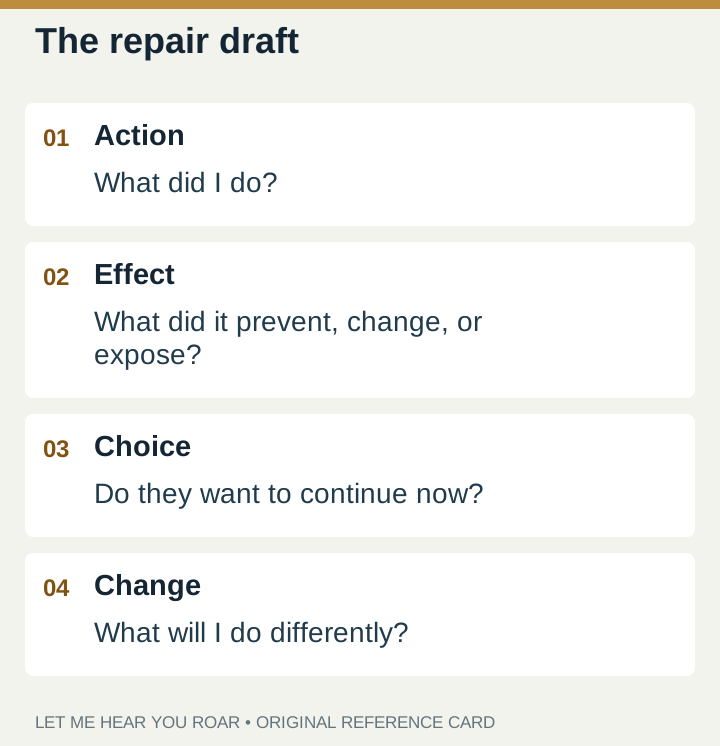
Begin with an observable action: “I interrupted you twice,” “I changed the subject when you mentioned the appointment,” or “I gave advice before asking what you wanted.” Specific language shows that you are addressing the actual exchange rather than offering a general apology for being imperfect.
Avoid opening with “I’m sorry you felt unheard.” That wording can leave your behavior unnamed and make the person’s feeling sound like the problem. “I moved on before you had finished” takes responsibility for your contribution without claiming to know everything about their experience.
If you are unsure what went wrong, say what you noticed and ask without demanding an immediate explanation. “I think I missed what you were trying to tell me. Would you be willing to say what I missed?” The person can decline.
2. Acknowledge the effect without arguing your intention
You may have meant to help, lighten the mood, or show that you understood. Those intentions can be true while the response still landed badly. Lead with the effect you can reasonably identify: “My advice left no room for you to finish explaining what mattered.”
If the person tells you a different effect, listen. Perhaps the interruption was less painful than your public disclosure of their private information. Repair needs to follow the concern they identify, not the smaller concern you prefer to address.
Avoid turning the apology into a trial about whether you are a kind person. You do not need them to declare you good before you can correct an action. An explanation may become relevant later, but it should not crowd out acknowledgment.
3. Ask whether they want to continue now
An apology does not reopen the conversation automatically. Try, “Would you like me to listen now, or would you rather stop here?” Include an option that does not require more engagement. If they ask for space, clarify only the practical information that is actually necessary.
Illustrative example: a friend says they do not want to revisit the subject tonight. You can answer, “Okay. I won’t push it tonight.” Do not keep adding one final explanation, sending multiple follow-up messages, or asking whether they are still angry. Those actions may make the requested pause harder to take.
If an unresolved shared task needs attention, separate it from the emotional conversation. “We can leave this discussion for now; we still need to confirm tomorrow’s pickup” keeps logistics visible without using them as a route back into the topic.
4. Reflect the point you missed
If the person wants to continue, offer a short reflection of their actual message. “You were asking for more notice, not asking me to cancel the plan” shows that you have identified the distinction. Then ask whether you have understood correctly.
A reflection is not a speech about everything you have learned. Keep it short enough to be corrected. If the person says, “That still is not it,” do not insist that your version is close enough. Ask what needs to change, or acknowledge that you need more time to understand.
Avoid adding a diagnosis, a hidden motive, or a sweeping story. “This reminded you of every time you were abandoned” may go far beyond what was said. The repair should return the microphone, not give you a more sophisticated way to take it.
5. Offer a concrete change you can keep
Connect the apology to a behavior: “Next time I will ask whether you want suggestions,” “I will let you finish before responding,” or “I will check before sharing anything in the group.” Choose something specific enough that both people can notice whether it happens.
Do not promise perfection or make the other person responsible for monitoring you. “I will never interrupt again” is difficult to guarantee. “I will pause before answering, and if I interrupt I will stop and return to your point” describes a practicable adjustment.
If the harm involved shared information, ask what repair is possible. You may need to identify who received it, request removal, or correct a misunderstanding. Do not claim that deleting a message erases every copy or that you can guarantee what others will do.
6. Follow through without asking for a reward
The next conversation is part of the repair. If you promised to ask before advice, ask. If you agreed to leave a topic alone, leave it alone. Repeatedly announcing how careful you are being can make the other person feel responsible for praising the change.
A brief check-in may help when welcome: “Has the new arrangement been more useful?” Ask about the practical change rather than demanding a verdict on whether trust has fully returned. Trust and comfort do not necessarily move at the pace of your effort.
Illustrative example: after interrupting a colleague, you begin the next meeting by leaving space for their update and referring accurately to their contribution. You do not need to make a public display of your apology. The relevant improvement is that their input receives room and proper acknowledgment.
7. Accept that repair may change the relationship
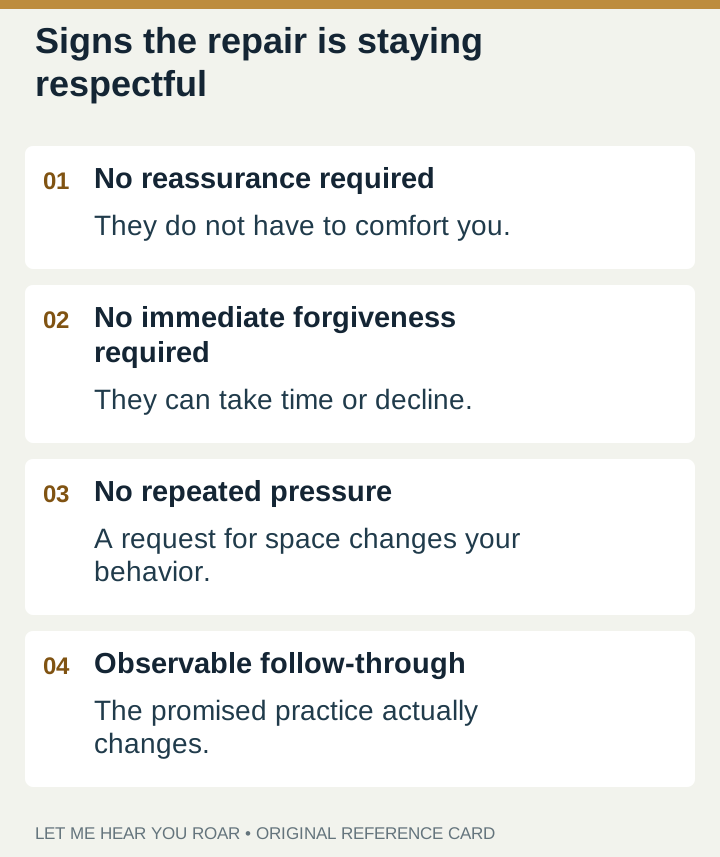
The person may appreciate the apology and still want more distance. They may prefer a different communication channel, less personal disclosure, or a narrower relationship. A respectful repair leaves those choices available.
You can ask practical questions about a new arrangement without bargaining for the previous level of closeness. “Would you prefer that we keep messages to the project?” is different from “After all I have done, why are you still holding this against me?” The first seeks clarity; the second pressures reconciliation.
If the same harm keeps recurring, look beyond the wording of the apology. You may need to change a habit, a meeting structure, a commitment, or the support you seek. An apology that is repeatedly followed by the same behavior gives the other person reason to judge the pattern rather than the promise.
Bonus: repair the small miss while it is happening
You do not always need to wait for a formal conversation. If you catch yourself interrupting, stop: “I cut in. Please finish.” If you notice unsolicited advice, pause: “I moved into solutions. Is that what you want?” A timely adjustment can prevent the misstep from taking over the exchange.
Keep the correction proportionate. A long apology for a brief interruption can create another interruption. Return attention to the person and let them decide whether there is more to address.
Your next action: write an apology with an action attached
Choose one real, manageable interaction that needs repair. Write three lines: what you did, what you understand about its effect, and the change you can make. Remove any sentence that asks the other person to reassure you, forgive you immediately, or admit that you meant well.
Then decide whether and how to offer the repair. Respect requests for no contact or space. A useful repair is an invitation to acknowledge and change your behavior, not a demand for renewed access to someone’s attention.
Connect the ideas
Repair begins with hearing the impact; listening without fixing can help you resist jumping immediately to your own explanation.
Repair can include a clearer limit. Return to speaking up and setting a boundary if the same pattern keeps repeating.
What to take with you
- Name your behavior rather than apologizing for someone’s feelings.
- Ask whether continuing the conversation is welcome.
- Attach the apology to a realistic change.
- Respect the other person’s pace and future boundaries.
Questions readers ask
What if I did not intend to hurt them?
Intent can provide context, but it does not erase the effect. Start by addressing the specific action and listening to what the person says they experienced.
Should I keep apologizing until they accept?
No. Repeated apologies can become pressure. Offer a clear acknowledgment, make the relevant change, and respect their choice about further conversation.
Can a brief repair be enough?
Sometimes. Match the response to the actual issue and the person’s wishes. A small interruption may need a quick correction; a breach of privacy may require practical follow-up.
PUT ONE IDEA INTO PRACTICE
Your next step
Practice a repair that names the action and leaves room for choice.
Explore gentle voice practices ↗AI-assisted educational writing based on Joshua’s project direction. How this content is created. Original coaching reflection. Examples are illustrative unless identified as Joshua’s personal story. This article is not a clinical assessment or individualized treatment advice. Research and Scripture are linked for context; no independent clinical review is claimed.

Father, Marine Corps veteran, Christian counselor, coach, and the founder of Let Me Hear You Roar.
Read the story behind the project ↗