
Belonging is more than being included in a room. In a useful relationship or community, you can participate without surrendering every preference, hiding every question, or becoming permanently available. You have a place, and you remain a person with choices.
Finding that kind of connection is usually a process of noticing, trying, and reviewing. This guide explores how to choose settings, build relationships gradually, contribute without overcommitting, and recognize when a group’s promises do not match its behavior. It is a practical framework for reflection, not a test that can certify any person or organization as safe.
Define the kind of belonging you are looking for
Start with what you want to do together. Friendship, shared learning, worship, creative collaboration, mutual support, and professional connection are different purposes. A group may be excellent for one and poorly suited to another. A choir can offer meaningful shared activity without being the place to discuss a deeply private experience.
Write three things you hope a connection would add to your life. Be specific: people to walk with, room to ask faith questions, an activity that does not require constant conversation, or someone who understands a particular challenge. Then write what you do not want to trade away to get it. You might name privacy, a manageable schedule, freedom to disagree, or access to other relationships.
This is not a demand that other people meet every need. It is a way to match your hopes to the actual setting. When one group is expected to provide companionship, spiritual authority, career opportunity, emergency support, and all your social contact, leaving or questioning it may feel unusually costly.
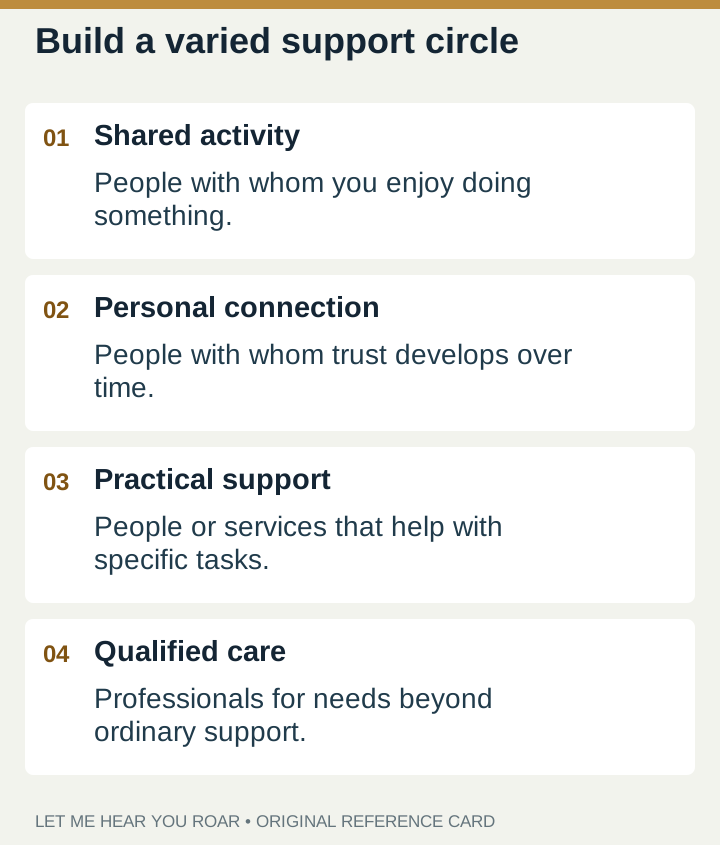
A broader circle can contain several kinds of connection. A neighbor, an interest group, a faith gathering, and professional support need not perform the same role. Belonging becomes more flexible when no single setting has to hold your whole life.
Look at behavior before adopting the group’s description
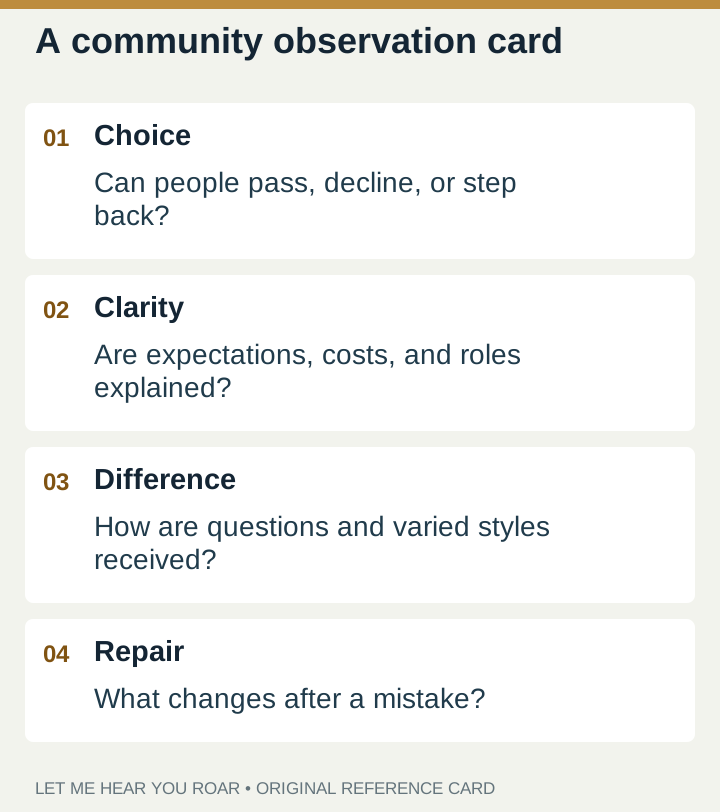
Words such as welcoming, authentic, and family can describe an intention. They do not tell you exactly what happens when someone declines, disagrees, arrives late, asks a difficult question, or needs an adaptation. Observe ordinary moments. How does the group respond to someone who does not follow the expected social style?
Notice how newcomers are introduced. Are they given clear information, or are they expected to understand unwritten rules immediately? Can someone attend without speaking publicly? Are costs, commitments, and leadership roles explained? Predictable practical information gives you more material for a decision than enthusiastic claims alone.
SAMHSA’s trauma-informed framework includes safety, trust, peer support, collaboration, and empowerment. Those principles inform a useful lens for observing community practices, but mentioning them does not certify a group as trauma-informed or replace proper organizational work.
Ask one concrete question before making a large commitment: “What happens if someone wants to step back?” Listen to the answer, then watch whether it matches how people are treated. A group can answer impressively and still behave differently. Your review should include both stated values and lived practice.
Build connection through manageable experiments
You do not have to decide whether a community is your permanent home at the first meeting. Try a limited form of participation: attend one open session, join a short activity, or speak with one member. Decide beforehand what you are willing to do and what you want to learn.
Afterward, review specific details. Did you know what was expected? Could you leave when you needed to? Did you have to share more than you wanted? Did someone show interest in your actual answer, or mainly invite you into their preferred role? A mixed experience can lead to another limited visit rather than an immediate verdict.
Allow for ordinary unfamiliarity. Feeling awkward in a new room does not prove the room is harmful. Equally, a strong welcome does not prove it is trustworthy. Give your judgment time to gather information. You can appreciate a kind encounter while remaining undecided about a larger commitment.
If attending alone is difficult, consider going with someone you trust, asking about the format beforehand, or choosing an activity with a clear task. These options make participation more predictable without requiring you to become a different personality.
A first visit has a narrow purpose
Your job on a first visit might simply be to learn the format and notice whether you want another visit. You do not need to find a best friend, disclose your history, or volunteer for leadership before leaving. A small purpose makes the experience easier to evaluate.
A second visit tests consistency
Look for whether the welcoming behavior continues when you are no longer the newest person. Notice how members speak about absent people and former members. Consistency is more informative than one impressive introduction, though no brief observation can guarantee future behavior.
A commitment deserves clear terms
Before joining a team or regular role, ask about time, cost, responsibilities, training, and how to step down. Clear expectations support both you and the group. If the role changes, revisit the agreement instead of assuming that your original yes covers every new task.
Let disclosure grow at the pace of trust
You can be genuine without making every private fact public. At an early meeting, authenticity might mean saying what kind of activity you enjoy or admitting that you prefer listening first. Later, you may choose to share more personal material with particular people in a more suitable setting.
Think about the purpose of a disclosure. Are you asking for an adaptation, explaining a limit, seeking emotional support, or simply wanting to be known? Each purpose may require a different amount of detail. To request a quiet place to sit, you may not need to explain the full history behind the preference.
Before sharing something sensitive in a group, ask what privacy expectations exist and what cannot be guaranteed. A group agreement can state what members are asked to do, but it cannot ensure that every person will comply. Online platforms, recordings, shared notes, and prayer lists introduce additional ways information can travel.
Illustrative example: a facilitator invites everyone to share a difficult life event. You might say, “I’m going to pass today,” or “I would rather talk about what I hope to learn.” A supportive response accepts that choice. You do not need to disclose a painful story to prove that you belong in a conversation about courage.
Contribute without buying your place through usefulness
Helping is one way to build connection, but it should not be the only route to being welcome. Notice if you become indispensable before anyone knows what you enjoy. You may be organizing every meal, responding to every message, or solving problems because activity feels easier than allowing yourself to be a participant.
Choose one contribution that fits your capacity and the group’s actual need. Give it edges: “I can help set up this month,” or “I can take one turn on the rota.” If you want a larger role, ask what support comes with it. A title without time, training, or shared responsibility can create an obligation you did not understand.
Practice attending occasionally without taking on extra work. Notice whether you are still included and whether you can tolerate being present without earning the invitation. This is a reflection exercise, not a claim that all volunteering conceals a problem. Freely chosen service can be meaningful; automatic overcommitment deserves review.
If you already hold too much, identify what can be handed over and provide reasonable notice where possible. “I can continue through the end of the month, then I need to step back” is clearer than quietly disappearing while hoping someone notices your exhaustion.
Make room for different ways of participating
A group should not assume that eye contact, rapid speech, public enthusiasm, or emotional disclosure is the only evidence of engagement. People can contribute through writing, careful preparation, practical tasks, questions sent in advance, or quiet attention. Ask what formats are possible instead of guessing what a person needs.
If you are organizing an activity, describe the format beforehand. Say whether people will be invited to speak, move around, work in pairs, pray, or share personal information. Explain how to pass and whether an alternative is available. The ability to make an informed choice begins before someone enters the room.
If you are a participant, request a concrete change where useful: “Could you send the questions in advance?” or “Can I contribute in writing?” You do not need to explain your entire identity to make the request. The group may have constraints, so ask what is feasible and assess whether the available arrangement fits you.
Do not make inclusion another demand for public gratitude. Someone who receives an adaptation should not have to perform relief, tell an inspiring story, or become the spokesperson for everyone with a similar need. Respect includes letting the support be ordinary.
Distinguish disagreement from a demand to disappear
A community can contain disagreement about preferences, decisions, or beliefs. The important question is how disagreement is handled. Can people ask for reasons, offer alternatives, and decide not to participate in a particular activity? Are leaders willing to acknowledge uncertainty or correct an error?
Some groups have a specific purpose or belief commitment. A Christian congregation, for example, may clearly describe its theological position. Clarity about that purpose helps people choose. It does not justify humiliating questions, demanding private disclosures, or using spiritual language to pressure someone into unsafe contact.
Notice whether a disagreement stays connected to its subject. “We decided to meet monthly because weekly meetings are not feasible” addresses a practical choice. “If you cared about us, you would stop asking” turns a question into a loyalty test. One imperfect response may be repairable; a repeated pattern deserves closer attention.
You can also disagree respectfully. Ask whether your concern belongs in the whole group, a private conversation, or a formal process. Make the issue specific. Participation includes responsibility for how you use your own voice, not only a desire for others to make room for it.
Practice reciprocity without keeping a rigid ledger
Reciprocity means that people can contribute and receive over time. It does not require every conversation to be divided into equal minutes or every favor to be repaid immediately. Illness, caring responsibilities, financial pressure, and changing circumstances can affect what someone can offer.
Look for whether both people’s needs can be discussed. Can you ask for help without being shamed? Can the other person say they are unavailable without being punished? Do you show interest in their life beyond the role they play in yours? These questions are more useful than counting messages alone.
Illustrative example: one friend has been listening to a difficult situation for several weeks. A reciprocal conversation might include, “I appreciate how much time you have given me. How is your week, and do you have capacity to talk about this today?” That acknowledgment does not erase your need; it recognizes theirs too.
If the balance feels persistently painful, discuss the concrete pattern before assigning a label to the person. You might need a clearer limit, additional support, or a different expectation of the relationship. Not every connection must become intimate to remain worthwhile.
Recognize repair and recognize its limits
Every group will have miscommunications. A useful repair names what happened, listens to its effect, and changes something observable. An apology that asks the hurt person to reassure the speaker may leave the original problem untouched. Look for follow-through rather than a moving speech alone.
If someone shares your information without permission, a repair could include identifying where it went, correcting or removing it where possible, and changing the sharing process. If a facilitator regularly interrupts, repair may require a different meeting structure. The appropriate action depends on the actual harm and the person’s wishes.
You are not required to restore the same level of access after an apology. Trust may return gradually, remain limited, or not return. In situations involving coercion, abuse, or serious misconduct, an informal repair conversation may be inadequate or unsafe. Seek suitable specialist or organizational support rather than relying on the group to resolve everything internally.
Leaving a group can be a considered choice. You can appreciate what it once offered and still decide that its current practices do not fit. You do not have to turn every former member into a villain to justify changing where you spend your time.
Use the companion guides for specific relationship skills
For supporting a person who has experienced trauma, read “How to Support Someone Finding Their Voice After Trauma: A Beginner’s Guide.” To clarify the listening skill itself, read “What Is Listening Without Fixing? Making Room for Another Person’s Voice.” For a faith setting, use “How to Find or Build a Faith Community Where Honest Questions Are Welcome.” For a conversation that has already gone wrong, read “7 Ways to Repair a Conversation After Someone Felt Unheard.”
These four guides turn the broader question of belonging into particular actions. Choose the one that matches your role today: a person seeking connection, a friend offering support, a facilitator shaping a room, or someone who needs to make a repair.
Your next action: choose one connection experiment
Pick one manageable action: ask about a group’s format, attend an open activity, invite one person for a short conversation, or revisit a commitment that has become too large. Write what you hope to learn and one limit you intend to keep.
Afterward, review the experience with curiosity. Did your choice matter? Were expectations clear? Is another small step worth trying? Finding your people can be gradual. You are allowed to build connection at a pace that leaves enough room to remain yourself.
Connect the ideas
If belonging has required automatic agreement, examine people-pleasing and boundaries alongside the relationship itself.
A welcoming group also makes room for different neurodivergent communication needs.
What to take with you
- Match a community to a specific purpose rather than every need.
- Observe how people respond to limits, questions, and difference.
- Let trust and disclosure grow gradually.
- Belonging includes contribution, receiving, and the freedom to step back.
Questions readers ask
How do I know whether a group is safe?
No checklist can guarantee safety. Observe behavior over time, ask practical questions, keep manageable commitments, and seek independent advice when you notice serious concerns.
Can I belong without sharing my whole story?
Yes. Participation, interests, questions, and ordinary companionship can be meaningful forms of connection. You choose what personal information to disclose.
What if I feel awkward in every new group?
Try a setting with a clear activity, ask about the format beforehand, or attend with a trusted person. Review specific interactions rather than using awkwardness alone as the verdict.
Is leaving a community a failure?
No. Your needs, circumstances, or understanding of the group may change. Consider practical responsibilities and safety, then choose the level of participation that fits.
PUT ONE IDEA INTO PRACTICE
Your next step
Reflect on the kind of belonging you want to build.
Take the private voice reflection ↗Sources & further reading
AI-assisted educational writing based on Joshua’s project direction. How this content is created. Original coaching reflection. Examples are illustrative unless identified as Joshua’s personal story. This article is not a clinical assessment or individualized treatment advice. Research and Scripture are linked for context; no independent clinical review is claimed.

Father, Marine Corps veteran, Christian counselor, coach, and the founder of Let Me Hear You Roar.
Read the story behind the project ↗