
Supporting someone who has experienced trauma means making room for their choices, listening to what they actually want to share, and offering help you can realistically provide. It does not mean getting the full story, finding a hidden explanation, or taking charge of their recovery.
A friend, relative, colleague, or community member can be supportive without becoming a therapist. Begin with the person in front of you rather than a theory about how they ought to behave. This guide offers ordinary relationship practices and illustrative language; it does not promise that a particular response will make someone feel safe or ready to speak.
Why choice belongs at the center
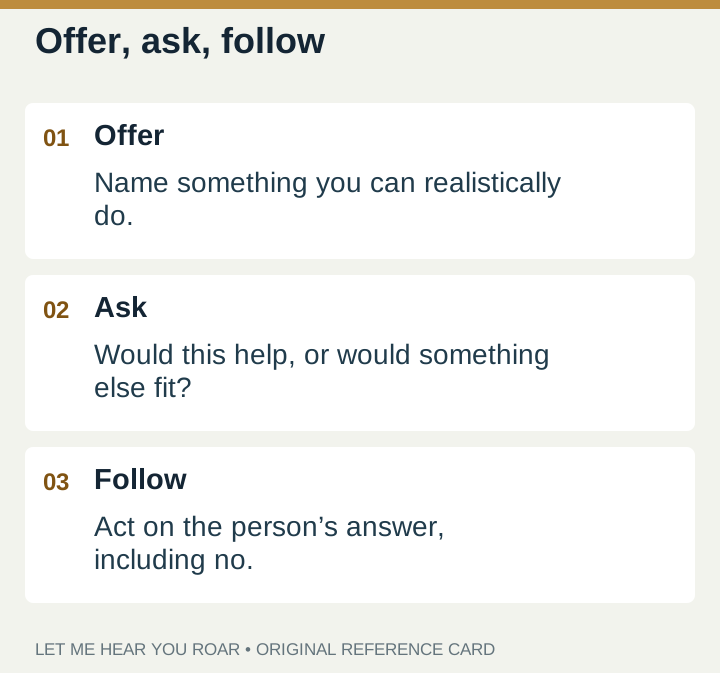
When you care about someone, it is tempting to act quickly: ask more questions, offer advice, arrange help, or tell them what you would do. Before acting, ask whether the help fits their wishes. “Would you like me to listen, help think through options, or do something practical?” makes several possibilities available without assigning one.
In guidance specifically about sexual violence, RAINN recommends listening without judgment, avoiding pressure, and respecting the survivor’s choices. The source addresses that particular context; the exercises below are original, general communication practices rather than a treatment method.
Choice can be small and immediate. The person may want to sit somewhere else, send a message instead of talking, leave a topic unfinished, or discuss an ordinary part of their day. Do not treat every interaction as an opportunity to draw out the story. Their life contains more than the painful experience they have mentioned.
Begin with an invitation that can be declined
If someone seems to want to talk, try an invitation with an easy exit: “I have some time if you would like company. We do not have to talk about anything particular.” If they decline, accept the answer. A second offer later may be welcome, but repeated requests in the same moment can turn interest into pressure.
If they begin sharing unexpectedly, check your actual availability. “I want to give this attention. I have ten minutes now, or more time this evening” is more honest than promising unlimited listening while watching the clock. If the situation is urgent, help identify timely support rather than postponing it merely to fit your preferred schedule.
You do not need a perfect opening. A straightforward acknowledgment can be enough: “Thank you for telling me.” Avoid claiming to know exactly how they feel. Even a similar experience does not make the person’s response identical to yours.
Listen for what they are asking from you
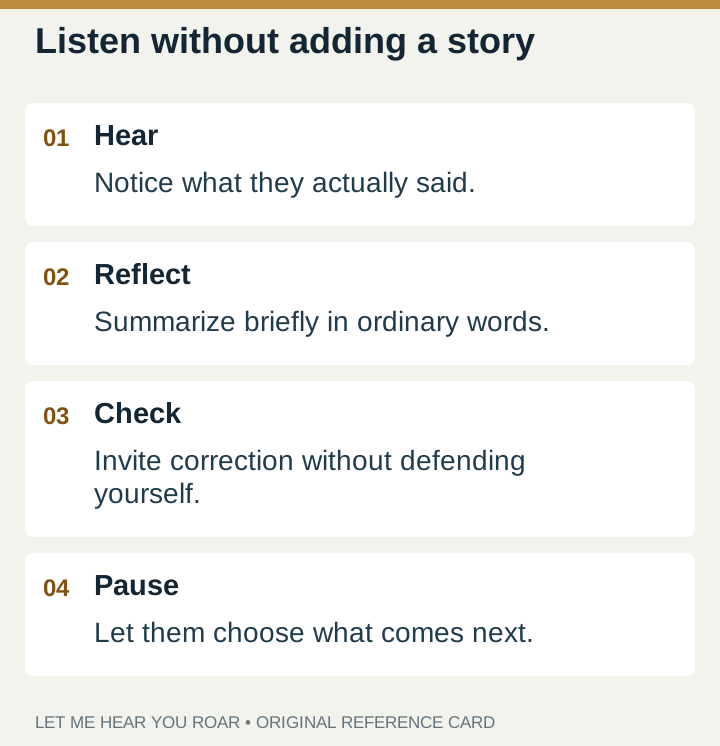
Notice whether the person is sharing a feeling, describing an event, asking for a decision, or requesting practical help. These are different tasks. If you are unsure, ask: “What would be most helpful from me right now?” Then let the answer shape your response.
Reflect only what you have heard. “You felt dismissed when that happened” is closer to the person’s account than “You have never been allowed to trust anyone.” The second sentence invents a wider story. A useful reflection leaves room for correction: “Have I understood that accurately?”
Avoid questions that satisfy curiosity without helping the person’s stated purpose. You may not need names, dates, physical details, or an explanation of why they made a particular decision. If information is necessary for a practical task, explain why you are asking and let them choose what to provide.
Silence can be part of the conversation. You do not have to fill it with reassurance or meaning. You can ask, “Would you like a pause?” without deciding that quiet means distress, agreement, or a wish for you to continue.
Offer something practical and bounded
A vague “Let me know if you need anything” leaves the person to invent the request and judge your capacity. A concrete offer may be easier to answer: “Would it help if I brought dinner on Wednesday?” or “I could sit with you while you look through the information you already have.” Include a real choice and an honest limit.
Illustrative example: a friend says they are tired of explaining their situation to different people. Instead of asking them to explain it again to you, offer, “Would you like company while you draft the message, or would you rather do it alone?” If they want help, ask what the message needs to accomplish. Do not turn their brief note into your account of what happened.
Follow through on what you agree to do. If your circumstances change, communicate promptly and help clarify the new plan where possible. Dependability is practical: showing up at the agreed time, keeping the agreed scope, and not adding surprise guests or activities.
Protect privacy without making promises you cannot keep
Ask before sharing someone’s information, including in a prayer request, group chat, or conversation with a mutual friend. Removing a name may not make a story unrecognizable. If you want advice about supporting them, share the minimum needed and consider whether you can discuss your own uncertainty without exposing their details.
Do not promise absolute confidentiality if your role or the situation has limits you cannot guarantee. Teachers, clinicians, volunteers, and other roles may have specific responsibilities. Know the rules that apply to your actual role and explain relevant limits plainly before inviting sensitive details where possible.
If you have already shared something without permission, do not hide it to protect your image as a good supporter. Acknowledge exactly what you shared and with whom, apologize, and ask what repair is possible. Do not require immediate forgiveness or a new disclosure to prove that trust has returned.
Recognize the edge of your role
You can listen, provide company, and help someone explore support. You cannot diagnose them, determine why every symptom occurs, or guarantee how another person or organization will respond. If they ask for help beyond your knowledge, say so and offer to find an appropriate source with them.
If immediate danger is present, prioritize appropriate emergency or specialist help. If abuse or intimidation is involved, do not arrange a surprise confrontation or pressure the person to take a step you have chosen. The practical question is what support fits their circumstances and safety needs.
You also need limits. “I can talk until nine” or “I cannot be available overnight” can be said with care. If you are becoming the sole support person, discuss additional options without presenting the person as a burden. A sustainable circle usually needs more than one relationship or kind of help.
Troubleshooting: when your help does not land
If the person becomes quiet after advice, do not demand an explanation. Try a small repair: “I moved into suggestions quickly. Would listening be more useful?” They may want to continue, change the subject, or stop. Each response is information, not a test of whether they appreciate you.
If they reject an offer, avoid defending how thoughtful it was. “Okay, I won’t arrange that” respects the answer. If they correct your reflection, thank them and use the correction. Your willingness to be adjusted can matter more than the accuracy of your first sentence.
If you feel helpless, discuss your own feelings with an appropriate support person while protecting privacy. Do not make the person you are supporting responsible for reassuring you that you are doing enough.
Your next action: make one respectful offer
Choose one ordinary act of support that you can carry out this week. State what you can offer, ask whether it would help, and accept the answer. You might offer a short walk, a meal, a ride, or ten uninterrupted minutes of listening.
Then notice whether you followed the person’s stated preference. Supporting a voice begins with letting that voice influence what happens next, including when it asks for less conversation, more privacy, or a different kind of help.
Connect the ideas
The person sharing gets to choose the detail. The guide to telling a story without oversharing can help a supporter understand those choices.
For a concrete listening approach, explore listening without fixing or rushing to advice.
What to take with you
- Ask what kind of support the person wants.
- Listen without pressing for a complete account.
- Offer concrete help with honest limits.
- Keep the person’s choices and privacy visible.
Questions readers ask
Should I bring up the experience every time we meet?
No. Ask what kind of contact is welcome, and make room for ordinary shared life. The person can choose whether the topic belongs in a particular conversation.
What if I say the wrong thing?
Name the specific misstep, apologize without defending it, and ask what would help now. Respect a request to stop or change the subject.
Can I offer prayer?
Yes, if it fits your relationship, but ask first. A no should be accepted without explanation, pressure, or a change in practical support.
PUT ONE IDEA INTO PRACTICE
Your next step
Explore appropriate support options and the limits of coaching.
Understand care and coaching options ↗Sources & further reading
AI-assisted educational writing based on Joshua’s project direction. How this content is created. Original coaching reflection. Examples are illustrative unless identified as Joshua’s personal story. This article is not a clinical assessment or individualized treatment advice. Research and Scripture are linked for context; no independent clinical review is claimed.

Father, Marine Corps veteran, Christian counselor, coach, and the founder of Let Me Hear You Roar.
Read the story behind the project ↗