
Compassionate conviction means expressing a sincerely held belief while treating the other person as someone with their own dignity, choices, and perspective. You can be definite about what you believe without claiming the right to control what another person thinks or says.
This is a practical communication term used in this guide, not a clinical diagnosis or a formal test of character. Its usefulness lies in a simple question: can your words make your position clear while leaving room for the other person to respond, disagree, or decline the conversation?
The three parts of compassionate conviction
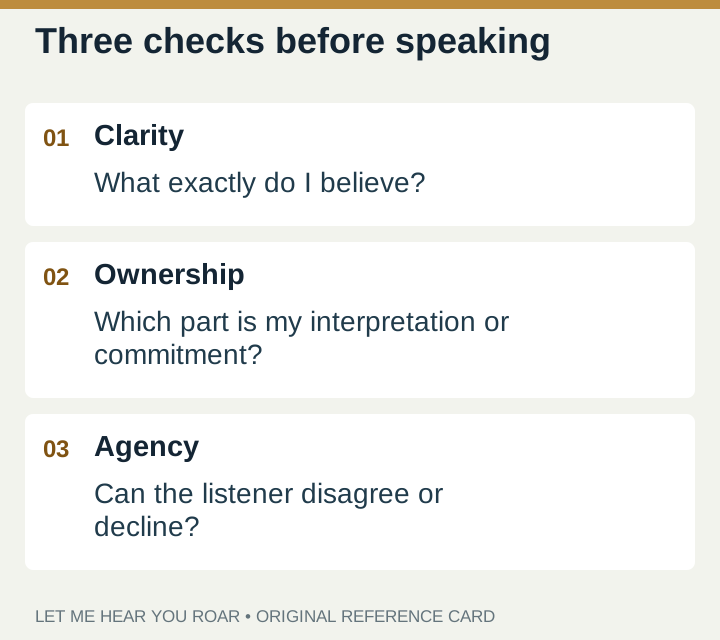
The first part is clarity. You state the belief in words the listener can understand. “This matters to me because…” is often more useful than hints, sarcasm, or a question that disguises a verdict. Clarity also includes admitting uncertainty. You can be convinced about a principle while unsure about its application in a particular situation.
The second part is ownership. “I believe” identifies your position without pretending that every reasonable person already agrees. Ownership does not require treating all claims as equally well supported. It does require distinguishing your interpretation, experience, and sources of authority from assumptions about the other person’s motives.
The third part is respect for agency. The listener is not obligated to debate, disclose personal information, accept prayer, or provide an immediate answer. A conversation that continues only because one person cannot safely refuse needs more attention to power and safety than to elegant wording.
An example of clear belief with room to answer
Illustrative example: two friends disagree about whether a community group should discuss a controversial issue. One says, “I think the group should make room for the discussion because silence affects people who are already involved. I also want a format where no one is pressured to disclose personal experiences. What concerns you about it?”
The sentence names a position and a reason, then asks a real question. A real question is one whose answer you intend to hear. If the reply is, “I’m worried people will be personally targeted,” compassionate conviction does not require abandoning the discussion. It invites a more specific question about safeguards, facilitation, and whether the proposed format can meet its purpose.
The conversation may still end without agreement. One person could say, “I understand your concern, and I still think we should postpone.” The presence of disagreement does not mean respect has failed. Respect shows in how people handle the difference and what choices remain available afterward.
How it differs from agreement, avoidance, and persuasion
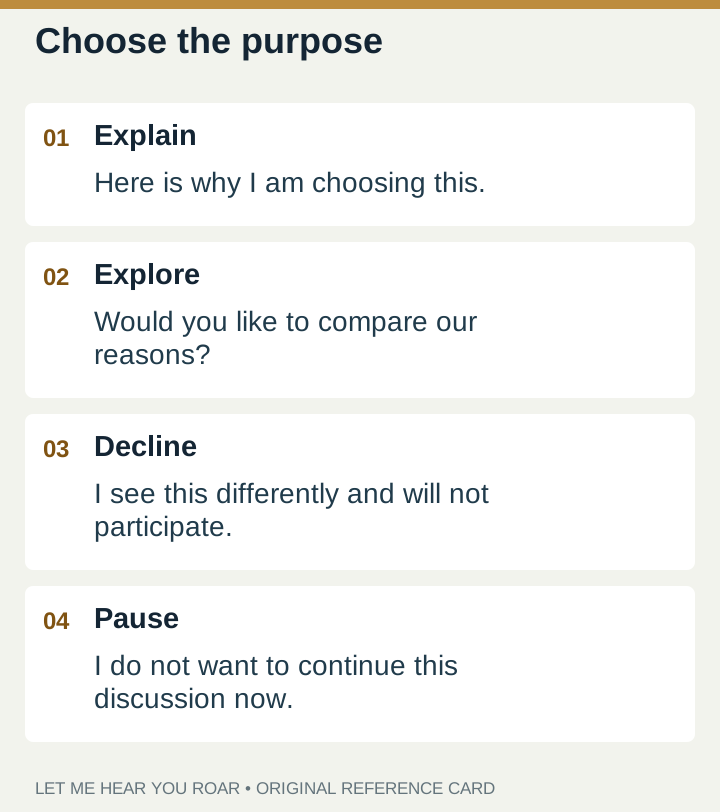
Agreement means sharing a conclusion. Compassionate conviction describes how you communicate a conclusion, including when it is not shared. You do not need to say, “We both make equally good points,” if that is not what you think. You can acknowledge the other person’s concern without endorsing their claim.
Avoidance leaves a topic untouched. Sometimes that is a wise boundary: a family celebration may not be the right setting for a debate. Compassionate conviction allows you to say, “I hold a different view, and I’m not discussing it at dinner.” Declining a conversation is not the same as hiding every belief.
Persuasion aims to change someone’s mind. You can make a persuasive case compassionately, but persuasion is not required every time you state a value. Sometimes your task is simply to explain why you will not participate in something. If you ask whether someone wants your reasons, be prepared for them to say no.
What compassion does not require
Compassion does not require unlimited access to your attention, a friendly tone in response to degradation, or an endless debate about your worth. You can stop a conversation that is becoming insulting. Where intimidation or abuse is present, prioritize safer support instead of trying to communicate your way out of danger.
It also does not require pretending that words have no consequences. If you have responsibility for a group, you may need to address behavior that prevents others from participating. Describe the behavior and the relevant agreement: “We agreed not to make personal attacks.” Avoid using your leadership role to force private beliefs or personal disclosures.
A compassionate approach can include firmness. “I will not support that proposal” is clear. “Anyone who supports it is worthless” attacks people rather than explaining the objection. You can critique an action, claim, or policy strongly while being precise about what you are criticizing.
Common misunderstandings to notice
One misunderstanding is that certainty excuses interruption. It does not. Being strongly convinced of your position gives you something to communicate, not ownership of all the airtime. A useful check is whether you can summarize the other person’s actual point before answering it.
Another misunderstanding is that gentle wording makes any demand respectful. “With love, you must tell me everything” still pressures disclosure. Examine what the sentence asks the other person to give up. Courtesy cannot turn a refusal of consent into consent.
A third misunderstanding appears in faith conversations: if a belief is sacred to you, another person must engage with it on your terms. You can describe your Christian faith openly and ask whether prayer or a spiritual perspective would be welcome. If the answer is no, respecting that answer keeps the invitation meaningful.
Finally, compassion is not mind-reading. You may not know why someone disagrees. Ask if the context allows, and leave the question open. Assigning fear, ignorance, or bad intentions may feel explanatory while making a useful conversation less likely.
Your next action: use the definition as a sentence check
Write one belief you want to communicate. Underline the claim, circle the reason, and identify the choice you are leaving the other person. If there is no choice, ask whether you are making a request, setting a participation rule you legitimately oversee, or trying to control another adult’s private decision.
Then revise one sentence. “You need to understand why this matters” might become, “This matters to me, and I’d like to explain why if you’re open to it.” Compassionate conviction is clear belief expressed with ownership and respect for another person’s agency. It is a way to make your voice more honest without making theirs less welcome.
Connect the ideas
For a Christian reflection on how language affects others, read about speaking life and the responsibility of words.
Conviction also leaves room to hear a response; practice listening without fixing before preparing your next argument.
What to take with you
- Clarity, ownership, and agency give the term practical meaning.
- Respect does not require agreement or endless debate.
- An invitation must leave room for refusal.
Questions readers ask
Can I be compassionate and say someone is wrong?
Yes. Explain the claim or behavior you disagree with and why. Avoid treating disagreement as permission for humiliation, coercion, or assumptions about motives.
What if the other person will not listen?
You cannot make listening happen through perfect wording. Decide whether to pause, choose another setting, or end the discussion. Use safer support when intimidation is involved.
PUT ONE IDEA INTO PRACTICE
Your next step
Practice one sentence that holds conviction and choice together.
Explore gentle voice practices ↗AI-assisted educational writing based on Joshua’s project direction. How this content is created. Original coaching reflection. Examples are illustrative unless identified as Joshua’s personal story. This article is not a clinical assessment or individualized treatment advice. Research and Scripture are linked for context; no independent clinical review is claimed.

Father, Marine Corps veteran, Christian counselor, coach, and the founder of Let Me Hear You Roar.
Read the story behind the project ↗