
Neurodivergence and communication is a broad subject because people, tasks, and environments differ. A useful guide must make room for someone who speaks readily but struggles to organise a request, someone who prefers a communication device, and someone whose needs change with the setting.
Here, finding your voice means having meaningful ways to contribute and make choices. It is not a programme for appearing typical. This guide brings identity, communication access, privacy, and self-advocacy together, with original planning exercises that you can adapt or decline.
Start with the person and the purpose
Begin with the actual task. Are you trying to share an opinion, understand instructions, maintain a friendship, make a decision, or communicate distress? Each purpose can require different conditions. An agenda might support a decision meeting while a picture, gesture, or familiar communication aid may serve an immediate everyday choice.
Next ask what participation would look like for this person. The answer should come from them wherever possible, with accessible ways to express it. Do not assume that fluent speech means unlimited capacity for fast discussion. Do not assume that limited speech means someone lacks an opinion. Build enough time and flexibility into the interaction to find out.
This guide uses neurodivergence as a broad descriptive term, not a diagnosis that can be assigned from a communication style. Quietness, directness, distractibility, or discomfort with eye contact cannot establish an individual diagnosis. If diagnosis is the question, take it to a qualified professional rather than trying to settle it with a coaching exercise.
Understand identity without making it a new performance
A diagnosis can become an important part of someone’s self-understanding. It can also remain private background information. Neither position creates a duty to represent everyone with the same diagnosis. Two people can use different language, have different strengths, and disagree about the support that suits them.
Try an identity map with four spaces: what I enjoy, what I value, what support I need, and what I am still exploring. Fill them with ordinary details rather than impressive traits. Enjoying detective stories, needing written instructions, valuing loyalty, and questioning a career direction can sit beside each other without one becoming the explanation for all the others.
A practical benefit of this exercise is specificity. “I am learning what this diagnosis means” can be true alongside “I still want to attend the family celebration, but I need a shorter visit.” Identity reflection and an immediate plan do not have to compete. If the larger questions feel heavy, begin with the part that has a clear next action.
Recognise masking without prescribing unmasking
Hull and colleagues’ qualitative study examined autistic adults’ accounts of social camouflaging, including what they did, why they did it, and how they experienced its consequences. Such accounts illuminate lived experience; they do not demonstrate that every adaptation has the same effect or establish a treatment prescription.
For reflection, distinguish a chosen skill from an adaptation that feels compulsory. You might genuinely like preparing an opening sentence for a meeting while disliking the expectation to hold eye contact throughout it. The useful question is whether you have choice, what the adaptation costs you, and whether another arrangement could serve the purpose.
There is no requirement to remove every social adaptation at once. Workplaces, families, public spaces, and intimate relationships offer different degrees of security. An adjustment that feels welcome with a trusted friend may feel exposed elsewhere. Consider the setting and available support before trying a change; public disclosure is not proof of authenticity.
An illustrative experiment could be asking a trusted person to accept looking away while you think. Agree on the purpose beforehand: you are trying to make thinking and listening more workable, not withdrawing from the relationship. Afterward, ask whether the arrangement helped. You may keep it, revise it, or decide that a different experiment would be more useful.
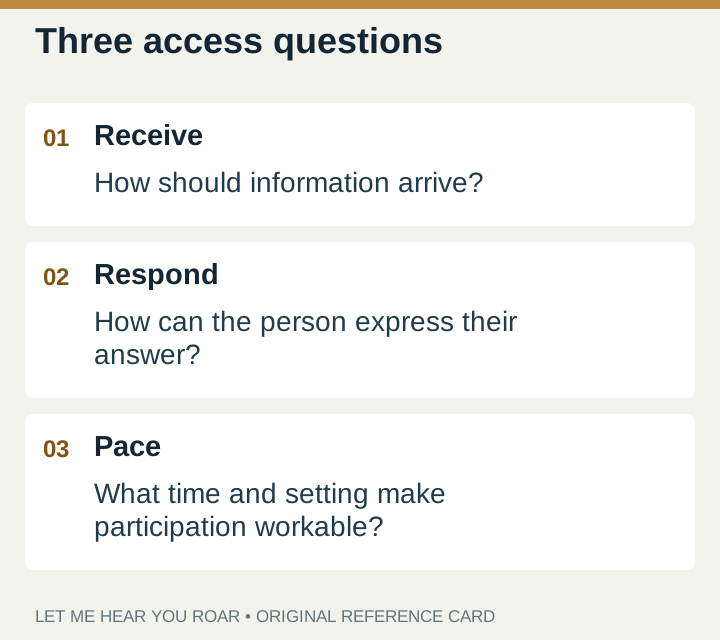
Build communication access around three questions
Communication access should be practical enough to discuss. Broad requests such as “please understand me” matter emotionally, but a specific arrangement is easier to implement and review. The following questions can help a person or group decide what to change.
Receiving information
Ask how information should arrive. Would a brief written agenda, spoken explanation, captioned call, accessible document, demonstration, or combination help? A wall of text can be as difficult as a rapid speech. Offer usable choices rather than declaring that one medium is accessible to everyone.
Giving a response
Ask how responses can be given. Someone may need to write after the meeting, use a communication aid, speak through an interpreter, point to options, or have a trusted supporter help convey their words. When a helper is involved, agree on their role and address the person whose decision it is. Support should preserve their opportunity to correct or refuse an interpretation.
Pace and setting
Ask what pace and setting support the exchange. Consider turn-taking, interruptions, room noise, lighting preferences, breaks, and time to process. You do not need to redesign the entire environment to test one improvement. A single question at a time or a clearer end point may make the immediate task easier to navigate.
Make support requests concrete
A workable request names a situation and a change. “Could you put the deadline in the message?” points to something another person can do. “Could we agree which task takes priority?” invites a decision that vague encouragement cannot provide. These examples are planning tools, not promises about someone’s response.
Describe the outcome that the arrangement supports. An agenda helps someone prepare relevant thoughts. A written summary helps both parties check what was agreed. A planned pause can create time to formulate an answer. Keeping the shared purpose visible can make the conversation less abstract without requiring you to justify your entire history.
Decide whether you are making an everyday request or beginning a formal process. If a workplace, school, or service has an accommodation procedure, ask where to obtain accurate guidance about documentation and decisions. Requirements vary. A general article cannot determine entitlements or replace local professional advice about a disputed situation.
ADHD self-advocacy: clarify the task before blaming yourself
NIMH describes adult ADHD as involving persistent difficulties with inattention and/or hyperactivity and impulsivity that affect daily functioning across settings. Its diagnostic guidance includes childhood history and professional assessment. Being disorganised on a busy day is not enough to establish ADHD.
A practical self-advocacy conversation can focus on what a task requires. If instructions arrive in several channels, ask which one contains the final version. If everything is labelled urgent, ask the responsible person to identify the first priority. If a project is vague, ask what a completed result should contain. These requests can clarify work regardless of diagnostic status.
For an original example, imagine a community organiser who leaves a planning call with five ideas and no assigned next action. A useful follow-up might be, “My understanding is that I will contact the venue, and you will confirm the date. Is that correct?” The point is not to introduce more tracking for its own sake. It is to make responsibilities visible enough to act on.
Support should not become an endless collection of tools. Before adopting another planner, ask where the current arrangement breaks down. Is the information missing, scattered, unclear, or difficult to act on? A shared decision about priority may help more than a beautifully formatted personal system that leaves the underlying ambiguity unchanged.
Protect privacy while seeking understanding
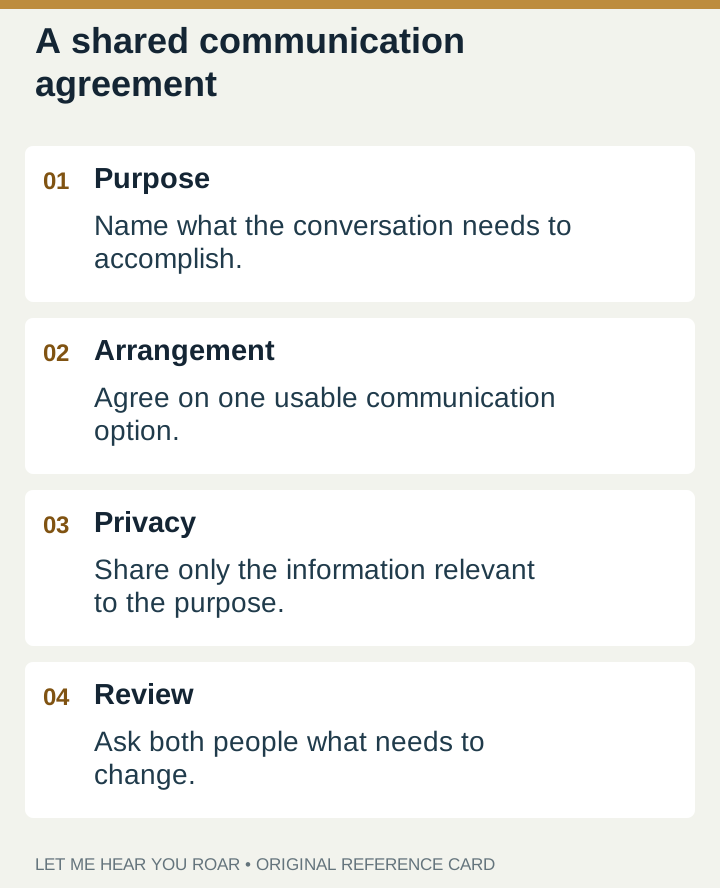
You can separate what someone needs to know from what you are willing to share. A friend may only need to know that a quieter venue helps. A clinician may need a fuller history. An administrator may need specific documentation through a defined process. Those conversations have different purposes and should not automatically contain identical information.
Before disclosure, consider the audience, the record, and your follow-up options. Will the information remain in a private conversation, become an email that can be forwarded, or enter an official file? Who can answer questions about access and confidentiality? You can ask these practical questions before giving details.
Prepare a closing sentence if you want one: “That is all I want to share today; the practical request is a written agenda.” This is an illustrative script, not a guarantee of privacy or safety. If the setting is coercive or threatening, seek appropriate support rather than relying on a carefully worded sentence to change the risk.
Make relationships a shared communication task
Difference does not remove responsibility for how people treat each other. Someone can need more direct language and still care about the effect of their words. Someone can feel hurt by an interruption and still be willing to agree on a clearer way to take turns. Discuss the specific event before assigning a global character judgment.
An illustrative repair might be: “I meant to ask for more detail, but my wording sounded dismissive. I would like to try again.” Another person might say, “When several questions arrive together I lose track; please separate them.” These statements name an effect and a possible adjustment without claiming that intent erases impact.
You can also negotiate how disagreements end. Perhaps either person can ask for a pause, and both agree how to resume. Perhaps a written summary is useful, but live messages during work hours are not. A good arrangement is one both people can understand and revisit, not a secret test of whether someone cares enough to infer the rule.
Choose support with a clear job
Different helpers serve different purposes. A clinician can evaluate health and diagnostic concerns within their qualifications. A communication professional may assess specific access needs. A coach may help prepare a request, organise a goal, or practise a conversation within their scope. Peer connection can offer shared experience without becoming a substitute for individual clinical assessment.
Before working with someone, ask what they do, what they do not do, how privacy works, and how they adapt communication. Explain the format you need to ask questions. An introductory conversation should allow room for uncertainty; you need not buy a package because a helper says your hesitation proves that you need it.
Ask what success would look like in ordinary life. A useful goal might be receiving instructions in a usable form or feeling able to decline a discussion. Be cautious about goals defined only by appearing indistinguishable from other people. Support can build skills while still respecting the person who is using them.
Explore the four focused guides
For a first step after diagnosis, read Finding Your Voice After a Late Neurodivergence Diagnosis: A Beginner’s Guide. It narrows the task to one communication condition and one possible request, with space for uncertainty about identity.
For language that separates a style from a moral judgment, read What Is a Communication Style? Quiet, Direct, and Different Explained. For an ordered practical process, use How to Ask for the Support You Need with ADHD. For a broader identity reflection, explore 7 Ways to Remember a Diagnosis Is Information, Not Your Whole Identity.
These guides approach different questions rather than forming a test you must pass in order. Choose the one that fits the problem in front of you. You may return to another topic after an experience raises a more specific question.
Put one arrangement into practice
Choose one upcoming interaction and write three lines: the purpose, the condition that would help, and the person who can discuss that condition. If writing is inaccessible, use a voice note, symbols, or supported communication. The output only needs to be usable to you.
Review the result with curiosity. Was the arrangement available? Did it help you contribute? Did it create a new obstacle? Keep the useful part and revise the rest. Finding your own style is not a final performance to perfect; it is an ongoing opportunity to make communication fit the people involved.
Connect the ideas
When the next step is a specific request, use the guide to asking for support with ADHD as an example of practical self-advocacy.
Communication is shared work. A companion can begin with listening without trying to fix someone.
What to take with you
- Start with the task and the person’s chosen way to participate.
- Masking reflection should preserve choice rather than impose public unmasking.
- Specific requests, privacy decisions, and shared responsibility can coexist.
Questions readers ask
Can someone be articulate and still need communication support?
Yes. Ask about the actual task and setting rather than inferring all of someone’s needs from fluent speech.
Should everyone use the same accommodations?
No. Offer options and check what helps the individual. Review arrangements when tasks or circumstances change.
Is a coach qualified to diagnose autism or ADHD?
A coaching title alone does not qualify someone to diagnose. Ask about professional credentials, scope, and the appropriate clinical referral pathway.
Where should I begin if everything feels relevant?
Choose one upcoming interaction with a clear purpose. Identify a single change that would make participation more workable.
PUT ONE IDEA INTO PRACTICE
Your next step
Bring one concrete communication goal to a coaching conversation.
Explore coaching with Joshua ↗Sources & further reading
AI-assisted educational writing based on Joshua’s project direction. How this content is created. Original coaching reflection. Examples are illustrative unless identified as Joshua’s personal story. This article is not a clinical assessment or individualized treatment advice. Research and Scripture are linked for context; no independent clinical review is claimed.

Father, Marine Corps veteran, Christian counselor, coach, and the founder of Let Me Hear You Roar.
Read the story behind the project ↗