
People-pleasing is used here as an everyday description of repeatedly prioritizing another person’s approval over an answer you actually want to give. It is not a diagnosis. You might notice it when you agree too quickly, disguise disagreement as confusion, or take responsibility for a mood you cannot control.
The goal of this guide is not to make you less caring. It is to help you make care more deliberate. A freely chosen yes, an honest no, and a thoughtful request can all belong in a generous life. The practical work begins with understanding the exact moment at which your choice disappears.
Start with a particular moment, not a personality verdict
“I’m a people-pleaser” can become another fixed identity you must overcome. A more workable statement is, “When a colleague asks for help at the end of the day, I say yes before checking my workload.” That sentence contains a setting, a behavior, and a place where you can try something different.
Think of one recent interaction. Write what the person requested, what you wanted to answer, what you actually said, and what happened afterward. Keep interpretation separate from observation. “She asked twice” is an observation. “She would never respect me” is a prediction. The prediction may reflect a longer pattern, but naming the difference helps you decide what evidence you have.
Do not turn the exercise into an investigation of everything that has ever gone wrong. One moment can reveal enough to begin. Perhaps your difficulty is the speed of the request. Perhaps it is the public setting. Perhaps you agree because the alternative has real consequences. Those situations call for different kinds of support.
Ask what your yes is trying to protect
An unwanted yes may protect something you value: belonging, employment, family stability, a reputation for reliability, or relief from an uncomfortable conversation. Understanding the purpose of the behavior does not require approving every result. It helps you avoid replacing a familiar strategy with a new instruction that ignores the problem it was solving.
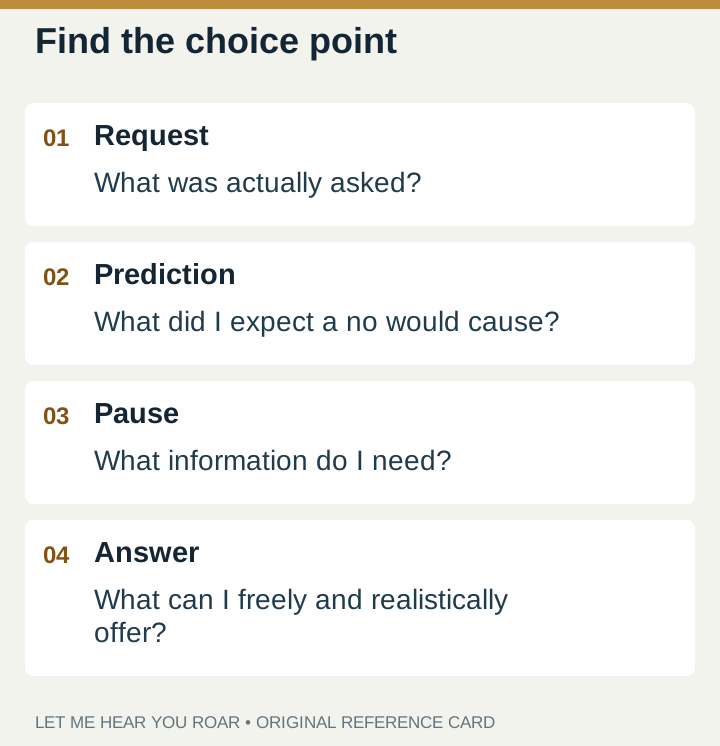
Use three questions. What do I expect will happen if I pause? What evidence supports that expectation? What would make a more honest response more possible? If the answer is “I need time to review my schedule,” a delay may help. If the answer is “I could lose access to housing,” you need a broader plan than a confidence exercise.
Sometimes the feared result is ordinary disappointment, and sometimes it is serious retaliation. Do not flatten that difference. If someone uses threats or coercion, do not confront them simply to complete this guide. Individualized safety support is appropriate; choosing a quieter route is not a failure of courage.
A useful private phrase is, “This strategy made sense to me for a reason; I can examine whether it still fits.” It leaves room for self-respect and change without inventing a diagnosis or assuming that every habit has the same origin.
Separate four things that often become tangled
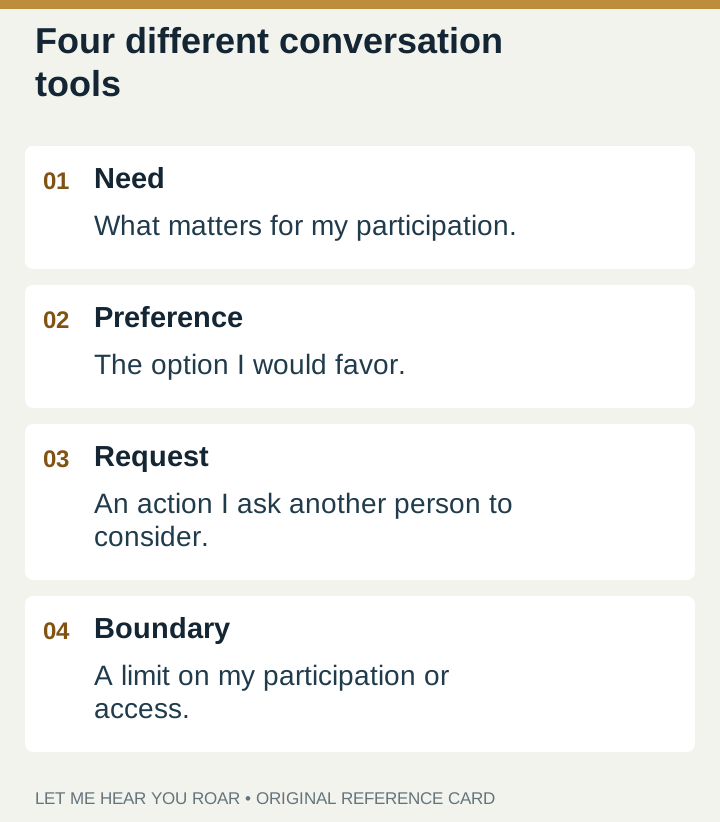
Needs, preferences, requests, and boundaries overlap, but distinguishing them can make a conversation much easier. A need describes what matters for your functioning or participation. A preference identifies a favored option. A request asks someone else to act. A boundary identifies a limit on your own participation or access to what you control.
Illustrative example: you need enough time to finish your work. You prefer requests in writing. You ask a colleague to send the details. You set a limit by saying you cannot accept another task before completing the current deadline. The colleague can decline your preferred method; you still need to decide what work you can realistically take on.
These categories are coaching tools, not legal classifications or rules for every relationship. They are most useful when your draft sentence asks the other person to read your mind. Replace “You should know what I need” with the information that would let them respond. You may still discover that they are unwilling to cooperate, but the problem will be clearer.
A request invites an answer
A genuine request leaves room for a response you do not like. Ask yourself whether you are prepared to hear no, negotiate, or seek another option. If refusal produces threats or punishment, the interaction has moved beyond an ordinary request.
A boundary describes your participation
A boundary might be about availability, conversation topics, possessions, physical contact, or sharing personal information. Make the relevant limit explicit. “I’m not discussing that here” gives clearer information than hoping your discomfort will be noticed.
An agreement coordinates shared responsibility
Some decisions affect obligations you already share. A household budget, childcare plan, or project deadline may require negotiation rather than unilateral announcement. You can state your limits while acknowledging that a workable arrangement still needs to be made.
Create space between the request and the answer
A pause is often the smallest useful experiment because it changes timing without forcing an immediate yes or no. Prepare a sentence such as, “Let me check what I can offer,” or “I need the details before I agree.” If the request is time-sensitive, ask for the actual deadline rather than assuming urgency.
During the pause, check three resources: time, energy, and responsibility. How long will the task probably take? What will it displace? Is it yours to do, shared, or optional? You cannot calculate every cost perfectly, but you can stop treating your resources as invisible.
Then distinguish the answer you want to give from the answer you feel permitted to give. Write both if necessary. The difference may show where the conversation is difficult. You might want to say no but fear appearing unreliable; you might want to help but need a smaller role. “I can review one page, not the full proposal” could be a truthful middle option.
A pause should not become a way to avoid answering indefinitely. Where it is appropriate, give a realistic return time and follow through. If you need more time, say that directly. Clarity includes making your uncertainty understandable.
Build a boundary that fits the relationship
Start with the practical issue. In an ordinary friendship, “I’m not free this weekend” may be sufficient. In a work setting, “I can complete the report or the new presentation by Friday; which should take priority?” may be more useful because it invites a decision about competing tasks. In a shared household, identify the commitment that needs renegotiating.
You can choose warmth without surrendering the answer. “I value spending time with you, and I need a quieter evening” communicates care and a limit. Avoid attaching praise that you do not mean, or writing a paragraph so affectionate that the boundary disappears. The message should still be easy to summarize.
Consider the medium. Speaking may allow quick clarification. Writing may give you time to organize your thoughts or communicate more accessibly. A group conversation may provide witnesses but may also increase pressure. None is universally best. Choose with attention to privacy, power, your communication needs, and the practical purpose of the exchange.
Rehearse enough to recognize your sentence. If you memorize every possible response, preparation can become an attempt to control an uncontrollable conversation. You need a clear opening and a plan for uncertainty, not an answer to every imagined objection.
Respond to pushback without making a courtroom case
Pushback contains information. A question may reveal confusion. A disappointed reply may be an honest feeling. Repeated demands after a clear answer may show a pattern you need to consider. Try to respond to what is actually happening rather than treating every follow-up as either harmless or hostile.
If the person lacks information, clarify briefly: “I mean I can attend, but I cannot organize it.” If they dislike the answer, acknowledge that without changing it automatically: “I understand that makes planning harder.” If the conversation loops, a repeat can close the loop: “My availability is still the same.” These are ordinary coaching examples for contexts where direct communication is reasonably safe.
Do not keep increasing the volume or the severity of the consequence to make the boundary feel real. A calm sentence can be ignored, and a loud sentence can also be ignored. The question then becomes what choices and support are available to you. Ending a low-stakes discussion, revisiting a shared arrangement, or consulting a trusted adviser may be more useful than another explanation.
If new information changes your decision, say so clearly. “I did not realize this was the only available appointment; I can make an exception this time.” An exception can be intentional. What matters is whether you chose it, understood its cost, and made the new agreement understandable.
Learn to receive another person’s boundary
Practicing your own voice also means making room for other voices. If a friend declines an invitation, resist asking for enough detail to decide whether their reason qualifies. If someone does not want to discuss their history, do not interpret their privacy as a challenge to your closeness. Their limit can be valid even when you feel disappointed.
You may still ask practical questions when shared responsibilities are affected. “When can we finish the budget discussion?” is different from “Why are you always avoiding me?” Focus on what needs coordinating rather than demanding proof of care. A boundary does not erase every obligation, and a relationship does not erase every limit.
Notice whether your preferred script would feel respectful if it were addressed to you. Would it leave you an actual choice? Would it distinguish a request from an ultimatum? This reversal can reveal places where the language of boundaries is being used to control someone else’s friends, beliefs, movement, or private decisions.
Work with guilt without making it the decision-maker
Feeling guilty after a no does not automatically mean the no was wrong. It also does not prove the no was right. Treat the feeling as a prompt to review the situation: Did I break a commitment? Was I misleading? Did I ignore a responsibility? Or did I disappoint someone while communicating a reasonable limit?
If you made a mistake, repair the specific mistake. You might say, “I should have told you earlier that I could not attend.” That apology does not require agreeing to attend after all. If the issue is simply discomfort, give yourself time before sending a reversal message. You can care about the other person and still remain unavailable.
Choose a review partner who can think with you, not someone who will automatically declare you right. Ask, “Was my limit clear and proportionate?” rather than “Tell me I’m not selfish.” Useful support helps you assess the decision instead of repeatedly outsourcing permission to make one.
Build a practice plan that respects your actual life
For one week, record requests without changing anything. Notice where you answer quickly, where you feel free to choose, and where the stakes are high. In the next week, try one delay in a low-risk setting. After that, test one smaller offer or one straightforward no. The sequence is optional; adapt the pace to your circumstances.
Define success by what you can observe. You paused before agreeing. You checked the deadline. You stated your available time. The other person’s approval is information about the interaction, but it is not the sole measure of your practice. A useful attempt can feel awkward.
If Christian faith matters to you, prayer can be a private space for considering honesty, responsibility, and care. It should not become an instruction to tolerate coercion or a way to declare your preference God’s command for another person. Someone who does not share your faith can use the same practical reflection without the spiritual component.
If the pattern is deeply distressing or closely connected with harmful experiences, consider support suited to the difficulty. Coaching can help with decisions and rehearsal. A qualified mental health professional can assess concerns beyond coaching’s scope. You do not have to retell your whole history to begin asking what kind of help is available.
Choose the next guide for your actual obstacle
If you need a first sentence, read “How to Speak Up and Set a Boundary Without a Speech: A Beginner’s Guide.” If disagreement about values is the hard part, read “What Is Compassionate Conviction? Speaking Your Beliefs Without Silencing Others.” For a workplace situation, use “How to Find Your Voice at Work After Being Dismissed.” For examples you can adapt, use “7 Clear No Scripts for Difficult Conversations.”
These four companion articles address different obstacles. You do not need to read them in a fixed order. Choose the one that matches the decision in front of you, and return to the broader guide when you want to review your pattern over time.
Your next action: change one moment of choice
Choose one recurring request and finish these three lines: “I usually answer…,” “I need to check…,” and “My pause sentence will be….” Try the pause once where it is reasonably safe. Review what became clearer before deciding whether to take a larger step.
A life with more honest answers is built through workable decisions. You do not need to become fearless, less generous, or permanently certain. You need enough room to notice your answer and enough support to choose how to communicate it.
Connect the ideas
Limits and connection can coexist. Explore finding belonging without losing yourself when keeping the peace has meant becoming less visible.
If you need a smaller starting point, return to setting one boundary without a speech.
What to take with you
- Describe one behavior instead of fixing your identity.
- A pause creates room to assess time, responsibility, and choice.
- Your boundary and another person’s autonomy both matter.
- Evaluate your decision without using approval as the only measure.
Questions readers ask
Is people-pleasing always harmful?
No. Courtesy, flexibility, and generosity can be freely chosen. The useful question is whether your yes reflects an informed choice or a pattern that repeatedly erases your limits.
How can I stop feeling guilty?
There is no guaranteed way to remove guilt on demand. Review whether you owe a repair, seek perspective if needed, and allow discomfort without making an immediate reversal.
What if saying no has real consequences?
Take those consequences seriously. Consider support, timing, resources, and alternatives before acting. A direct confrontation is not a required step, especially where threats or abuse are present.
PUT ONE IDEA INTO PRACTICE
Your next step
Explore the situation in a focused coaching conversation.
Explore coaching with Joshua ↗AI-assisted educational writing based on Joshua’s project direction. How this content is created. Original coaching reflection. Examples are illustrative unless identified as Joshua’s personal story. This article is not a clinical assessment or individualized treatment advice. Research and Scripture are linked for context; no independent clinical review is claimed.

Father, Marine Corps veteran, Christian counselor, coach, and the founder of Let Me Hear You Roar.
Read the story behind the project ↗