
To ask for support with ADHD, identify one task that is difficult, describe a concrete change that could help, and agree on how to review it. You do not need to arrive with a complete explanation of your life. A useful request gives the other person something specific to consider.
This process concerns everyday self-advocacy. It does not diagnose ADHD, determine formal accommodation rights, or replace clinical care. The examples are invented planning situations, and no script guarantees a helpful or safe response from another person.
Before you begin: choose a task and a way to prepare
Have one upcoming or recurring task in mind and a way to keep a short note. You can type, record a voice memo, use symbols, or ask someone to help organise your words. Choose a format you will be able to access when the conversation happens. An elaborate document is unnecessary if a few lines will do.
NIMH notes that adult ADHD diagnosis involves more than occasional difficulty concentrating or organising: assessment considers persistent symptoms, their effect across settings, and earlier history. If diagnosis or treatment is your question, speak with a qualified health professional.
For this exercise, stay with a practical issue you can describe. Perhaps instructions change without a clear final version. Perhaps a meeting ends without agreement about who does what. A support request is easier to discuss when it points to an observable part of the task rather than a global statement that everything is going wrong.
Step 1: describe the point where the task becomes difficult
Write the sequence in ordinary terms. “I receive a request in a meeting, a different version in chat, and a third version by email. I do not know which one to follow.” This description reveals a decision that someone needs to clarify. It is more actionable than “I need to be better at keeping up.”
Limit the initial request to one bottleneck. If five things are difficult, choose the part whose clarification would make the next action possible. You are not claiming that it is your only need; you are deciding where to begin. Additional issues can be recorded for a separate conversation if that helps prevent them from being forgotten.
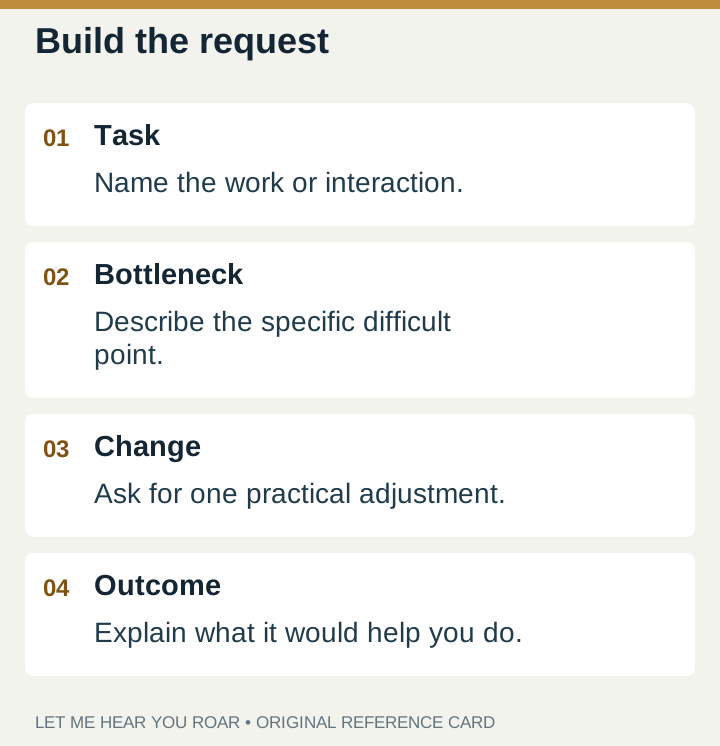
Step 2: choose one concrete change
Ask what another person could actually do. Examples include confirming the final instructions in one place, identifying the first priority, breaking a broad request into named deliverables, or sending a short written summary after a discussion. Choose the change that corresponds to the difficulty you identified.
Avoid building the request around a fashionable tool before knowing the problem. Another app will not settle conflicting priorities unless someone decides which priority comes first. A reminder cannot clarify an instruction that was never clear. The support should address the task’s missing or difficult element, not simply add another thing for you to maintain.
Step 3: write a short request with a clear purpose
Try this optional structure: “When [situation], I have difficulty with [specific part]. Could we [change], so I can [task outcome]?” An illustrative version is: “When the deadline changes verbally, I lose track of the current date. Could we confirm changes in the project note so I can plan the next step?”
Use words you would naturally use. You can leave out the first clause and ask directly if that feels sufficient: “Please confirm which deadline is current.” You can also request a conversation rather than sending a long explanation. The goal is to make the need understandable, not to produce a persuasive autobiography.
Step 5: choose the channel and timing
Think about where the request can receive attention. A short message may help someone consider the details; a scheduled conversation may allow questions. You can combine them by sending a brief outline and asking to discuss it. If calls are difficult, ask whether an accessible written route is available.
Keep a copy of the request if that is useful and appropriate. Bring your note to the discussion so that you do not have to remember everything while responding. A trusted supporter can help you prepare, but agree beforehand whether they will attend, speak, take notes, or simply help you rehearse.
Step 6: agree on what will happen next
A helpful conversation ends with an arrangement clear enough to use. Who will update the shared instructions? Where will the current deadline appear? What should you do if a new request conflicts with an existing one? Ask those questions while the discussion is still focused on the practical change.
If the first proposal is not possible, ask which constraint prevents it and whether another option could meet the same need. For example, a detailed meeting transcript may be unrealistic, while a three-line summary of decisions may be manageable. You can consider alternatives without pretending that every substitute will be equally useful.
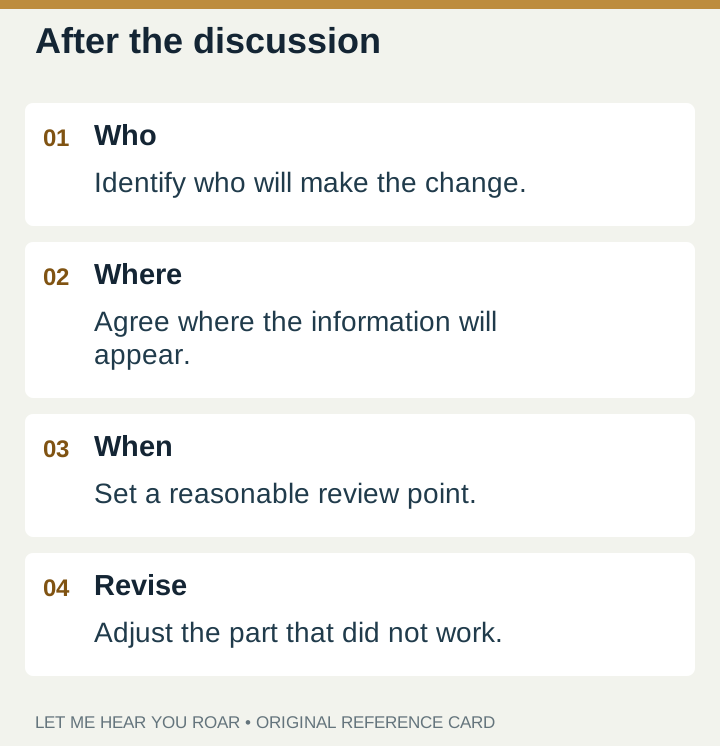
Step 7: review the arrangement, not your worth
After trying the change, note whether it was available and whether it addressed the original difficulty. “The priority list was clear, but nobody updated it when plans changed” identifies a process issue. It does not mean that requesting a list was foolish or that you failed to make the support work.
Bring a specific observation to any follow-up. You might ask for a named person to confirm updates or for a different place to keep the final version. If the arrangement helps, keep it as simple as possible. Successful support does not need to expand into a complex system to count.
Alternatives and troubleshooting
If speaking feels difficult, send the core request in writing and ask for a response through a usable channel. If writing is the obstacle, dictate a rough version or ask a helper to record your words, then check that the final message says what you intend. Assistance should preserve your control over the request.
If the other person hears the request as an excuse, return to the practical outcome: “I want to complete the task accurately; this would clarify the next action.” You do not have to keep arguing indefinitely. Consider whether a different contact or formal process is appropriate, especially if there is a pattern of dismissal.
If disclosure could expose you to retaliation, threats, or coercion, obtain individual support before deciding how to proceed. A polished script is not a safety plan. You can prepare privately and delay sending it while you learn what options are available.
Take one action now
Write the name of one task, one difficult point, and one proposed change. Stop there if that is enough for today. When ready, identify the person who can discuss the arrangement and the communication method you want to use.
The aim is an understandable request connected to a real task. You do not need to prove that you deserve support through an exhaustive account of past struggle. Start with the practical change, preserve your choices about disclosure, and review what happens with the same specificity.
Connect the ideas
If you also need to decline a demand, adapt these clear no scripts without adding explanations you do not want to share.
A request can be easier to sustain when it fits a manageable routine during overwhelm.
What to take with you
- Match the requested support to the point where the task becomes difficult.
- Clarify privacy and formal procedures before sharing diagnostic documents.
- Review whether the arrangement works instead of treating the outcome as a character judgment.
Questions readers ask
What if I do not have a formal diagnosis?
You can ask about everyday task clarity and communication preferences. Formal accommodation processes may require particular documentation; ask the relevant organisation.
What if I forget my request in the meeting?
Bring a short note or send it in advance. You can ask to pause, read your note, or follow up through another agreed channel.
Does asking for support mean avoiding responsibility?
A clear request can support responsibility by making expectations and next actions explicit. The arrangement should identify what each person will do.
PUT ONE IDEA INTO PRACTICE
Your next step
Prepare one support request with a practical coaching goal.
Explore coaching with Joshua ↗Sources & further reading
AI-assisted educational writing based on Joshua’s project direction. How this content is created. Original coaching reflection. Examples are illustrative unless identified as Joshua’s personal story. This article is not a clinical assessment or individualized treatment advice. Research and Scripture are linked for context; no independent clinical review is claimed.

Father, Marine Corps veteran, Christian counselor, coach, and the founder of Let Me Hear You Roar.
Read the story behind the project ↗