
A communication style is a person’s usual way of expressing and receiving information in a particular setting. It can involve pace, wording, detail, turn-taking, and preferred communication methods. It is a description of an interaction pattern, not a diagnosis or a measure of someone’s kindness, intelligence, or worth.
The parts of a communication style
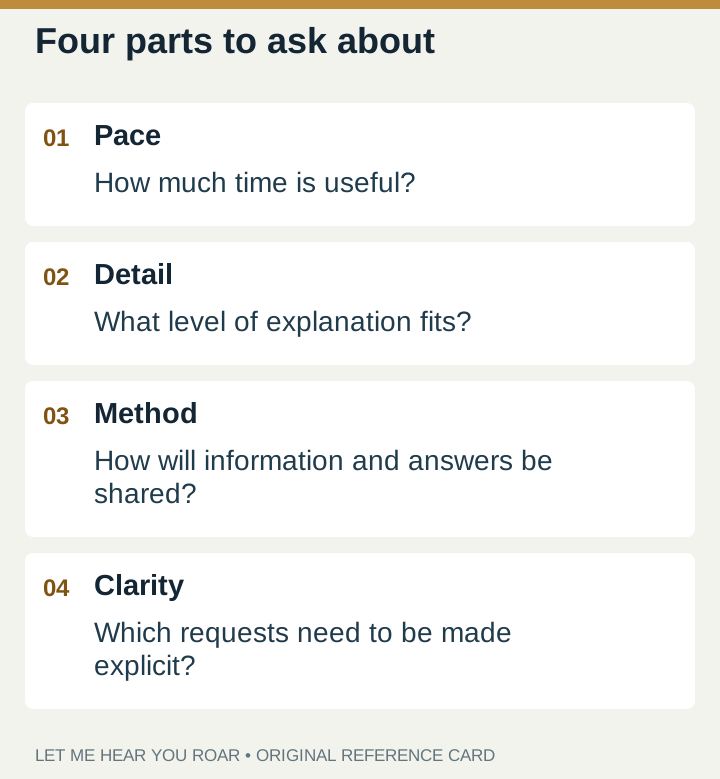
Start with pace: how much time does someone want before answering, and how quickly do they prefer information to arrive? Then consider detail: do they want a brief overview, a worked example, or the full background? These preferences may differ across tasks. Someone can enjoy a long discussion of a familiar subject and want short instructions for an unfamiliar practical activity.
Consider directness and inference. One person may prefer a clear request; another may expect the request to emerge from context. Neither preference automatically tells you what the person intends. If an indirect invitation is repeatedly missed, making the invitation explicit is an available adjustment. It is often more useful than continuing to test whether the other person will infer it.
Communication method matters too. Speech, writing, signing, gesture, images, and communication devices can all play a role. A person may combine methods or change them with the situation. Ask what works for the exchange in front of you instead of ranking methods by how natural they seem to an observer.
Three illustrative examples
Imagine two colleagues receiving a complicated question. One begins speaking while forming an answer; the other needs quiet time and sends a considered response later. The difference does not establish who understood more. If the task allows it, hearing initial thoughts and then accepting written follow-up can give both contributions a place.
Imagine a friend who asks, “Are you inviting me, or telling me about your plans?” That direct question may be an attempt to understand an ambiguous message. The recipient can answer it without turning the exchange into a judgment about social competence. Clearer information helps both people decide what happens next.
Imagine someone who uses a communication device and wants others to wait while they prepare a response. Finishing the sentence for them might be unwelcome, even if intended as help. The appropriate arrangement should come from the person: perhaps waiting, checking whether help is wanted, or using another agreed signal. These invented examples illustrate choices, not clinical profiles.
Style is different from access
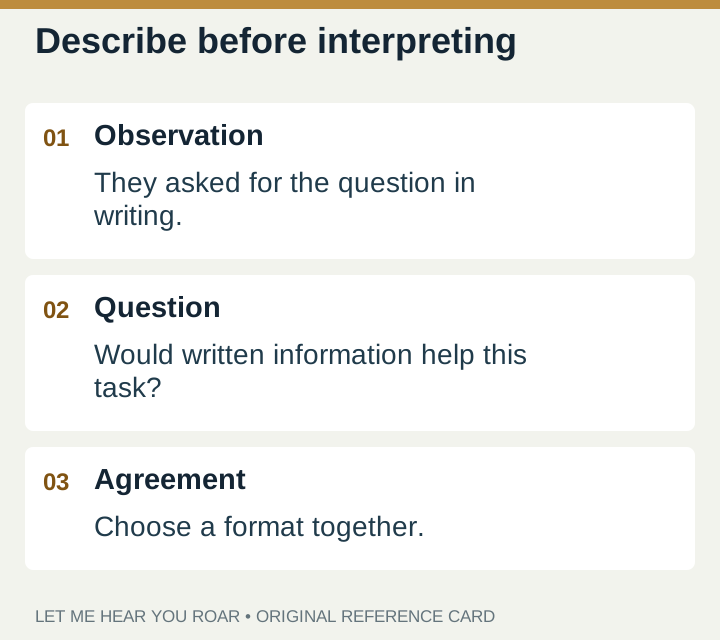
A preference is what a person favours; an access need concerns what makes participation possible or workable. The boundary is not always obvious from the outside. A written question might be convenient for one person and essential for another. Do not demand that someone perform without support merely to prove the distinction.
You can describe a practical need without turning the discussion into a contest over labels. Ask, “What format would let you answer this?” Then identify which arrangement can be provided. If formal accommodations are involved, use the relevant local process for determining requirements. This article offers communication language, not a legal assessment.
Style also differs from a skill. Someone might want to learn how to organise a presentation while keeping a naturally quiet delivery. Building that skill need not require erasing their accent, temperament, or preferred way of thinking. Agree on the actual goal before assuming that the aim is to resemble the most outspoken person in the room.
Style is different from diagnosis
NIMH describes autism as a developmental condition with varied characteristics and support needs, assessed through professional evaluation. A single feature of communication does not establish that diagnosis.
The same caution applies when interpreting yourself. Enjoying direct language or preferring messages to calls can be useful information about your preferences without settling why you have them. If you want to explore a possible diagnosis, bring concrete questions to an appropriately qualified professional. You can still make practical communication changes while that question remains open.
Do not use this definition to diagnose a partner, colleague, or child from a frustrating exchange. “They always answer bluntly” is an observation that still needs context. Ask what was meant, explain the impact where appropriate, and consider the conditions of the conversation before assigning a medical explanation.
Difference does not erase impact
Respect for communication differences and responsibility for words belong together. A person can intend a concise answer and still discover that it sounded dismissive. The listener can describe the impact without declaring that the speaker is uncaring. A repair can address the specific moment: “I wanted more detail; I did not mean that your idea was worthless.”
Likewise, a preference for indirect language does not make others responsible for guessing every need. If something matters, consider making it explicit. A shared agreement might be that either person can ask, “Is that a request?” without being mocked. Such agreements reduce avoidable ambiguity while allowing people to keep their own personalities.
These suggestions assume there is enough mutual respect to discuss the interaction. In a threatening or coercive relationship, communication technique cannot guarantee safety. Support from an appropriate professional or trusted person may be more important than finding a better explanatory sentence.
Common misconceptions to leave behind
Quiet does not automatically mean uninterested. Fast answers do not automatically mean confidence. A detailed message does not automatically mean an argument is being prolonged. Treat these as possibilities to clarify, not facts to infer from appearance alone. There may be information about the task, the setting, or the person’s preferences that you do not yet have.
There is also no universal “best” communication style. A concise emergency instruction and a reflective conversation serve different purposes. The useful question is whether the people involved can understand, contribute, and make informed choices in that setting. Effectiveness depends partly on fit, not just on an individual trait.
Use the definition in your next conversation
Describe one preference in ordinary language: “I think more clearly when I can see the question,” or “I want to answer, but I need a pause.” These are illustrative phrases to adapt, not prescriptions. Invite the other person to name a preference too, then find an arrangement that serves the shared task.
A communication style is a pattern of expression and understanding. It can inform how you arrange a conversation, but it cannot reveal a whole personality or diagnose a condition. Let the definition open a practical question: what would help this person be understood here?
Connect the ideas
Preferences become practical when you apply them to speaking up at work, including how you prepare and follow up.
A style description is only part of a person; explore seeing yourself beyond a diagnosis for another perspective on labels.
What to take with you
- Communication style describes patterns; it does not diagnose a person.
- Ask about pace, detail, method, and clarity rather than inferring character.
- Respecting difference includes making room for repair and shared responsibility.
Questions readers ask
Is direct communication rude?
Not automatically. Wording, context, and impact matter. A direct request can be respectful, and a brief repair can help when meaning and impact diverge.
Can a communication style change?
Yes. People may use different approaches across settings and tasks. Ask about current preferences rather than treating a past description as permanent.
PUT ONE IDEA INTO PRACTICE
Your next step
Notice one communication preference in a short reflection.
Take the private voice reflection ↗Sources & further reading
AI-assisted educational writing based on Joshua’s project direction. How this content is created. Original coaching reflection. Examples are illustrative unless identified as Joshua’s personal story. This article is not a clinical assessment or individualized treatment advice. Research and Scripture are linked for context; no independent clinical review is claimed.

Father, Marine Corps veteran, Christian counselor, coach, and the founder of Let Me Hear You Roar.
Read the story behind the project ↗