
A useful no answers the request in front of you. It does not need to explain your entire history or persuade the other person to feel pleased. The seven scripts below are illustrative starting points for ordinary situations where direct communication is reasonably safe.
Adapt the wording to your voice and responsibilities. If someone uses intimidation, surveillance, or violence, seek individualized safety support instead of testing a script on them. No sentence can guarantee a respectful response.
1. The invitation no: “Thank you for asking. I won’t be able to come.”
Use this when the question is simply whether you will attend. You can appreciate the invitation without supplying a detailed explanation. If you already know the answer, avoid “maybe” or “I’ll try” merely to soften the moment; those phrases may leave the organizer waiting.
Illustrative example: a friend invites you to a busy weekend gathering, and you want a quiet evening. “Thank you for thinking of me. I won’t be there this time” is enough. If you genuinely want another meeting, add a specific possibility: “Would you like to have coffee next week?” Do not offer another date solely to make your no seem acceptable.
If you previously accepted, acknowledge the change. “I’m sorry to change the plan; I need to cancel” recognizes the inconvenience. Check whether there are practical costs or responsibilities to address. A boundary does not make every prior commitment disappear.
2. The capacity no: “I can do this part, but I cannot take on the whole task.”
Use this when a smaller contribution is both possible and freely chosen. Name the edges of the offer so that help does not quietly become ownership. “I can proofread two pages by Thursday” is clearer than “I can help a bit.”
Illustrative example: a volunteer group asks you to organize an event. You cannot take responsibility for the event, but you can check the invitation. Say, “I cannot organize it. I can review the invitation once if you send it by Tuesday.” The order matters: communicate the no before the optional alternative.
At work, competing responsibilities may require a priority decision. “I cannot finish both by Friday; which should come first?” makes the constraint visible. Avoid promising to absorb an impossible workload simply because you have offered a polite sentence.
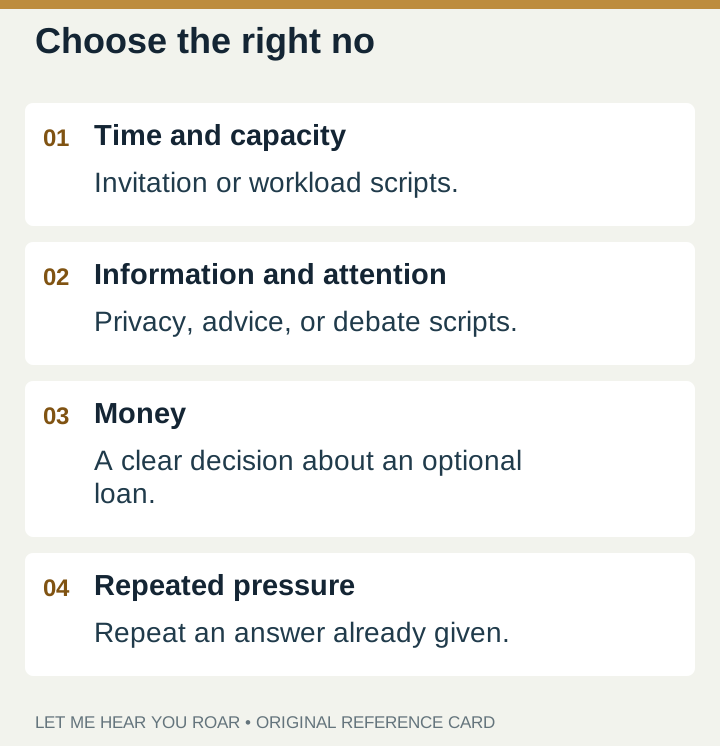
3. The privacy no: “I’m keeping that part of my story private.”
Use this when someone asks for personal details you do not want to share. You may want to talk about your present needs without explaining the experience behind them. “I’d rather focus on what would help now” redirects the conversation without providing a new disclosure.
Illustrative example: a group member asks why you passed on a sharing exercise. “I did not want to share today” answers the relevant question. You do not need to prove that your reason is serious enough. If you are facilitating the group, model this by accepting other people’s decisions to pass.
Privacy includes other people’s stories. “That is not mine to share” can protect information entrusted to you. Consider any actual responsibilities attached to your role, and never promise absolute secrecy when you cannot keep that promise.
4. The advice no: “I’m not looking for suggestions right now.”
Use this when you want company, acknowledgment, or practical help rather than a solution. You can name the useful alternative: “Could you listen for a few minutes?” or “What would help is someone sitting with me while I make the list.”
Illustrative example: you mention a difficult week, and a relative immediately recommends several changes. You might say, “I know you want to help. I’m not looking for a plan tonight; I’d like to talk about how the week felt.” This gives the listener a chance to change course.
The listener can also name their capacity. If they cannot listen now, work together on another time or another support. Asking for a kind of listening does not require the other person to provide unlimited attention on demand.
5. The money no: “I’m not able to lend money.”
Use this when you have decided not to make a loan. Keep the decision separate from a judgment of the person’s worth or financial choices. A lengthy explanation of your own finances may invite a negotiation you do not want to have.
Illustrative example: a friend requests a loan you cannot comfortably offer. “I’m not able to lend money” is a direct answer. If you wish, you can offer a nonfinancial form of help, such as looking through options they have already identified. Do not offer advice or budgeting supervision as a condition of remaining their friend.
Shared financial obligations are different from a new optional loan. If the request concerns money you jointly owe or have already committed, address that arrangement explicitly. This script is not a way to avoid responsibilities or a substitute for professional financial or legal advice.
6. The debate no: “I’m not discussing this topic today.”
Use this when the timing, setting, or subject does not fit the conversation you want to have. You can hold a conviction without defending it in every room. “I know we see this differently; I’m here to spend time together” may fit an ordinary family gathering.
Illustrative example: someone repeatedly turns dinner into an argument about your beliefs. You say, “I am not having that debate at dinner.” If the setting allows, redirect to another subject or step away from the discussion. Choose an action you can realistically and safely take.
Do not use a debate boundary to silence someone’s account of how your own behavior affected them. You can request a better time for that conversation while still acknowledging that it needs attention. The purpose of the script is to choose participation, not to make yourself immune to feedback.
7. The repeated-request no: “My answer is still no.”
Use this when you have already answered clearly and the person keeps presenting the same request. You do not need to invent a stronger reason each time. A brief repeat can make clear that repetition has not changed your availability or decision.
Illustrative example: a friend keeps asking you to join an optional activity after you have declined. “I understand you’d enjoy having me there. My answer is still no” acknowledges the invitation while closing the question. If the exchange continues, you may end that topic or the conversation where it is safe to do so.
Check whether the repeated question contains genuinely new information. You are allowed to reconsider. The aim is not stubbornness; it is avoiding automatic agreement simply to end pressure. If pressure becomes threatening, stop treating the exchange as an ordinary communication exercise and seek suitable support.
Bonus: the pause before the no
When you do not yet know your answer, use a pause rather than a premature refusal or an unwanted yes: “I need to check before I commit.” Give a return time if you can. Then actually check your capacity, responsibilities, and wishes.
A pause is especially useful when the request arrives publicly or unexpectedly. You can make a better decision once you understand what is being asked. It is a preparation tool for these scripts, not an eighth kind of no.
Your next action: personalize one script
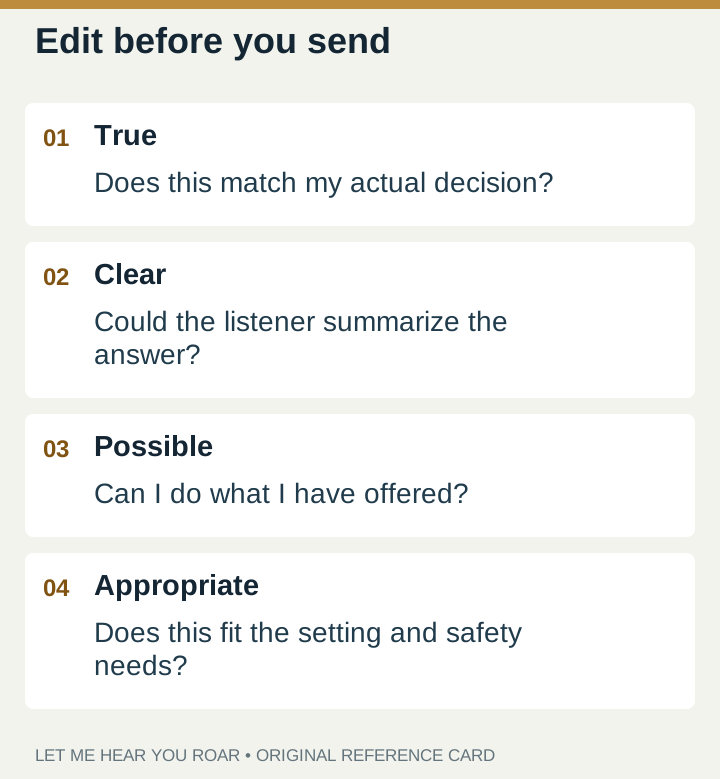
Pick the script that matches a situation you are likely to face. Replace any wording that feels unnatural, then read the result once. Make sure it answers the actual request and does not promise an alternative you resent.
Write a brief follow-up sentence for ordinary pushback. You now have a practical pair: an opening and a repeat. Use them where appropriate, and assess afterward whether the wording, timing, or setting needs to change.
Connect the ideas
For the reasoning behind a short refusal, read the beginner’s guide to speaking up and setting boundaries.
When a refusal is misunderstood in an otherwise safe relationship, repairing a conversation may help you clarify the message without withdrawing the limit.
What to take with you
- Match the no to the actual request.
- Alternatives are optional and should be realistic.
- Respect shared responsibilities and other people’s consent.
Questions readers ask
Do I have to say sorry?
No. An apology may fit a cancellation or inconvenience, but it is not required for every limit. Choose language that is courteous and accurate.
What if the script sounds too formal?
Use your everyday words. Keep the answer clear, and remove language that feels borrowed or theatrical.
PUT ONE IDEA INTO PRACTICE
Your next step
Choose and rehearse the script that fits your week.
Explore gentle voice practices ↗AI-assisted educational writing based on Joshua’s project direction. How this content is created. Original coaching reflection. Examples are illustrative unless identified as Joshua’s personal story. This article is not a clinical assessment or individualized treatment advice. Research and Scripture are linked for context; no independent clinical review is claimed.

Father, Marine Corps veteran, Christian counselor, coach, and the founder of Let Me Hear You Roar.
Read the story behind the project ↗