
Finding your voice after a late diagnosis means learning how to express your needs, preferences, and ideas in ways that fit you. It can include speaking, writing, signing, using a communication device, or deciding that a subject is private. It does not require becoming louder or more socially effortless.
A diagnosis may supply useful language without immediately answering every question. Some people want to revisit their history; others want help with next Tuesday’s meeting. Both starting points deserve room. This beginner’s guide offers practical reflection, not a diagnostic checklist or a treatment programme.
Begin with information, not an identity deadline
NIMH explains that autism can be diagnosed in adulthood and that an accurate diagnosis can help someone understand earlier difficulties and find appropriate support. Its guidance also emphasizes variation in people’s strengths and support needs. That does not predict how any individual will feel about receiving a diagnosis.
You do not have to announce a new identity, join a community, or adopt particular language immediately. You might prefer “autistic person,” “person with autism,” another description, or different wording in different settings. Ask others to use the language you choose, while allowing that your preference may change.
Make three private headings: what feels clearer, what remains uncertain, and what matters this week. Put only one thought beneath each. For example, a busy restaurant may now make more sense, an old friendship may still feel complicated, and an upcoming appointment may require a written question list. You can leave the past partly unresolved while arranging something useful today.
Why communication conditions matter
An instruction such as “be confident” says little about the conditions in which you are expected to communicate. A conversation may demand quick answers, background-noise filtering, interpretation of vague language, and steady eye contact at the same time. Before concluding that you lack courage, consider which demands are actually relevant to the task.
For an original illustrative example, imagine a volunteer who offers clear suggestions by email but rarely speaks in a crowded planning meeting. The useful question is not necessarily how to make that person talk more. It may be whether the group can receive written suggestions beforehand and pause between agenda items. These are options to discuss, not a guarantee about someone’s needs.
Separate the outcome from the performance. If the goal is to choose a venue, accurate information about access and cost matters. A particular tone, posture, or speed of response may not. You can ask for a communication route that serves the shared purpose without making yourself imitate every surrounding habit.
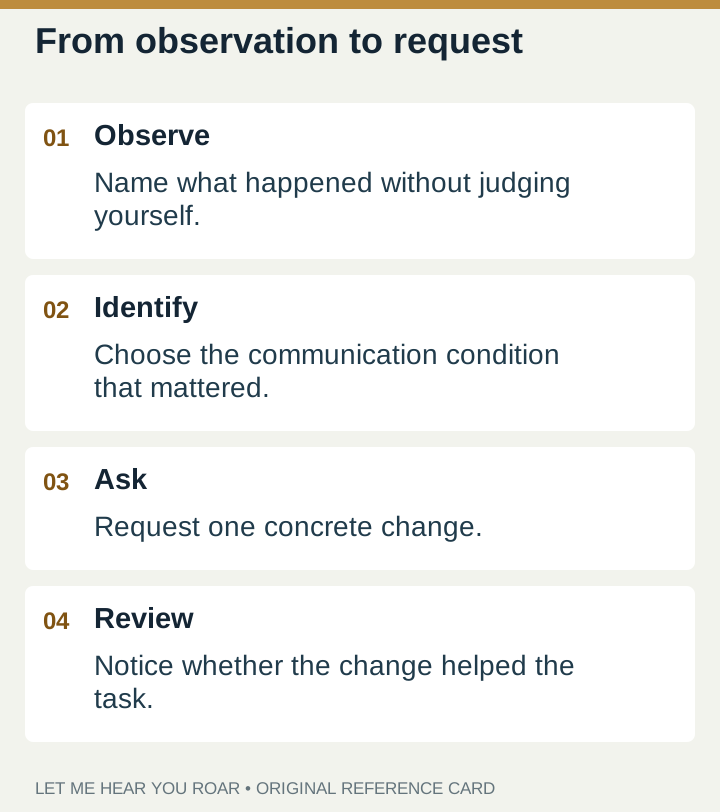
Notice one workable condition
Choose one ordinary interaction to examine. Avoid starting with the most painful conversation in your history. Write what happened, what made participation harder, and what might have changed the situation. Keep observations concrete: “Three people spoke at once” offers more possibilities than “I am terrible with groups.”
Look for existing successes as well as difficulties. Perhaps you answer well when a question is visible, enjoy talking while walking, or prefer a short voice note to a long message. Someone else may need face-to-face signing, captions, a quiet room, or communication assistance. No one format is automatically the accessible choice for everyone.
If keeping records feels burdensome, make a single note after a useful moment. A recording, a symbol, or an answer given to a trusted helper can work. This is not a tracking assignment to complete perfectly. Its purpose is to notice a condition you would like to have again.
Turn that condition into a specific request
A request can name the task, the change, and the practical benefit. An illustrative version is: “For tomorrow’s discussion, could you send the questions in advance? That will help me bring a considered answer.” Another is: “Please ask one question at a time so I can respond to each.” These scripts are optional examples, not guaranteed safe in every setting.
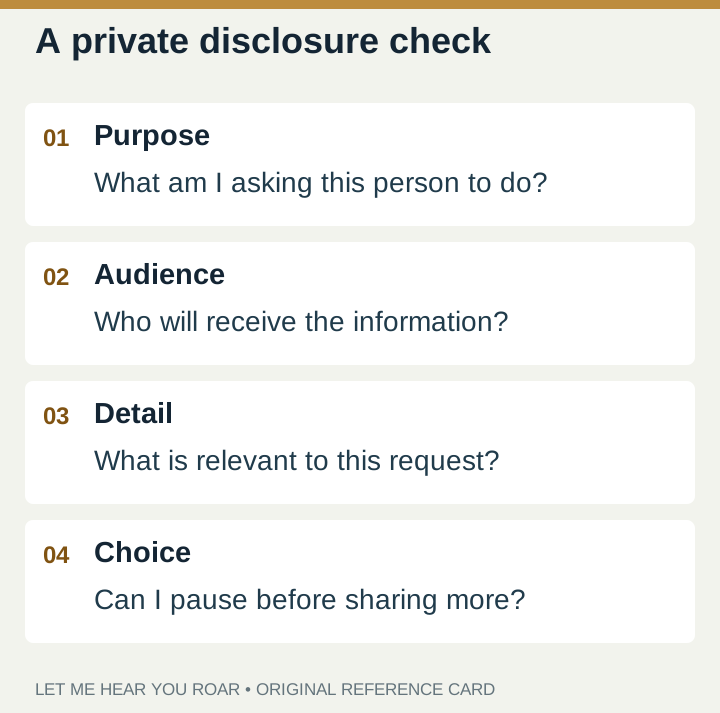
You can usually discuss an everyday preference without beginning with your entire medical history. A formal accommodation process may have different requirements; ask the relevant organisation what its process involves. Before sending documents, clarify who receives them and what information is needed. This article does not determine your legal rights or the documentation rules in your location.
If the request sounds too polished, shorten it. “Can I reply in writing?” may be sufficient. If another person needs more detail, provide only what serves the discussion. Explaining a preference is not the same as inviting unrestricted questions about your diagnosis.
Apply the idea in one manageable setting
Start where you have some choice and an identifiable purpose. That may be a conversation with a friend, a planning session, or an appointment with a professional. Decide how you will begin, what you want the other person to know, and how you can pause. A saved sentence can be easier to use than an improvised explanation.
For a friend, you might say, “I enjoy spending time together; a quieter place helps me stay in the conversation.” For an appointment, you might bring a page headed “My main question” and ask the professional to return to it if the discussion wanders. For a group, you could ask whether comments can be submitted beforehand.
Afterward, evaluate the arrangement rather than your likeability. Did you understand the question? Did your answer reach the right person? Was the agreed format available? Those observations can guide another attempt without turning communication into a score for your worth.
When the first attempt does not help
A refused request may reveal a resource problem, a misunderstanding, or an unwilling audience. It does not prove the request was unreasonable. If useful and appropriate, ask which part is difficult to arrange and whether another route could meet the same need. Written questions might be possible even when a meeting cannot be moved.
If you cannot identify your preference, choose between two concrete alternatives instead of asking yourself an enormous question. Would you rather receive a phone call or a message? Is the obstacle the sound level or the speed? “Neither” and “I do not know yet” remain valid answers.
If someone mocks, threatens, or punishes you for naming needs, further explanation may not make that setting safer. Seek support from an appropriate trusted person or professional; you are not required to confront the person alone. Finding your voice includes deciding where your words are likely to be handled with care.
Choose a next step that belongs to you
Complete one sentence: “I communicate more easily when…” Keep the answer private, share it with one person, or bring it to a support appointment. Choose a situation where experimenting is manageable. You do not have to repair every misunderstanding or reinterpret every memory this week.
If a diagnosis has raised questions that need clinical interpretation, return to the diagnosing professional or another qualified clinician. Coaching can help organise a request or rehearse a conversation; it cannot establish a neurodevelopmental diagnosis. Your next useful step might be practical, relational, clinical, or simply a little more time to think.
Connect the ideas
For a broader look at access needs and everyday exchanges, continue with neurodivergence and communication.
A new understanding of yourself can also change how you approach belonging without losing yourself.
What to take with you
- Voice includes multiple communication methods and the choice to keep something private.
- A concrete change to a conversation can be more useful than a demand for confidence.
- A diagnosis can inform your needs without defining every part of your identity.
Questions readers ask
Do I have to tell everyone about my diagnosis?
No. Consider your purpose, privacy, and the setting. Formal support processes may require specific information, so ask about those requirements before sharing documents.
What if I communicate differently on different days?
Describe the options you might need rather than promising one fixed style. A preference card can include more than one workable method.
PUT ONE IDEA INTO PRACTICE
Your next step
Explore a reflection about one communication preference.
Take the private voice reflection ↗Sources & further reading
AI-assisted educational writing based on Joshua’s project direction. How this content is created. Original coaching reflection. Examples are illustrative unless identified as Joshua’s personal story. This article is not a clinical assessment or individualized treatment advice. Research and Scripture are linked for context; no independent clinical review is claimed.

Father, Marine Corps veteran, Christian counselor, coach, and the founder of Let Me Hear You Roar.
Read the story behind the project ↗