
The lioness belongs in any honest conversation about lions and voice. Female lions roar, too. Yet a human lesson about strength cannot be settled by a wildlife fact alone. We must choose what the image is meant to encourage and where its usefulness ends.
This guide uses the pride as a clearly labeled human metaphor for a group where people can express needs, contribute, and belong without sounding alike. It explores confidence, family play, listening, boundaries, and leadership. The practical exercises are original suggestions for reflection, not conclusions that human wellbeing works like lion behavior.
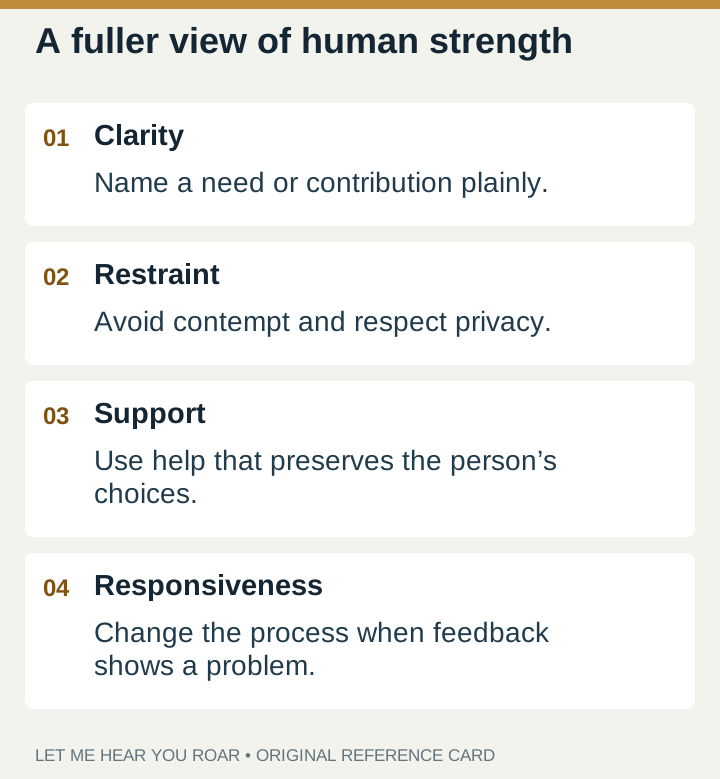
Begin with a fuller image of strength
San Diego Zoo Wildlife Alliance's lion account includes females in its description of roaring and describes pride life as a social context. A male lion's mane is visually striking, but it does not make the male the only animal with a voice.
Our human application is to notice who disappears from a familiar picture of courage. If a poster, lesson, or activity consistently shows one kind of person as powerful and everyone else as a follower, ask what assumption it encourages. A fuller image can include women, children, quiet adults, disabled people, and people whose communication differs from the group's expectations.
This does not mean mapping lion roles onto human genders or families. Animal behavior cannot tell women to be caregivers, men to be protectors, or children to obey without question. Human roles should be discussed through human values, circumstances, consent, and responsibilities. The wildlife image can open a question; it cannot settle it.
Strength as clarity
A clear sentence can be strong without sounding forceful. 'I need the instructions one step at a time' names a condition that helps a person participate. The speaker does not have to become louder to make the need legitimate. A listener's job is to consider the request rather than evaluate whether it was delivered confidently enough.
Strength as restraint
Restraint can mean pausing before a contemptuous reply, keeping someone else's disclosure private, or refusing to make a joke at a vulnerable person's expense. These choices may receive less attention than a dramatic speech. They still affect whether other people can participate honestly in the next conversation.
Strength as receiving help
Asking for a note-taker, an advocate, a quieter setting, or more time can be a deliberate act of agency. Support does not erase the person's voice. The useful question is whether the support carries what the person means and preserves their choices. Help becomes intrusive when it replaces those choices with the helper's agenda.
Separate wildlife observation from a human invitation
A practical way to use the pride image is to divide a page into three spaces: what the animal source says, what the image brings to mind, and what you want to try. The first space needs a reliable source. The second may contain a personal interpretation. The third should describe a human action you can evaluate on its own terms.
For example, an animal communication fact might remind you of staying connected. Your chosen action could be checking in with a friend without requiring an immediate answer. The value of that action depends on the relationship and the friend's preferences, not on whether it imitates a pride accurately. You can change the action when the person tells you what helps.
This distinction also prevents impressive nature language from becoming a health claim. A story about roaring does not establish that vocal imitation releases trauma, changes a diagnosis, or repairs a relationship. Those are different questions requiring different evidence. You can enjoy a metaphor without asking it to do work it cannot support.
For the concise starting point, read 'Why Do Lions Roar? A Beginner’s Guide to Belonging, Boundaries, and Voice.' It establishes the animal fact and then offers three possible human message purposes: presence, connection, and limits. This guide expands the group and family applications.
Build belonging through the way decisions are made
A human group communicates belonging through practical arrangements. Who receives information before a decision? Who is asked directly? Who has time to think? Whose answer gets summarized accurately? Warm language cannot compensate for a process that regularly leaves the same people out.
Try an illustrative planning routine. Send the question in advance, invite written or spoken responses, set a reasonable point for deciding, and explain how the decision will be made. Do not imply that every preference will prevail. The promise is a fair opportunity to contribute, not a guarantee that everyone receives their first choice.
When summarizing, distinguish agreement from silence. 'No one objected aloud' is not always the same as 'Everyone agreed.' A useful follow-up may be, 'Before we finalize this, is there a concern anyone would prefer to send privately?' The setting and stakes matter; a private route should not be promised if the group cannot actually offer privacy.
After a decision, explain the reasoning in ordinary language. People are more able to evaluate the process when they can see which constraints mattered. If you could not accommodate a request, say so directly and consider whether another option is possible. Avoid telling someone that belonging requires never being disappointed.
Give children ways to express without becoming performers
A child can enjoy an animal game without turning it into a demonstration for adults. Offer a choice, follow the child's response, and keep the activity easy to stop. A child who draws a lion or watches quietly is participating differently from a child who makes a sound; neither needs a lower score for bravery.
Joshua remembers that when his children were about two or three, a playful roar sometimes helped a sad moment shift into play. That is a personal observation from the project's story, not a controlled test or a promise for other children. The useful invitation is to pay attention to the child in front of you rather than recreate the memory as a fixed method.
Do not require a cheerful ending. A child may enjoy a moment of play and still need comfort, information, food, rest, or help with a problem. Ask what is needed instead of treating a laugh as proof that the original difficulty disappeared. Play can coexist with sadness; it does not have to erase it to be worthwhile.
The companion definition article, 'What Is a Playful Roar? Connection Without a Performance,' explains the invitation and its limits. '7 Ways to Help Children Express Themselves Without Making Them Perform' gives distinct practical options for caregivers and group leaders.
Make room for different adult communication styles
Some people formulate an answer while speaking. Others need time to think before starting. Some communicate through signs, typing, devices, or a support person. You do not need to determine why someone prefers a form before considering a reasonable request to use it.
An illustrative discussion host can offer, 'You may contribute now or send a note after the meeting.' The host then needs a way to read and include the later note. Accessibility is a practical commitment, not merely an opening sentence. If the decision cannot wait, communicate that limitation and offer the available alternatives honestly.
Avoid praising a person only when they approximate the dominant style. 'You finally looked confident' may imply that their previous communication was inadequate. A more useful response names the content: 'Your question helped us notice an assumption.' This recognizes contribution without assigning a performance standard to the speaker's body or tone.
You can also ask before interpreting silence. It may mean thought, disagreement, fatigue, contentment, uncertainty, or a wish for privacy. There is no single answer available from observation alone. A respectful question gives the person an opportunity to clarify while leaving them free not to explain.
Practice boundaries as information, not a contest
In a human group, boundaries can communicate time, access, privacy, and conditions for participation. An illustrative sentence is, 'I can help with setup, but I cannot stay for cleanup.' Another is, 'I am keeping that part of my story private.' A limit does not need a roar or a long defense to carry meaning.
Before stating a consequence, check whether it is a choice you can actually make. 'If the discussion becomes insulting, I will step away' may be realistic in one setting and difficult in another. Think about support, transport, dependence, and the authority of the people involved. A generic script cannot assess those conditions for you.
If a person uses intimidation or violence, prioritize individualized safety support. The pride metaphor should never be used to tell someone to stand their ground physically or confront a dangerous person alone. A chosen distance, a supported report, or a request for help may be the more relevant expression of agency.
Good boundaries also require listening. If someone tells you they do not want a photo shared or do not want to join an exercise, treat the limit as information. You may need clarification, but you should not assume the person owes you a persuasive account of their history before the limit deserves consideration.
Handle rivalry without inventing villains
Wildlife rivalry makes vivid storytelling, but it does not divide animals into moral heroes and villains. Spotted hyenas have complex communication; their familiar laugh-like sound is not evidence of malicious humor. A teaching metaphor should not replace an animal with a caricature.
The same care applies to people. Calling a critic a hyena or a rival a predator can obscure the specific issue and encourage contempt. Ask what behavior you want to address. Are they spreading a false statement, interrupting, declining an invitation, or simply disagreeing? Those situations call for different responses.
The companion how-to article, 'How to Use the Lions-and-Hyenas Metaphor Without Creating Villains,' offers a way to revise a story while preserving its useful theme. It keeps factual claims, personal interpretations, and human actions separate so the image remains accountable to its purpose.
Design a simple group reflection
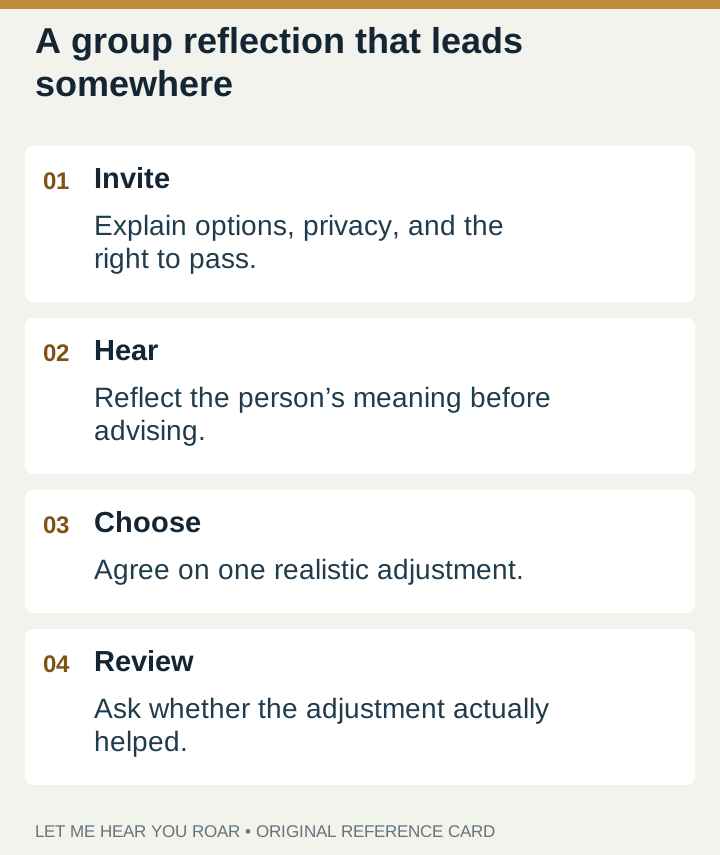
Start with a clear invitation: 'We are using an animal image to think about communication. You can participate in any of the offered forms or pass.' Explain whether responses stay private, are shared voluntarily, or are collected. Never promise confidentiality that the setting cannot provide.
Offer three prompts: something I want to contribute, a condition that helps me participate, and a limit I want respected. Participants can answer one, several, or none. Avoid requiring them to explain the origin of a need. The information may be useful without a personal disclosure.
If people choose to share, reflect their meaning before solving anything. Ask, 'Have I understood correctly?' Then identify which request the group can act on. A conversation that collects vulnerable answers but changes nothing can feel extractive. Choose one realistic change, assign responsibility, and revisit whether it helped.
For example, a group might agree to circulate questions in advance. At the next meeting, ask whether the questions arrived early enough and whether another adjustment is needed. This feedback makes the reflection practical. The success measure is the usefulness of the change, not the emotional intensity of the activity.
Review what the image has made possible
After using the metaphor, ask who it included and who it left out. Did anyone feel pressed to be loud, cheerful, physically expressive, or eager to disclose? Did the group notice a communication need it had overlooked? A helpful symbol can be revised when its unintended message becomes visible.
It is also reasonable to stop using the animal image. Some people dislike it, have different cultural associations, or simply find direct language clearer. You can preserve the purpose by asking, 'What helps you be heard here?' The project is better served by a useful question than by insisting that every person identify with a lion.
Your next step: make one opening wider
Choose one setting you influence: a family conversation, meeting, friendship, or community gathering. Identify one practical opening for expression, such as written input, a genuine pass, more thinking time, or a clear limit on interruptions. Discuss the change with the people it affects.
Then review it after use. Keep what helped and change what did not. The human lesson of the pride is a chosen commitment to belonging with room for difference. It becomes meaningful through the way people are heard and treated, not through how closely they imitate the animals that inspired the image.
Connect the ideas
For the human relationship behind the metaphor, read about finding your people without losing yourself.
A quieter style can still be clear. The explanation of communication styles offers language beyond loudness.
What to take with you
- Female lions belong in the factual account of roaring.
- Human values and responsibilities cannot be read directly from animal roles.
- Belonging becomes practical through choices, accessible participation, and follow-through.
- The best metaphor can be revised or set aside when it stops helping.
Questions readers ask
Does lioness behavior define a woman’s role?
No. This article does not derive human gender roles from animal behavior. The image opens reflection; it does not determine a person’s responsibilities or identity.
What if someone does not like the pride metaphor?
Use direct language about communication and belonging instead. Participation does not require liking or identifying with the animal image.
How can a group tell whether a change helped?
Ask the people affected whether it made participation more workable, and review a concrete process such as written input or time to answer.
Is playful roaring a treatment?
No. A playful imitation is an optional shared activity. The project’s family memory does not establish a clinical effect.
PUT ONE IDEA INTO PRACTICE
Your next step
Explore one practical change that makes expression more workable.
Explore coaching with Joshua ↗Sources & further reading
AI-assisted educational writing based on Joshua’s project direction. How this content is created. Original coaching reflection. Examples are illustrative unless identified as Joshua’s personal story. This article is not a clinical assessment or individualized treatment advice. Research and Scripture are linked for context; no independent clinical review is claimed.

Father, Marine Corps veteran, Christian counselor, coach, and the founder of Let Me Hear You Roar.
Read the story behind the project ↗