
A strong metaphor can help someone recognize distracting noise, intimidation, or the desire to speak with courage. It can also oversimplify animals and people. This guide shows how to use a lions-and-hyenas image while keeping wildlife facts, Christian interpretation, and human choices distinct.
You will need the story or teaching you want to use, a reliable animal source, and a willingness to revise the image. No animal sound is required. The method can apply to a devotional talk, a family conversation, or a piece of writing.
Before you begin: decide the purpose
Write one plain sentence describing what you want the image to help someone do. 'Notice the difference between helpful feedback and ridicule' is specific. 'Become the lion and defeat the hyenas' is vivid, but it does not define a responsible human action. Translate the slogan before building a lesson around it.
Consider the audience, too. A child may hear an animal label literally. An adult who has been targeted by a group may hear an invitation to divide everyone into allies and enemies. You cannot predict every response, but you can explain your purpose clearly and give people room to question the image.
Step 1: Check the animal claim
San Diego Zoo Wildlife Alliance describes competition between lions and spotted hyenas and explains that hyenas use varied vocalizations. Their giggle is associated with social situations such as nervous excitement or submission, while whoops can help locate and gather clan members. Those are animal communication facts, not moral judgments.
Do not describe hyenas as cowardly, deceitful, or evil because they make a sound people compare with laughter. Those words assign human moral qualities to an animal. If a story requires the audience to misunderstand the species, revise the story. Accurate detail can make the image more interesting than a familiar villain stereotype.
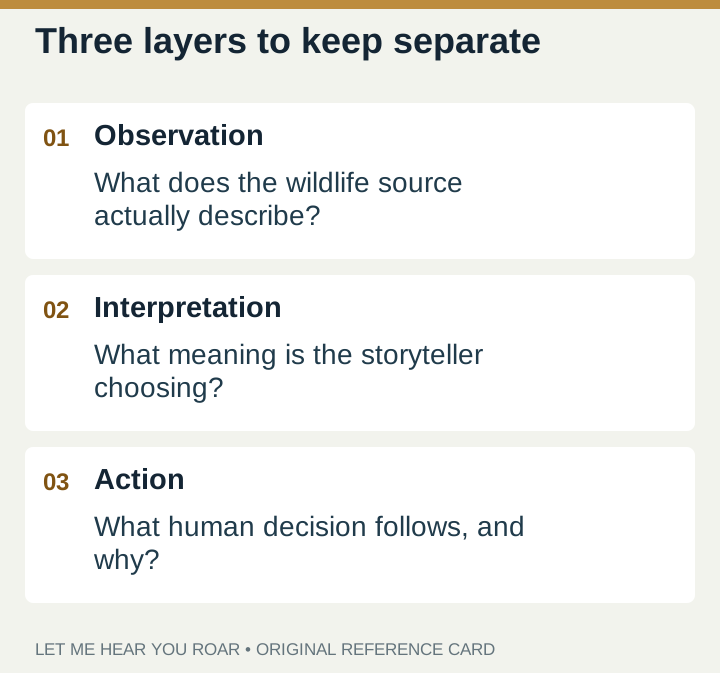
Step 2: Label the interpretation explicitly
Use a sentence such as, 'In this illustration, the distracting sound represents the criticism a person is trying to evaluate.' That wording tells the reader where the factual account ends and the teaching choice begins. It also makes the interpretation available for discussion rather than presenting it as a law of nature.
In Joshua's devotional teaching, a hyena image may represent distracting or intimidating noise. That is a storytelling choice. It does not identify a species as spiritually evil, establish a biblical meaning for every hyena, or authorize attaching the label to a person or group. Say those limits plainly when the image could otherwise imply them.
Step 3: Replace animal labels for people with descriptions of behavior
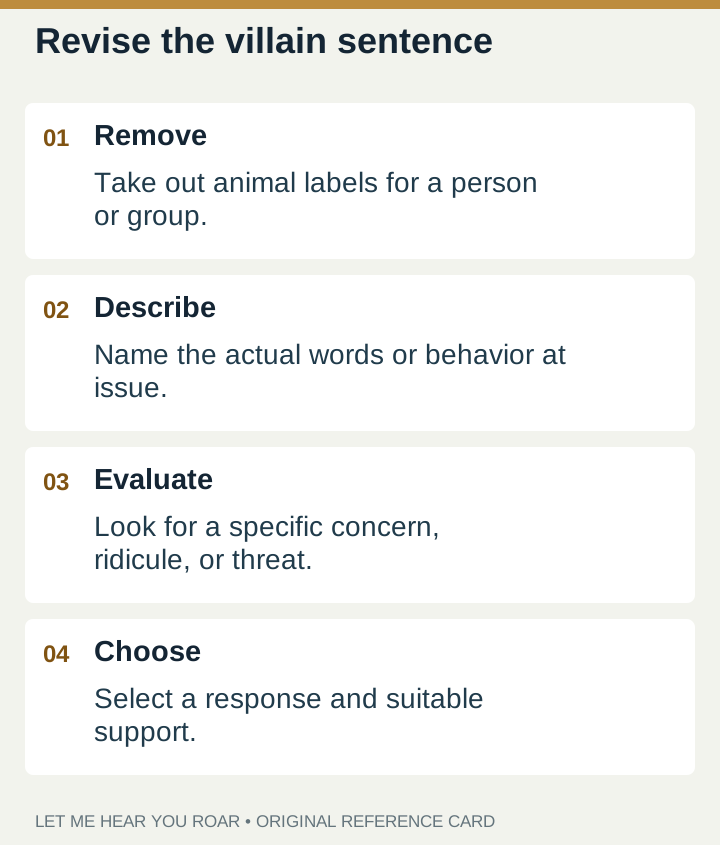
Review the draft for sentences such as 'Your critics are hyenas.' Replace them with language that names what matters: 'Some feedback includes mockery rather than useful information.' The revised sentence gives a listener something to assess. It does not require deciding that a whole person has one fixed moral identity.
Try this illustrative revision: instead of 'Ignore the hyenas around you,' write, 'Ask whether the comment contains a specific concern you can evaluate; if it is only ridicule, consider a limit or support.' This keeps discernment open. Some criticism may be valuable, some may be unfair, and some may involve a serious threat requiring a different response.
Step 4: Keep the Christian application accountable to Scripture
If the lesson includes spiritual resistance, identify the passage and read it in context. Ephesians 6:10–18 distinguishes spiritual struggle from a struggle against people, and James 4:7 places resistance beside submission to God. These texts provide a Christian frame; they do not supply a zoological ranking of lions and hyenas.
An original application might be, 'I want to resist contempt without becoming contemptuous.' That is more actionable than declaring everyone who disagrees to be an enemy. You can hold a religious conviction and still listen carefully, correct a factual error, or apologize for your own conduct. The image should support those possibilities rather than close them down.
Step 5: Give the listener a practical choice
After the metaphor, ask a question that connects to ordinary life: 'What part of this feedback is specific enough to examine?' or 'What boundary would help you respond without getting drawn into insults?' The question should lead beyond the image into a decision the person can understand.
Offer several possible responses rather than one heroic script. Someone might ask for clarification, seek another perspective, write a reply later, decline the discussion, or seek support. If intimidation or danger is present, a confrontation exercise is not appropriate. Individualized help matters more than completing the metaphor's dramatic ending.
Step 6: Invite revision from the audience
Ask, 'Does this image help, or would direct language work better?' Then take the answer seriously. A person may enjoy wildlife and dislike a moralized animal story. Another may find the lion image energizing but want the hyena element removed. Those responses are useful feedback about the teaching's effect.
If you are leading a group, offer a way to comment without speaking in front of everyone. Do not require people to explain personal experiences to justify discomfort. You can revise an analogy simply because it confuses the point or excludes people. A teaching tool does not need to become an identity you must defend.
Alternatives when the image does not fit
Use a signal-and-noise comparison for evaluating feedback, while remembering that people are not noise. Use a map-and-compass comparison for values and decisions. Or skip a metaphor and describe the actual task: separating a concern from a contemptuous delivery, identifying a request, or choosing a limit.
Each alternative has limits, too. The point is not to find a perfect image that explains every situation. It is to use a small tool for a defined purpose and set it down when direct conversation becomes clearer. A listener should leave with a useful question, not a new category of people to despise.
Troubleshooting common problems
If the story sounds exciting but the action is vague, return to the purpose sentence. Specify what the listener can observe and decide. If the story implies that all disagreement is persecution, add an example of useful criticism and show how to examine it. If children hear 'hyena' as 'bad animal,' correct that directly rather than assuming they will infer the distinction.
If someone has already used the label against another person, a repair can be specific: 'I used an animal label that obscured the actual issue. I should have described the behavior.' Then name the concern accurately. Do not use the apology to repeat the insult or to recruit agreement with the original judgment.
Your next step: revise one sentence
Find the most dramatic sentence in your teaching or draft. Mark the animal fact, the interpretation, and the suggested human action. If one sentence blurs all three, rewrite it into separate statements.
Keep the image only if it helps the audience act with clearer understanding and greater responsibility. Lions and hyenas can remain fascinating animals. People can remain people. A metaphor works best when it illuminates a choice without replacing reality with a cast of heroes and villains.
Connect the ideas
For the scriptural distinction at the center of this project, read about the Lion of Judah and the roaring lion.
In a real disagreement, compassionate conviction offers a practical alternative to casting another person as a villain.
What to take with you
- Check animal facts before adding a moral or spiritual interpretation.
- Name behaviors rather than assigning animal identities to people.
- Make the human action specific and offer alternatives.
- Revise or remove the metaphor when it obscures the purpose.
Questions readers ask
Are hyenas evil in this teaching?
No. Any spiritual symbolism is a human storytelling choice. Actual hyenas are animals with their own ecology and communication.
Can I still use a lion as a symbol of courage?
Yes. Identify the symbolism as a chosen interpretation and avoid claiming that it proves a human psychological effect.
What if the audience loves the original dramatic version?
Enjoyment alone does not make a factual claim accurate or a label fair. Keep the energy while revising the parts that mislead or dehumanize.
PUT ONE IDEA INTO PRACTICE
Your next step
Explore a reflection that connects courage with responsible expression.
Explore faith and speaking life ↗Sources & further reading
AI-assisted educational writing based on Joshua’s project direction. How this content is created. Original coaching reflection. Examples are illustrative unless identified as Joshua’s personal story. This article is not a clinical assessment or individualized treatment advice. Research and Scripture are linked for context; no independent clinical review is claimed.

Father, Marine Corps veteran, Christian counselor, coach, and the founder of Let Me Hear You Roar.
Read the story behind the project ↗