
A child does not need to entertain adults, disclose a private feeling, or look confident to have a voice. Expression can be a sentence, a drawing, a gesture, a communication aid, a question, or a refusal. The seven ideas below are practical invitations to make room for that variety.
They are original caregiving examples, not a treatment plan or a guarantee that a child will respond in a particular way. Adapt them to the child's age, communication preferences, circumstances, and the responsibilities of the adults involved.
1. Offer a choice you can genuinely honor
Instead of asking, 'Tell everyone how you feel,' offer two workable routes: 'Would you like to tell me, draw it, or leave it for now?' Make sure the alternatives are real. If you keep asking until the child speaks aloud, the choice was only a different form of demand.
Keep the number of options manageable and use language the child understands. The goal is to make participation possible, not to turn the moment into a complicated decision. When a choice cannot be offered because something necessary must happen, explain the limit clearly and offer choice within what is possible.
2. Ask one question and leave room for an answer
Adults can unintentionally bury an invitation under several follow-up questions. Try asking one concrete question, then wait without supplying the answer. 'Which part was difficult?' is easier to respond to than a rapid series about what happened, why, who was there, and how the child should feel.
If the child does not answer, you can say, 'You can tell me later.' Avoid interpreting a pause as defiance or as proof that a particular explanation is correct. A question should create space for the child's account, not steer them toward a story you have already decided to hear.
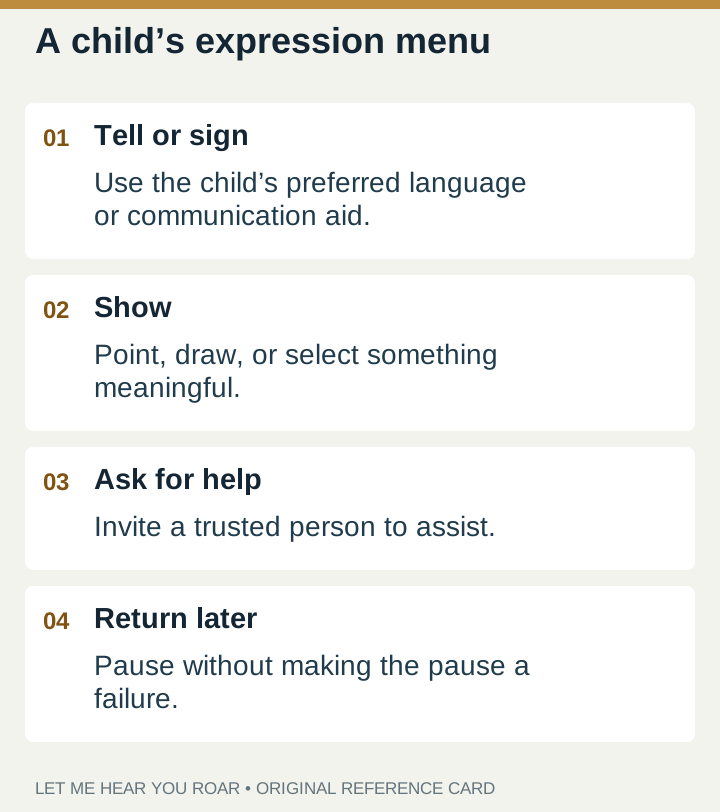
3. Make play an invitation rather than an emotional assignment
You might offer an animal game, a pretend scene, or a drawing together. A playful roar is one possible choice; no special sound or volume is needed. Follow what the child enjoys and allow the game to change. If the child wants a quiet creature instead of a lion, the adult can accept the new direction.
Do not require play to remove sadness. Joshua's memory of some playful moments with his young children inspired this project, but it is not evidence that a roar will help every child. A child can laugh briefly and still need support with the original difficulty. Notice the person beyond the activity.
4. Reflect what you heard before giving a lesson
An illustrative response is, 'You wanted another turn, and it was disappointing when the game ended.' That reflection stays close to what the child communicated. It does not require agreeing with every request or removing every limit. The adult can recognize the feeling and still explain what happens next.
If you are uncertain, check rather than declare: 'Have I understood that?' Leave room for the child to correct you. Avoid attaching a large explanation such as jealousy, attention-seeking, or spiritual struggle to a small moment without evidence. Hearing the child's meaning is a different task from deciding what caused everything.
5. Protect privacy when other people are watching
A family gathering, group activity, or camera can change an invitation into a performance. Before asking a child to demonstrate a sound, tell a story, or show a drawing, consider whether they want an audience. A private moment does not become public simply because an adult finds it sweet or inspiring.
If the child declines, move on without announcing that they are shy or need to be braver. Those labels can make a refusal into a public identity. You can appreciate their choice quietly. If sharing is necessary for a practical reason, explain what will be shared, with whom, and why in an age-appropriate way.
6. Praise the contribution specifically
Instead of 'You were finally brave enough to talk,' try, 'Your question helped me understand what you needed.' The second response values the contribution without implying that quietness was a failure. You can also acknowledge a clear limit: 'Thank you for telling me you wanted to stop.'
Specific feedback need not become constant commentary. Sometimes the most respectful response is to answer the question, provide the requested item, or continue the conversation normally. A child does not always need their ordinary expression turned into a milestone. Let communication do its work without putting a spotlight on every attempt.
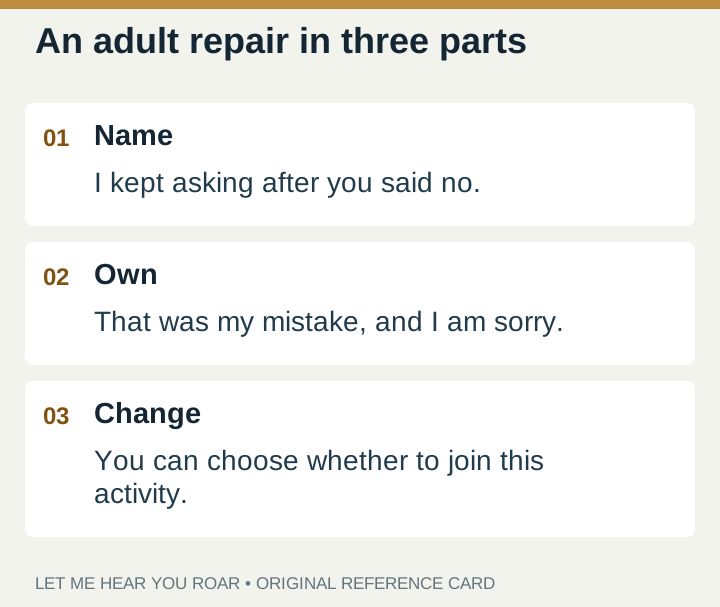
7. Model a repair when you get it wrong
Adults sometimes interrupt, assume, tease, or insist. A simple repair might be, 'I kept asking after you said no. I am sorry. You can decide whether you want to join.' Then change the behavior. The child should not have to reassure the adult or perform gratitude for the apology.
If the situation still requires a limit, separate that limit from the mistake. 'We do need to leave now, and I should not have mocked your disappointment.' This example shows that adult responsibility and authority can coexist with accountability. It gives the child a model of honest words that do not depend on pretending to be perfect.
Your next step: change one adult habit
Choose one thing within your control: ask fewer questions at once, accept a pass without commentary, offer a private route, or repair a moment of pressure. Try the change in an ordinary interaction and pay attention to what the child communicates about it.
The aim is not to produce a more impressive child. It is to make expression more workable in the relationship you share. If a communication concern or distress persists, seek appropriate qualified support instead of treating these suggestions as a substitute for assessment or care.
Connect the ideas
If animal sounds appeal to your family, a playful roar is one optional form of connection.
Adults sometimes get the invitation wrong; repairing a conversation after someone felt unheard can include acknowledging pressure and trying again.
What to take with you
- Make offered choices real, including a genuine option to pass.
- Recognize a child’s meaning before adding advice or interpretation.
- Protect privacy and avoid measuring courage by performance.
- Adults can model responsibility through specific repairs.
Questions readers ask
Should I encourage a child who is reluctant to speak?
You can offer supportive options, time, and help without repeatedly demanding a performance. Consider the setting and the child’s preferred way to communicate.
Does accepting a pass mean having no limits?
No. Adults can explain necessary limits while allowing choice about expression and acknowledging a child’s disappointment.
What if I am concerned about development or ongoing distress?
Seek appropriate qualified advice. A play or communication exercise cannot assess the cause or replace needed care.
PUT ONE IDEA INTO PRACTICE
Your next step
Choose one small change that gives a child more room to express.
Explore gentle voice practices ↗AI-assisted educational writing based on Joshua’s project direction. How this content is created. Original coaching reflection. Examples are illustrative unless identified as Joshua’s personal story. This article is not a clinical assessment or individualized treatment advice. Research and Scripture are linked for context; no independent clinical review is claimed.

Father, Marine Corps veteran, Christian counselor, coach, and the founder of Let Me Hear You Roar.
Read the story behind the project ↗