
A playful roar is a freely chosen imitation of an animal sound within a game or moment of shared imagination. It can be tiny, ordinary, exaggerated in gesture, or replaced by a drawing or facial expression. Its purpose here is connection and play, not a test of bravery, a demand for happiness, or a treatment for distress.
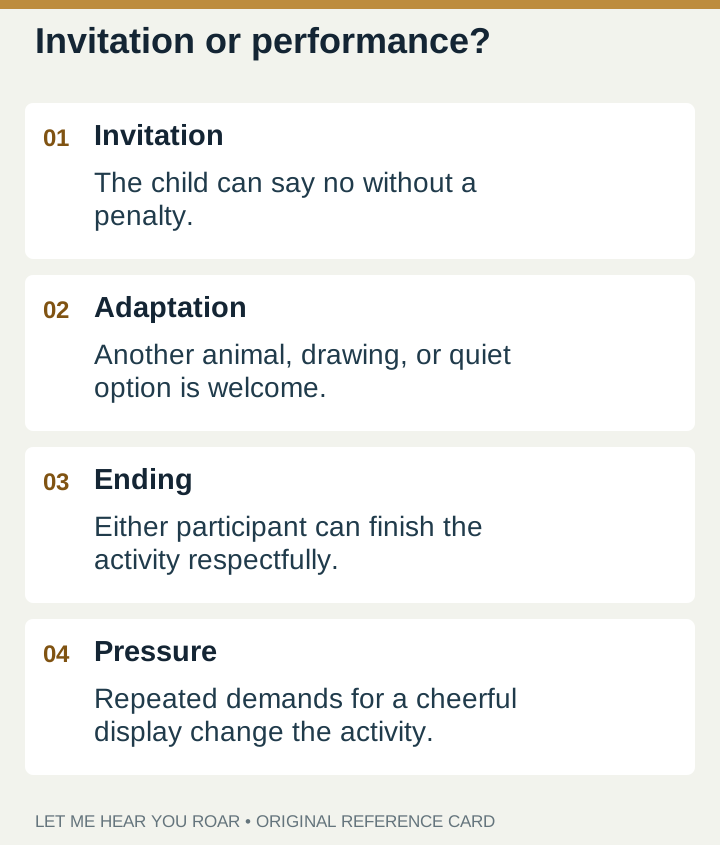
The important part of the definition is freely chosen. If an adult requires a child to perform, judges the result, or insists on repeating it until the child looks cheerful, the activity has changed. It is no longer the invitation described in this article.
The family memory behind the image
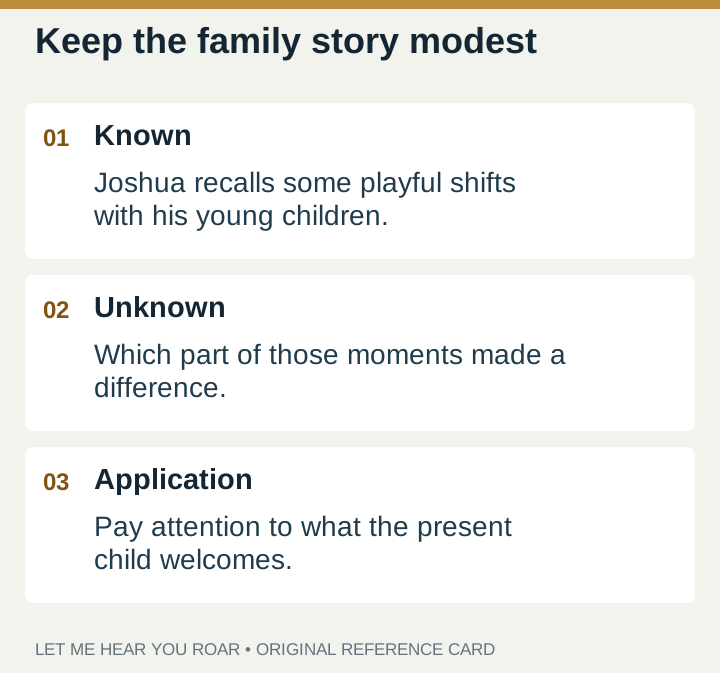
Joshua remembers moments when his children, around ages two or three, sometimes shifted from sadness into play after a lion imitation. This is the limited personal story shared by the project. It does not establish which part of the moment mattered, how often it happened, or what another family should expect.
A parent was present, a child was responding, and imagination was available. Those are ordinary features of the memory, not controlled variables. We should not turn an appealing account into a claim that roaring reliably changes children's emotions. The useful question it raises is gentler: what kind of invitation would this child welcome right now?
Keeping the story modest also protects the family from becoming a testimonial for a method. There is no need to add invented dialogue, a dramatic turning point, or a promise that the same game helped every time. A small memory can inspire care without being made to carry scientific authority.
The components of a playful invitation
An invitation offers a possibility: 'Would you like to pretend to be an animal, draw one, or do something else?' It leaves an easy way to decline. If the child says no, turns away, or chooses another activity, the adult can follow that information without demanding an explanation.
Shared attention means the adult notices the child's contribution rather than concentrating on getting a particular response. Perhaps the child wants to be a mouse, invent a creature, or have the adult do the silly part. You can join that version if it is appropriate. The game does not have to preserve the lion theme to serve connection.
An ending is part of the activity, too. The child can stop because they are bored, tired, uncomfortable, or simply finished. An adult can also set a calm practical limit if the noise or setting does not fit. Choice does not require endless play; it means the boundaries of the game are clear and respectful.
Three examples of what it might look like
In an illustrative example, a child chooses a tiny lion voice while an adult makes an oversized silent lion face. They share a brief game and then return to their previous activity. The absence of loud sound does not make it a lesser version. The shared choice is what connects the example to the definition.
In another example, the adult offers an animal game and the child asks to draw instead. The adult provides paper and stays nearby if wanted. The invitation has worked by making a preference expressible, even though nobody roared. An activity should not be judged a failure because a child took an offered alternative seriously.
A third example begins with sadness. The child enjoys a moment of pretend play but then returns to the concern that upset them. The adult can listen and help with that concern. A brief laugh does not prove the problem disappeared, and renewed sadness does not mean the play was harmful or useless. More information is needed than a single expression.
Playful roaring is different from emotional pressure
Play invites participation; pressure requires a display. You can hear the difference between 'Would you like to try?' and 'Show everyone how brave you are.' Even a warmly delivered request may feel like a performance demand when a group is watching or an adult keeps asking after a refusal.
Playful roaring is also different from shouting as a prescribed emotional release. This project does not ask a child to intensify distress, push a strained voice, or recreate frightening events. There is no required loudness, duration, or emotional endpoint. If sound is uncomfortable, choose another form or stop.
Nor is the activity a wildlife lesson by itself. A child's imitation can be imaginatively satisfying without resembling a real lion. San Diego Zoo Wildlife Alliance describes multiple lion sounds in addition to roaring. Learning about the real animal can be a separate activity, with facts clearly distinguished from pretend play.
Misconceptions that can distort the invitation
A common assumption is that louder means more confident. In a child's game, volume may reflect preference, excitement, imitation, the room, or many other things. It cannot reliably tell you how courageous or emotionally well the child is. Avoid awarding approval according to how much sound they produce.
Another assumption is that a parent must turn every difficult feeling into play. Sometimes the child needs listening, an explanation, a practical change, or time. Offering play is one option among many, not a parenting obligation. If a concern persists, seek appropriate support rather than increasing the intensity of a game.
A final assumption is that a good moment should be recorded or shared. A child's participation does not automatically authorize an audience or publication. Consider privacy and the child's expressed wishes. The connection can remain valuable even if it exists only in the moment and becomes no content at all.
Your next step: offer a real choice
If the setting fits, offer one playful possibility alongside an alternative and the freedom to decline. Keep the invitation short. Then notice what the child chooses, rather than measuring whether the expected expression appeared.
A playful roar is an optional moment of animal-inspired imagination that leaves the child with room to participate, adapt, or stop. The roar itself is expendable. Respect for the person is the part worth carrying into the next interaction.
Connect the ideas
For more ways to offer choice during play, explore helping children express themselves without making them perform.
If a child wants to share afterward, listening without fixing can help an adult make room for their words.
What to take with you
- The project’s family memory is inspiration, not evidence of a treatment effect.
- A genuine invitation includes an easy no and a usable alternative.
- A child’s emotional needs may continue after a playful moment.
Questions readers ask
Does a playful roar have to make a sound?
No. A gesture, drawing, expression, or different game can serve the same freely chosen invitation to play.
What if the child stays sad?
Do not repeat the game as a demand to become cheerful. Ask what they need, listen, and consider practical or qualified support when appropriate.
PUT ONE IDEA INTO PRACTICE
Your next step
Explore an optional, choice-led moment of expression.
Explore gentle voice practices ↗Sources & further reading
AI-assisted educational writing based on Joshua’s project direction. How this content is created. Original coaching reflection. Examples are illustrative unless identified as Joshua’s personal story. This article is not a clinical assessment or individualized treatment advice. Research and Scripture are linked for context; no independent clinical review is claimed.

Father, Marine Corps veteran, Christian counselor, coach, and the founder of Let Me Hear You Roar.
Read the story behind the project ↗