
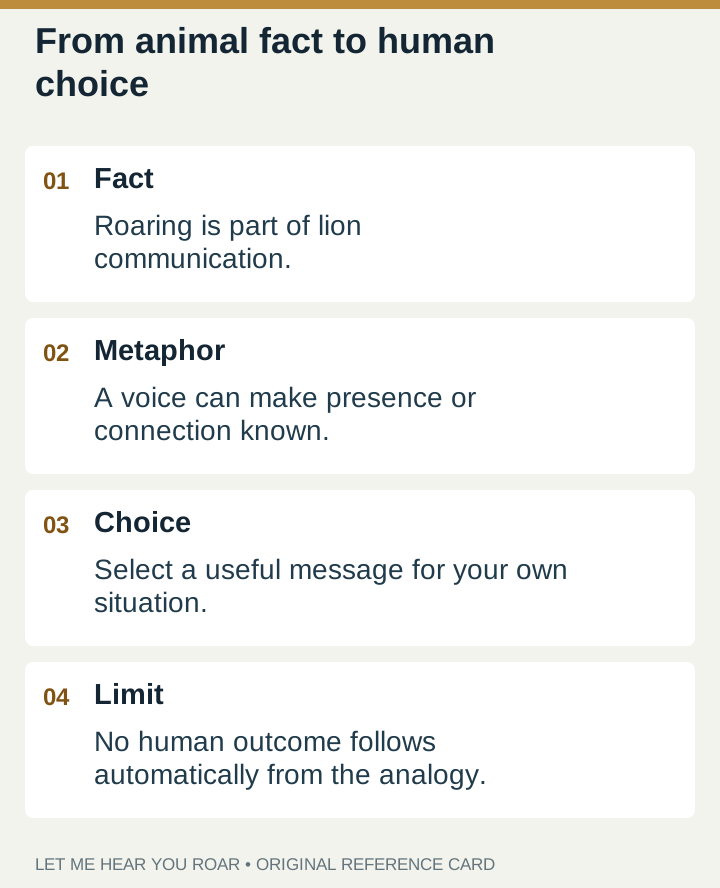
Lions roar as a form of communication, including contact within their social world and signaling the presence of a pride in its territory. Both male and female lions roar. That is the wildlife starting point. The human lesson this project draws from it is a metaphor: a voice can communicate presence, connection, and a limit.
You do not need to imitate a lion to explore that lesson. For people, voice includes writing, signing, a communication device, ordinary speech, and a choice to stay silent. This beginner's guide moves from a small set of animal facts to original reflection exercises you can adapt to everyday life.
Start with the animal, not the slogan
San Diego Zoo Wildlife Alliance describes roaring as one of several forms of lion communication, used in identification, connection, and territorial signaling. Its account also describes other sounds and scent communication. The roar is memorable, but it is not the whole communication system.
That distinction matters when a powerful animal becomes a personal symbol. A photograph can make a roaring lion look like a solitary declaration of confidence. The actual animal belongs to a complex living environment. Our human interpretation adds meanings such as bravery or self-belief; those meanings are not facts established by the photograph.
A useful reading habit is to ask, 'Is this sentence describing wildlife, or using wildlife to make a point about people?' Both can be worthwhile when clearly labeled. Problems arise when an inspiring image is presented as evidence that a human exercise will produce a particular psychological outcome.
What the metaphor can help you notice
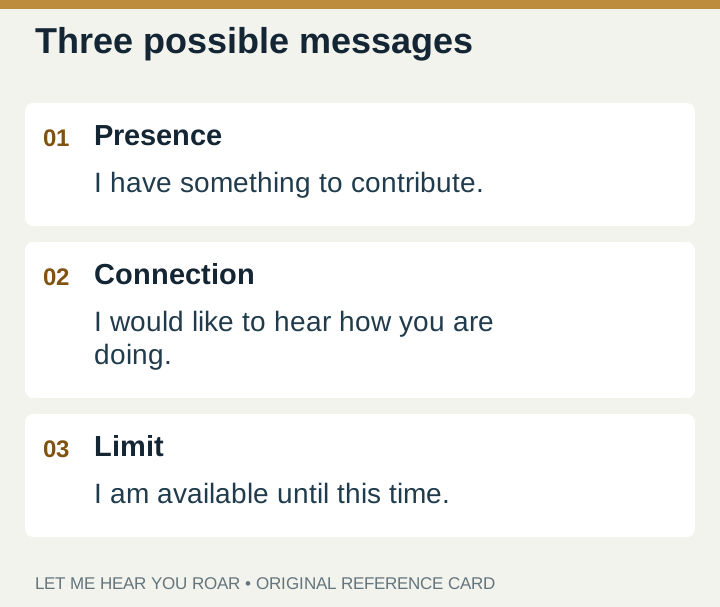
The first human theme is presence. You may want another person to know that you have a preference, a question, or a contribution. The practical task is to make that information available in a form that fits the setting. It may be as simple as adding a comment to a shared document or asking for time to answer.
The second theme is connection. A message can invite contact: 'Would you like to talk this week?' It can also maintain a relationship through a small acknowledgment: 'I remembered that today mattered to you.' Connection does not require constant availability or large emotional disclosures. Sometimes a modest, reliable response communicates more than an elaborate promise.
The third theme is a limit. 'I am not available tonight' tells someone something relevant about your choices. In this article, that is a human boundary example, not a claim that people should defend territory like predators. Human relationships depend on consent, judgment, and responsibilities that animal imagery cannot decide for us.
Begin with one low-stakes message
Choose a situation where the consequences are manageable: selecting a meeting time, asking for written instructions, or expressing a preference about a shared activity. Avoid starting with the person who most intimidates you. Practice is easier to assess when the task is specific and you have a reasonable degree of choice.
Write a sentence that names your actual message. If you want more time, say that rather than explaining every possible reason: 'I would like to answer tomorrow.' If you want to participate, try, 'I have a point to add when there is a pause.' These illustrative examples are starting material, not guaranteed solutions for every setting.
Then decide how you want to communicate. A written message gives you time to revise. A spoken sentence may fit an immediate clarification. A gesture or device may be your usual and preferred form. Choose what serves the message, not what most closely resembles an ideal of a bold public speaker.
Apply the three themes to a real choice
Imagine an ordinary group planning a shared meal. Presence might be, 'I would like to help choose the time.' Connection might be, 'I want to make sure we include you.' A limit might be, 'I can stay until seven.' All three can coexist. Being part of the group does not require giving up every preference.
Now consider a workplace discussion. You can communicate presence by submitting an idea in advance, connection by acknowledging a colleague's contribution, and a limit by clarifying your workload. None of those tasks requires an animal sound or a dramatic confrontation. The metaphor has done its job if it helps you identify the actual message.
Before using a sentence, ask what reaction is realistically possible. Another person may agree, disagree, need clarification, or ignore it. A clear message improves the chance of understanding; it cannot make cooperation inevitable. If you expect intimidation or danger, seek individualized support rather than treating the conversation as a courage challenge.
Notice belonging without demanding sameness
A human group can ask whether every member has a workable way to contribute. Are decisions made only by the fastest speakers? Are written comments read? Can someone decline an activity without being mocked? These questions translate the theme of belonging into choices that a family, team, or community can actually make.
An illustrative host might say, 'You can answer now, send a note later, or pass.' That small invitation creates several routes into the discussion. The host must then respect all three, including a genuine pass. Offering options while praising only the loudest participation sends a different message from the one the words suggest.
Troubleshooting the metaphor
If the lion image makes you feel that you must be forceful, change the image or set it aside. A metaphor is useful only while it helps. You do not owe loyalty to a branding symbol. The purpose is to support your expression, not to assign you an animal personality or judge your strength.
If you try a playful sound and it feels uncomfortable, stop. You can use a drawing, a written phrase, or ordinary conversation instead. Loudness is not a measure of courage, and an imitation should never become a challenge to push a strained voice. There is no requirement to roar as part of this practice.
If you remain unheard, examine the setting as well as your wording. Perhaps the group needs a different discussion process. Perhaps a decision-maker is not willing to listen. Repeating yourself more intensely is not always the missing ingredient. A different channel, support person, or limit may be more relevant.
Your next step: identify the job of your voice
Write three headings: presence, connection, and limit. Under one of them, add a sentence you might want to communicate this week. Keep the situation ordinary and the message small enough to revise. You can rehearse silently or keep the sentence as a note.
Afterward, ask whether the message expressed what you wanted and what you learned about the setting. That reflection is more useful than asking whether you sounded powerful. A lion's roar belongs to a lion's life. Your voice belongs to yours, with room for thoughtfulness, support, and many different forms of expression.
Connect the ideas
The pride’s story includes more than the male lion; explore lionesses, strength, and belonging for the project’s wider reflection.
To translate a boundary metaphor into human conversation, start with a simple spoken boundary.
What to take with you
- Lions use roars as communication; both sexes roar.
- Presence, connection, and limits are human applications, not wildlife prescriptions.
- A useful message can be written, spoken, signed, assisted, or postponed.
Questions readers ask
Do female lions roar?
Yes. The San Diego Zoo Wildlife Alliance lion account describes roaring in both males and females.
Must I roar to use the exercise?
No. The exercise is about identifying what you want to communicate. No animal imitation or particular volume is required.
PUT ONE IDEA INTO PRACTICE
Your next step
Try one comfortable expression of presence, connection, or a limit.
Explore gentle voice practices ↗Sources & further reading
AI-assisted educational writing based on Joshua’s project direction. How this content is created. Original coaching reflection. Examples are illustrative unless identified as Joshua’s personal story. This article is not a clinical assessment or individualized treatment advice. Research and Scripture are linked for context; no independent clinical review is claimed.

Father, Marine Corps veteran, Christian counselor, coach, and the founder of Let Me Hear You Roar.
Read the story behind the project ↗