
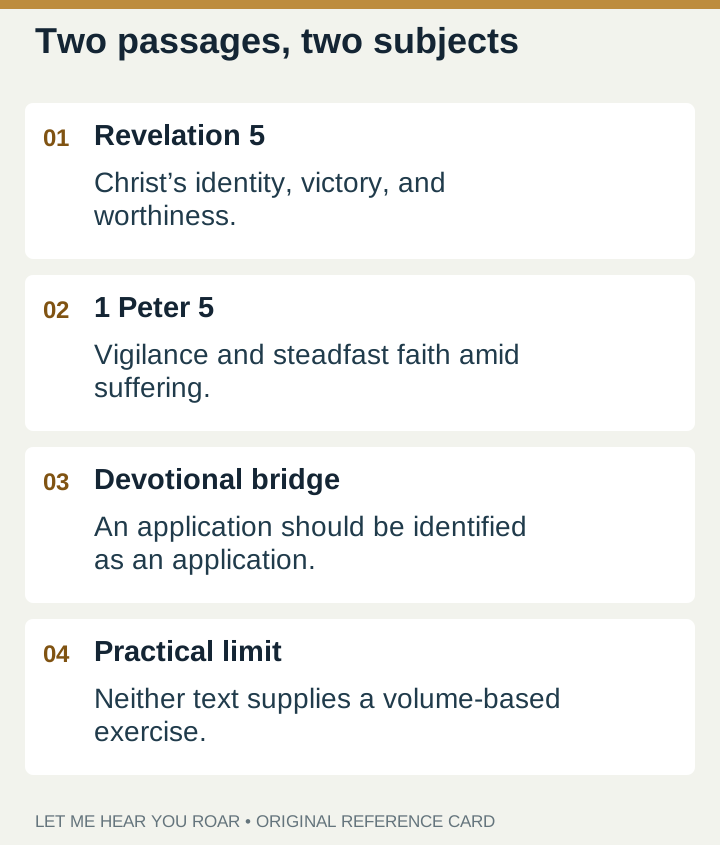
The lion can be a compelling Christian image of courage, but two biblical lion passages do different work. Revelation 5 names Christ through the image of Judah's Lion and then presents the Lamb. First Peter 5 uses a roaring lion as a comparison for the adversary. Reading each passage in context is more useful than building a spiritual technique around the shared animal.
This guide connects those texts with everyday questions about voice: How can a believer speak honestly? What does courage look like without domination? Can lament belong beside praise? How do we resist evil while treating people with dignity? The practical reflections are devotional applications, not additional statements from Scripture or promises of psychological treatment.
Read the two lion passages before combining them
In Revelation 5, an elder announces the Lion of Judah's victory, and John's vision turns to a Lamb bearing the marks of being slain. The imagery belongs to a vision of Christ's worthiness and worship. It does not describe a breathing exercise or direct believers to imitate an animal's vocal power.
In 1 Peter 5, the warning about an adversary appears among instructions about humble leadership, care, vigilance, steadfast faith, and suffering. The passage calls readers to resist; it does not assign spiritual authority according to the loudness of their voices.
Joshua's contrast between a true lion and an impostor is a devotional way of placing these images alongside one another. It should be introduced as his interpretation, never as a missing line of a Bible passage. Readers may find the contrast encouraging while still asking what the original texts actually say. Good devotional teaching can welcome that question.
Notice the subject of each passage
Ask who the image describes and what the surrounding verses ask the reader to do. In one passage the focus is Christ's identity and worthiness; in the other it is a warning addressed to believers. When those subjects blur, a vivid picture can become an unsupported rule. Write the subjects in separate columns before drawing any application between them.
Notice the literary form
A vision, a proverb, a prayer, and an instruction are not identical kinds of writing. The practical habit here is to resist flattening them into slogans. A poetic picture may help you express hope without becoming a prediction of what will happen in tomorrow's meeting. You can treasure imagery while using it carefully.
Notice the limits of the application
A meaningful application does not need to explain everything. 'I want courage rooted in Christ' can be a valuable reflection. 'Every loud person is spiritually strong' is an unwarranted leap. Ask whether your application leaves room for illness, disability, grief, different temperaments, and the freedom to speak quietly. If it does not, revise it.
Christian courage need not dominate a room
For this project, courage means making a considered choice toward truth and dignity despite difficulty. That is our working description, not a technical theological definition. It can include speaking publicly, but it can also include requesting time, declining a role, admitting uncertainty, or bringing a concern to someone equipped to help.
An illustrative church example: a volunteer is repeatedly added to schedules without being asked. A dramatic speech about taking back power may be less useful than a clear message: 'Please confirm with me before assigning another date. I am available once next month.' The sentence identifies the actual problem and an achievable change. It does not require humiliating the organizer.
Another example concerns listening. Someone challenges your interpretation of a passage. You may feel the urge to defend your faith by answering immediately. Courage can look like asking which part they question and checking the text together. Thoughtful reconsideration is not a surrender of conviction. It is a way of taking both the text and the other person seriously.
People have different capacities and communication preferences. A leader who welcomes written questions, allows pauses, and accepts a pass makes room for more people to participate. A gathering should not assume that visible emotion proves sincerity or that verbal hesitation reveals weak faith. The person speaking least may be thinking deeply about what is being said.
Speaking life includes responsibility and repair
Christian speech should not become a competition to sound positive. The devotional meaning of speaking life used here includes truthful encouragement, careful requests, refusal of contempt, and willingness to repair harm. It has room for saying, 'That was wrong,' and, 'I need help.' Those sentences do not cancel hope; they give hope an honest starting point.
Try separating intention, wording, and effect. You may have intended to encourage someone. Your wording may have sounded like a demand to stop grieving. The other person may tell you that they felt dismissed. You can acknowledge that effect without claiming that you intended harm. 'I was trying to help, and I can hear that I rushed you' keeps responsibility within reach.
A useful repair then names the change. 'I will ask whether you want advice before I offer it.' This is more concrete than promising never to make another mistake. If you have shared private information, stop repeating it and discuss a realistic repair with the affected person. Do not make a public apology that spreads the information farther.
The cluster article 'Speaking Life: A Beginner’s Guide to the Power and Responsibility of Words' develops small, practical sentences for encouragement, clarification, and requests. Start there if the language of finding your voice feels too large. A single appropriate sentence is a reasonable unit of practice.
Prayer can hold several honest voices
Psalm 13 moves through complaint and petition toward trust. Psalm 47 offers a different expression, calling for joyful praise. Christian readers need not turn one mood into the only acceptable form of prayer. These texts provide different resources for bringing life before God.
A practical prayer journal might have three spaces: what I am thankful for, what hurts, and what I am asking for. You do not have to fill every space every day. Some days one honest line is enough. These prompts are an original devotional exercise, not a prescribed sequence that guarantees a changed mood.
Acts 16 describes Paul and Silas praying and singing in prison, followed by an earthquake and opened doors. The account can inspire hope in suffering. It does not supply instructions for producing an earthquake, a breakthrough, or a particular outcome through vocal intensity.
Language about a roar shaking gates is therefore best understood as poetry within this project. If you use it, explain that it pictures hope and courage. Never tell someone that an unchanged circumstance means they did not sing, declare, or shout with enough conviction. That places a burden on the person that the image cannot justify.
For a focused explanation, read 'What Is a Prayer for Finding Your Voice?' For a practical sequence, read 'How to Make Room for Praise, Lament, and Honest Prayer.' The first defines the purpose; the second helps you choose an accessible way to participate without manufacturing emotion.
Discernment must preserve other people's humanity
James 4:7 places resistance to the devil beside submission to God. Ephesians 6:10–18 describes spiritual struggle and explicitly distinguishes it from a struggle against flesh and blood. Our application is to resist destructive behavior without turning people into symbols of evil.
A disagreement may involve misunderstanding, incompatible expectations, unfair treatment, or a genuine conflict of values. Calling it spiritual attack does not tell you which of those is happening or what action is appropriate. Start with observable details: what was said, what was done, what impact followed, and what help is available. Prayer can accompany that work.
For example, if someone repeatedly interrupts you, name the interruption rather than announcing that a spirit is speaking through them. 'I would like to finish this point' addresses a behavior. If someone threatens you, the priority is appropriate safety support. You do not need to test your courage by confronting them alone or proving that your faith can change their response.
The cluster article '7 Ways to Resist the Enemy Without Treating People as the Enemy' explores that distinction through everyday decisions. It is particularly useful when spiritual language has made a relationship more frightening or when disagreement begins to feel like a battle you must win at any cost.
Build a practice that respects choice
Begin by identifying the actual need. Is it a private prayer, a conversation about a limit, an opportunity to ask a question, or support with ongoing distress? Those needs call for different responses. A devotional exercise should not be expected to do the job of a safeguarding process, a qualified clinician, or an honest organizational review.
Choose the smallest workable form. You might read one paragraph of Scripture, write one sentence, or ask a trusted friend to sit with you. If a group practice makes you uncomfortable, you can pass without explaining your personal history. Hosts can make this easier by stating the options before an activity begins, rather than waiting for someone to object publicly.
Then decide how to review it. Ask, 'Was this honest?' or 'Did this make my next step clearer?' Avoid grading how spiritual you felt. A prayer can matter to you even when your feelings do not change. A practical decision may become clearer later, and you are allowed to seek advice rather than interpreting every immediate sensation as direction.
Consider keeping two separate notes: reflection and action. Under reflection, write what the passage or prayer brought to mind. Under action, write what you can reasonably do. 'I want reconciliation' belongs in reflection; 'I will ask whether a supported conversation is possible' may belong in action. The distinction prevents a hopeful desire from masquerading as a guaranteed result.
When a community wants to practice together
An accessible gathering needs more than warm intentions. Explain the purpose of the activity, the available forms of participation, how long it will last, and whether anything will be shared. Do not surprise people with a demand to disclose painful memories or perform a roar. An invitation is easier to trust when declining it has no social penalty.
Leaders can model this by saying, 'You can write, pray silently, use your own communication method, or simply listen.' They can also avoid interpreting participants' expressions afterward. A person who cries may not want an explanation; a person who smiles may still need support. Ask what would be helpful rather than announcing what God must be doing in their life.
If someone raises a concern about the exercise, listen before defending the intention. A community that welcomes questions about its practices makes discernment visible. If harm is reported, respond through appropriate support and accountability rather than asking the harmed person to protect the group's reputation. Spiritual language should make responsibility clearer, not less visible.
Keep faith and professional care in their proper roles
These reflections are optional Christian resources. They do not diagnose the reason someone struggles to speak or offer treatment for trauma, anxiety, or a voice condition. A person may choose prayer and also seek qualified mental health or medical care. Receiving help need not be presented as evidence of insufficient trust in God.
A coach might help someone prepare a request or clarify a communication goal. A pastor may offer spiritual companionship. A clinician may assess persistent symptoms or provide treatment. These roles can overlap in conversation, but training and scope still matter. Ask a helper what they can offer, what they cannot, and how they handle privacy and referrals.
If a practice creates pressure, you can stop and examine the pressure itself. Who said you had to participate? What result were you promised? What happens if you disagree? These questions can distinguish a freely chosen devotion from a demand disguised as encouragement. You do not have to resolve your whole spiritual history before choosing a more supportive next step.
Your next step: choose one doorway
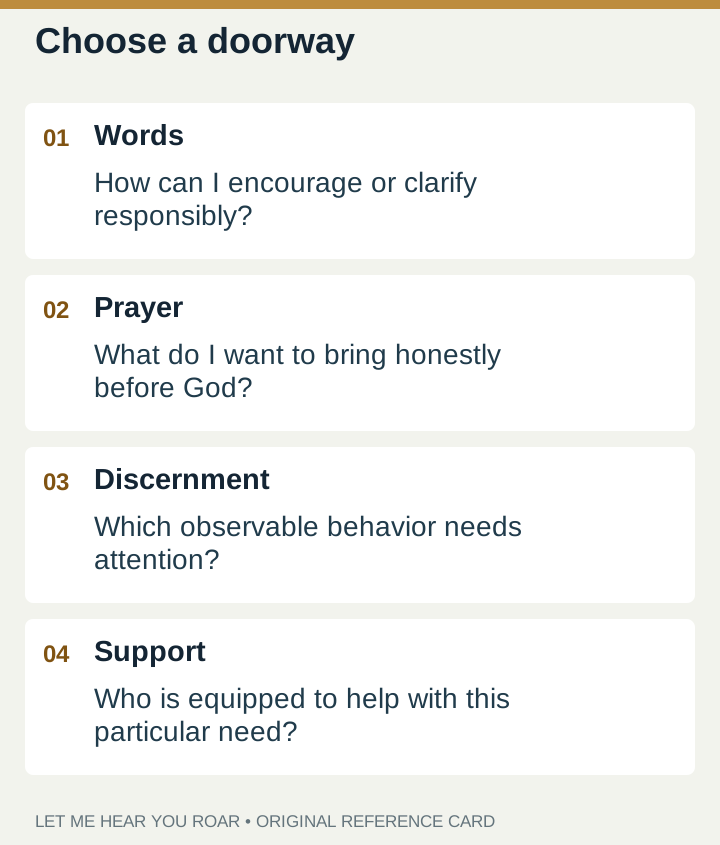
Select the topic closest to your current need: responsible words, the meaning of prayer for voice, space for praise and lament, or discernment without dehumanizing. The four companion articles named above each offer a narrower starting point. Read one rather than treating the whole collection as an assignment you must complete before speaking.
For today, finish this sentence: 'With God's help, I want my next act of courage to serve…' Name something concrete, such as honesty, privacy, a needed question, or repair. Then choose a small action consistent with that purpose. Let the image of the lion encourage you, while allowing Christ's character and the actual words of Scripture to guide the meaning.
Connect the ideas
To carry the animal imagery into daily relationships with care, explore using the lions-and-hyenas metaphor without creating villains.
For everyday application, consider resisting the enemy without treating people as enemies.
What to take with you
- Read Revelation 5 and 1 Peter 5 separately before combining their imagery.
- Devotional metaphors should not become formulas or demands for volume.
- Courage includes careful speech, listening, honest prayer, and practical support.
- Discernment can address wrongdoing while preserving human dignity.
Questions readers ask
Is the true lion and impostor contrast a direct Bible quotation?
No. It is Joshua’s devotional interpretation of two different biblical images. Read the passages themselves before evaluating the application.
Does a quiet prayer show less faith?
This guide does not rank prayer by volume. Silence, writing, speech, and assistive communication can all be chosen forms of devotion.
What if a spiritual exercise leaves me uncomfortable?
You can pause, decline, ask questions, or seek trusted support. A group should explain an exercise and accept a pass without demanding a personal explanation.
Where should a beginner start?
Choose the companion article on speaking life for ordinary sentences, or the prayer definition article if you want a private starting point.
PUT ONE IDEA INTO PRACTICE
Your next step
Choose a Christian reflection that fits your present need.
Explore faith and speaking life ↗Sources & further reading
AI-assisted educational writing based on Joshua’s project direction. How this content is created. Original coaching reflection. Examples are illustrative unless identified as Joshua’s personal story. This article is not a clinical assessment or individualized treatment advice. Research and Scripture are linked for context; no independent clinical review is claimed.

Father, Marine Corps veteran, Christian counselor, coach, and the founder of Let Me Hear You Roar.
Read the story behind the project ↗