
Freezing in a conversation is an everyday description for a moment when you want to respond but cannot readily find words, move the interaction forward, or make a decision. It is not, by itself, a diagnosis. People use the phrase for different experiences, and those experiences may have different causes.
The most useful first distinction is between describing what happened and explaining why it happened. “I could hear the question but could not form an answer” describes an experience. “My body proved that this person is dangerous” makes a conclusion that the moment alone cannot establish. You can take your discomfort seriously without making it explain everything.
The parts of the experience
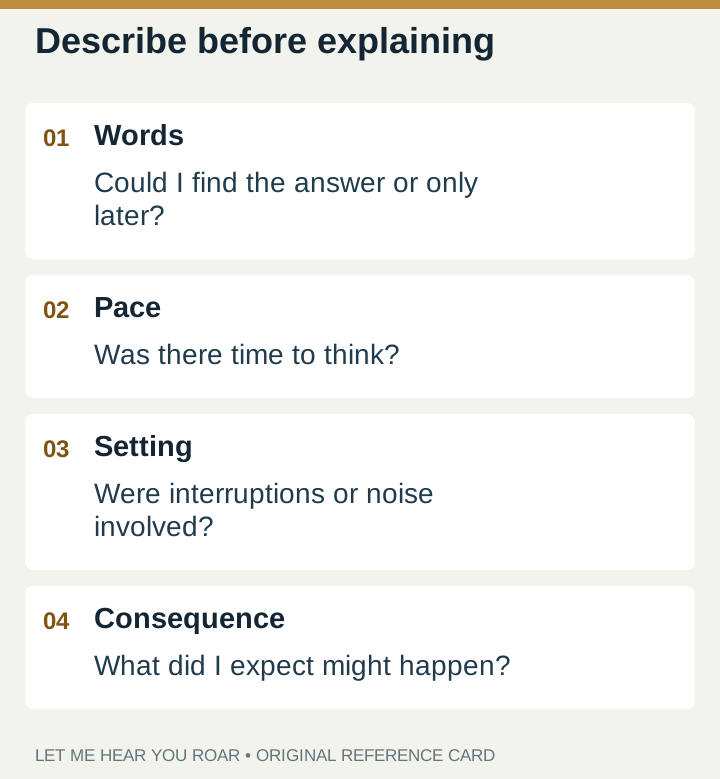
A conversational freeze may involve words, attention, action, or timing. You might know your answer afterward but not during the exchange. You might repeat a polite phrase because you cannot decide what else to say. You might hear the speaker but lose track of the sequence of questions.
Try describing the most concrete part. Did the conversation move too quickly? Were several people talking? Did you worry about consequences? Did a question arrive without warning? These observations can guide a practical adjustment even when the larger explanation remains uncertain.
A description can also include what was available. Perhaps you could type, nod, ask to leave, or respond later. Naming those options prevents the word “freeze” from erasing every form of agency you still had. You are mapping a moment, not defining your entire capacity to communicate.
How trauma may be relevant without becoming the only explanation
The VA explains that trauma can be followed by varied stress reactions, including difficulties with concentration and feeling on guard. That is relevant background for some readers. It does not establish that a particular pause, blank mind, or delayed answer was caused by trauma.
You may also be tired, overloaded, unfamiliar with the topic, speaking another language, or responding to an unequal power relationship. Several factors can coexist. A clinician can help when reactions are persistent or distressing; a blog cannot determine their cause from a familiar-sounding description.
This distinction protects you from two unhelpful extremes. You do not have to dismiss the experience as “just nerves.” You also do not have to label every difficult conversation as evidence of a disorder. Begin with what you know and leave room for an informed assessment when needed.
Examples of what people may mean
In an illustrative workplace example, a manager asks for an immediate decision about a schedule change. The employee cannot organize an answer until after the meeting. A useful adjustment might be receiving options in writing and agreeing on a response deadline.
In an illustrative family example, a person is asked an unexpected personal question at dinner. They do not want to answer but cannot find a polite refusal. A prepared sentence such as, “I am keeping that private,” may give them an option next time, if using it is appropriate in that setting.
In an illustrative friendship example, two people talk over each other during a disagreement. One becomes quiet because there is no space to finish. The issue may require a change in turn-taking, not an exercise in becoming louder. Examples help identify possible adjustments; they cannot diagnose the person experiencing them.
Freezing, choosing silence, and needing time are different
Chosen silence has a purpose you endorse: you may be listening, protecting privacy, or declining an unproductive argument. Needing time means your answer requires more processing or information. A freeze, as used here, involves a mismatch between your wish to respond and your access to a response in that moment.
These experiences can overlap. You may initially go blank and then deliberately choose to continue later. You may need processing time and also fear the listener’s reaction. You do not have to place the entire exchange into one category before asking for an accommodation.
Avoid treating immediate speech as the gold standard. A considered email can be more precise than an instant reply. The practical question is whether you have a workable route to communicate, not whether your timing matches another person’s preference.
Common misconceptions
One misconception is that a blank mind means you had nothing worth saying. Often, the content becomes clearer later. You can preserve that content by writing it down and deciding whether a follow-up would be useful.
Another is that a particular body sensation reveals someone else’s intent. Discomfort is information about your experience; it does not provide a complete account of another person’s motives. Consider observable behavior, context, and support alongside the sensation.
A third is that you must push through to prove progress. A pause can protect the quality of a conversation. If speaking could provoke retaliation or put you in danger, a generic assertiveness script is not a safety plan. Seek support suited to the actual circumstances.
A practical response and a closing definition
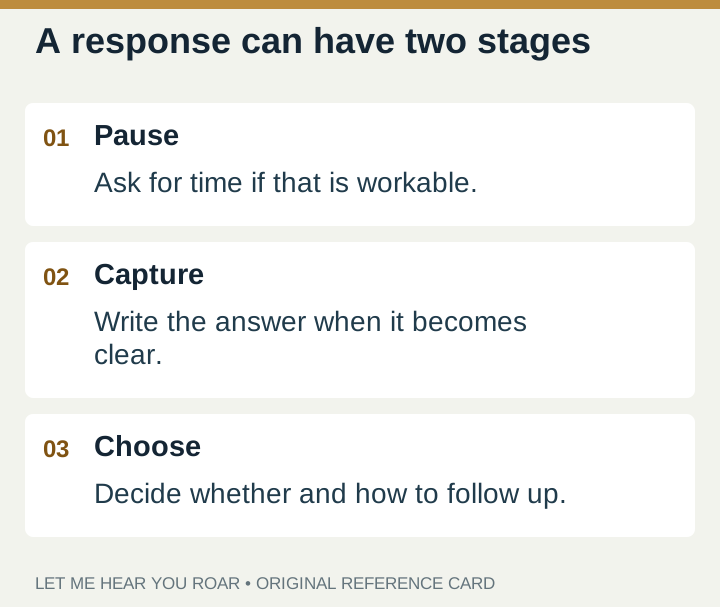
Prepare one pause and one return route. The pause might be, “I need a little time to answer.” The return route might be a message that says, “I have thought about your question; here is my answer.” These are illustrative options, not promises about how a listener will react.
If even that sentence is unavailable, a saved note or an agreed signal with a trusted person may help. Afterward, record what made the exchange difficult and what change might reduce that difficulty next time. Keep the reflection short enough to remain useful.
Freezing in a conversation means experiencing a temporary difficulty accessing the response you want to make. It is a description that invites curiosity, practical adjustments, and sometimes professional assessment. It is not a verdict on your intelligence, honesty, courage, or right to be heard.
Connect the ideas
When going blank comes with throat discomfort, read about a tight throat before speaking and the limits of self-directed practice.
A pause is not a complete personality profile; understanding communication styles can help separate preferences from a difficult moment.
What to take with you
- Describe the moment before assigning a cause.
- Delayed or written communication can be a complete response.
- A pause and a return route offer practical options.
Questions readers ask
Is freezing always a trauma response?
No. The phrase describes an experience, not a confirmed cause. Context and qualified assessment matter.
Can I answer after the conversation ends?
Often you can choose a written or planned follow-up. Consider whether the setting is appropriate and whether a response is actually needed.
PUT ONE IDEA INTO PRACTICE
Your next step
Prepare a pause sentence and a follow-up option.
Explore gentle voice practices ↗Sources & further reading
AI-assisted educational writing based on Joshua’s project direction. How this content is created. Original coaching reflection. Examples are illustrative unless identified as Joshua’s personal story. This article is not a clinical assessment or individualized treatment advice. Research and Scripture are linked for context; no independent clinical review is claimed.

Father, Marine Corps veteran, Christian counselor, coach, and the founder of Let Me Hear You Roar.
Read the story behind the project ↗