
A tight throat before speaking can make an ordinary conversation feel complicated. The first task is not to decide that the sensation means fear, trauma, or an unspoken truth. It is to notice what is happening, avoid forcing your voice, and choose an appropriate next action.
This guide offers a communication plan, not a diagnosis or treatment for throat symptoms. A sensation that occurs around stress can still have other causes. If you are having difficulty breathing, seek urgent medical help; do not work through a blog exercise. For ongoing or concerning symptoms, arrange appropriate clinical assessment.
Before you begin: separate the symptom from the conversation
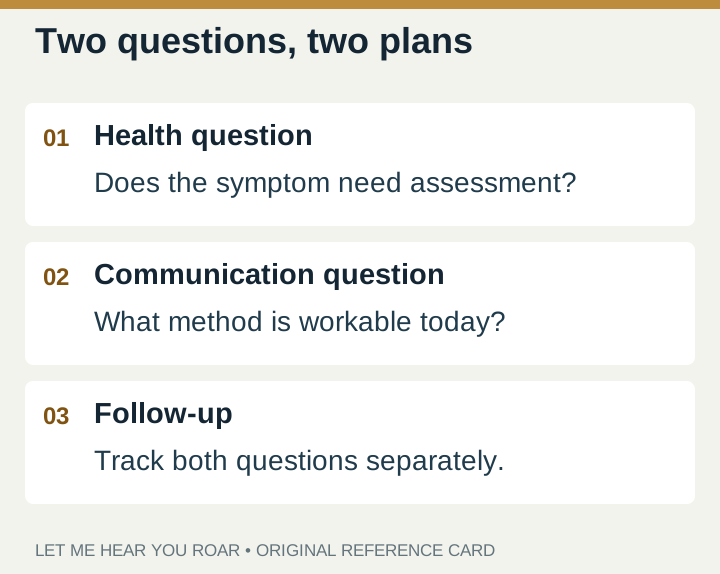
Identify two questions. The health question is, “Does this symptom need assessment?” The communication question is, “How can I handle the conversation today?” You can address both, but a clever script does not answer the health question.
NIDCD advises medical evaluation for persistent hoarseness and for concerns such as pain when speaking or swallowing, trouble swallowing, or difficulty breathing. Sudden voice loss during strenuous voice use also needs prompt medical attention. These are reasons to seek care rather than interpret the problem as an emotional blockage.
For the practical steps below, choose a situation in which you are otherwise well enough to participate and can pause or change methods. Have a way to write or type if speech is uncomfortable. If a clinician has given you individual guidance, follow that guidance instead of an informal online practice.
1. Describe what you notice without diagnosing it
Use plain observations: “My throat feels tight,” “My voice sounds different,” or, “Speaking feels effortful.” Add when it began and what you were doing. You do not need to assign a cause to make the observation useful.
Avoid testing the symptom repeatedly with louder speech, sustained sounds, or repeated throat-focused exercises. The aim is to gather enough information to decide what to do, not to keep provoking the sensation until it explains itself.
If you later speak with a clinician, a brief factual note may help you describe the pattern. Record relevant timing and impact rather than building an elaborate theory. “This began during yesterday’s presentation and is still present today” is clearer than “My body is refusing my truth.”
2. Remove the demand for an immediate spoken answer
Ask whether the conversation has to happen in this form right now. A meeting may allow a written contribution. A friend may be able to wait. A practical decision may need only a short message confirming when you will respond.
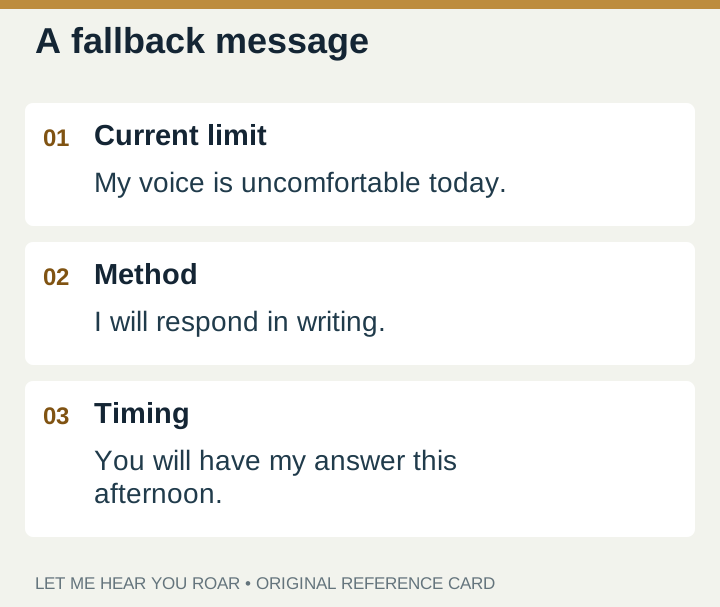
An illustrative sentence is, “My voice is uncomfortable today; I will send my answer in writing.” You can also use that sentence as a written message. You do not owe the listener a speculative explanation about stress or personal history.
If you are unable to change the setting yourself, ask a relevant person for help with the logistics. That might mean a colleague reading your prepared point with permission or a meeting chair accepting a typed question. The goal is to preserve participation without making voice production the only route.
3. Let the breath remain ordinary
If you are breathing comfortably, there is no need to take the largest possible breath before speaking. The NHS advises gentle, unforced breathing in its stress exercise. Here, you may simply leave your breathing alone and focus on the practical choice in front of you.
Do not introduce breath-holding, rapid breathing, or repeated large inhalations as a way to force the throat open. This guide does not prescribe a breathing treatment. If attention to breath makes you uncomfortable, stop focusing on it and use a different communication method.
You might look at your written message or check the agenda instead. These are ordinary ways of directing attention to the task. They do not need to be described as a biological reset to be useful.
4. Reduce the message to its essential job
If speaking is comfortable and appropriate, decide what the listener needs to know first. A short request can reduce the amount of improvisation involved. “Please confirm the deadline” may accomplish more than a long introduction about why the question is difficult.
Write the main sentence and any essential detail. Separate a request from its explanation. You may need both, but you can deliver them in a clear order rather than trying to say everything in one breath.
If speech is painful or strained, use the written version and seek advice about the symptom. Do not use the draft as a reason to push through. Clear communication includes choosing a method that works with your current capacity.
5. Change the environment when that is possible
Consider whether the room or format is making the task harder. Is there background noise? Are people interrupting? Are you trying to answer several questions at once? Those features can be changed independently of any explanation for the throat sensation.
An illustrative request is, “Could we take one question at a time?” Another is, “Can we move this discussion to email?” Choose the adjustment that addresses the actual barrier. You do not need to ask for a general atmosphere of calm when a concrete format change would help.
If the listener refuses a reasonable adjustment, that gives you information about the conversation. It does not prove that your body has failed. You may need another route, a different time, or support from someone responsible for access in that setting.
6. Review the pattern and arrange follow-up
After the interaction, note whether the symptom continued and whether the communication method helped. Keep those observations separate. A successful email does not explain the throat sensation; a persistent sensation does not mean the email was a poor choice.
If symptoms recur or interfere with work, relationships, or daily activities, arrange appropriate assessment. Ask what information would be useful to bring. You can also discuss the stress of the situation with a qualified mental health professional without assuming stress is the only cause.
For a future conversation, keep the adaptation that helped: a written first sentence, a quieter setting, more processing time, or an agreed alternative channel. You do not need to repeat a body-focused exercise to earn access to those supports.
Troubleshooting and a next action
If you keep checking whether your throat feels normal, return to the practical decision: continue comfortably, change method, stop, or seek care. If a facilitator insists the sensation means you must express a hidden emotion, ask them to separate their interpretation from an established clinical assessment.
If you worry that writing will look unprofessional, focus the message on the task and timing. “I will send the decision by three” gives the other person actionable information. A concise accommodation can be more useful than an elaborate apology.
Prepare one written fallback now for a conversation you may need to have. Keep it simple and specific. Then decide whether the symptom itself needs professional attention. Your health and your ability to participate both deserve consideration.
Connect the ideas
A practical companion is how to protect your voice, especially when you are tempted to push through discomfort.
If the conversation is a workplace meeting, finding your voice at work can help you plan the request as well as the setting.
What to take with you
- A throat sensation does not reveal its own cause.
- Separate medical assessment from the communication plan.
- Writing, timing changes, and clearer turn-taking can preserve participation.
Questions readers ask
Is a tight throat always caused by stress?
No. Do not assume a cause from timing alone. Persistent or concerning symptoms need appropriate assessment.
Should I hum to make the tightness go away?
Do not use sound to push through discomfort. This guide does not prescribe a vocal treatment; ask a qualified clinician about symptoms.
What can I say if I need to stop speaking?
An illustrative option is, “My voice is uncomfortable; I will continue in writing.” Adapt it to your circumstances.
PUT ONE IDEA INTO PRACTICE
Your next step
Review care options and prepare a written fallback for one conversation.
Understand care and coaching options ↗Sources & further reading
AI-assisted educational writing based on Joshua’s project direction. How this content is created. Original coaching reflection. Examples are illustrative unless identified as Joshua’s personal story. This article is not a clinical assessment or individualized treatment advice. Research and Scripture are linked for context; no independent clinical review is claimed.

Father, Marine Corps veteran, Christian counselor, coach, and the founder of Let Me Hear You Roar.
Read the story behind the project ↗