
Reclaiming your voice after a broken relationship can begin with decisions that have nothing to do with contacting the other person. You might choose how to spend an evening, ask a friend for a different kind of support, or stop rehearsing explanations nobody has requested. The aim is to make current choices more deliberate.
This process is for everyday communication, not for resolving abuse, legal disputes, or immediate danger. If threats, coercion, or stalking are involved, seek specialist support before acting on a generic script. You do not need a final confrontation to earn the right to move forward.
Before you begin: choose a manageable setting
You will need a little private time and somewhere to write or record a few thoughts. Choose a current, modest communication goal. Avoid starting with the most painful unresolved question about the relationship. A practical request in a supportive friendship may be a more useful beginning.
Decide what you will do if the exercise becomes too much. You could put the note away, return to an ordinary activity, or speak with a trusted support person. There is no reward for completing every step in one sitting. You may use only the part that fits today.
If you are working with a therapist, these notes can become a topic to discuss rather than a self-directed assignment. If you are seeking coaching, describe the practical goal clearly so the work stays within the coach’s appropriate scope.
1. Separate the old rule from the present situation
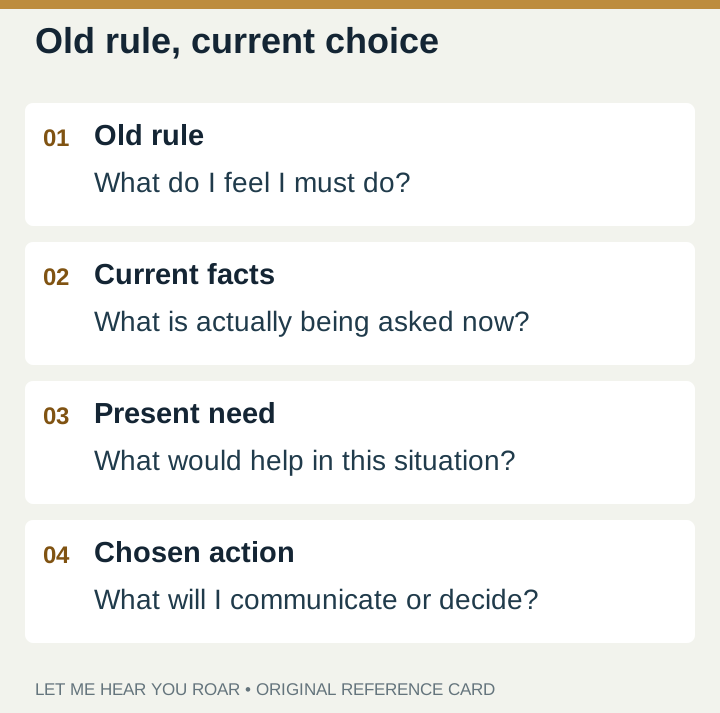
Write one rule you may still be following. Illustrative examples include, “I must answer immediately,” “A disagreement means the relationship will end,” or, “I need a long explanation before I can decline.” Treat the sentence as a working observation, not a diagnosis or a universal truth.
Then write what is happening in the current situation. Who is involved? What have they actually asked? What agreement exists? What evidence do you have about how they respond to differences? This second description helps distinguish a familiar expectation from present facts.
You do not have to prove that the old rule is completely false. It may have reflected a real pattern in the former relationship. The question is whether it should govern this particular interaction with this particular person now.
2. Name one present need in ordinary language
Choose a need connected to the event in front of you. “I need a day to decide,” “I want advice only after I ask,” or, “I would like to make my own weekend plan” is specific enough to work with. “I need to become independent forever” is too large for one conversation.
If you have several needs, choose the one that changes the next action. For example, you may want both reassurance and privacy. If a friend is asking for details you do not want to share, privacy may be the first communication task. Reassurance can be sought separately.
Keep your explanation proportional. A current need does not require a complete relationship history. You can say what helps without proving why you deserve it. Sharing context is an option, not an entrance fee.
3. Select a person and a communication channel
Choose someone whose actual behavior gives you a reasonable basis for the conversation. A person who listens to small preferences without ridicule may be a useful starting point. Being related to you or knowing your former partner does not automatically make someone the best confidant.
Decide whether speaking, writing, or a planned conversation fits the task. A written message may help when you want to edit your words. A scheduled call may help when text tends to create confusion. You can ask a supportive person to read a draft without asking them to send it for you.
The VA’s coping guidance encourages careful selection of support people and clear requests for what you need. Here, that becomes a practical preparation question: what exactly are you asking this listener to do? Listening, offering options, and helping with logistics are different tasks.
4. Draft a request with a clear endpoint
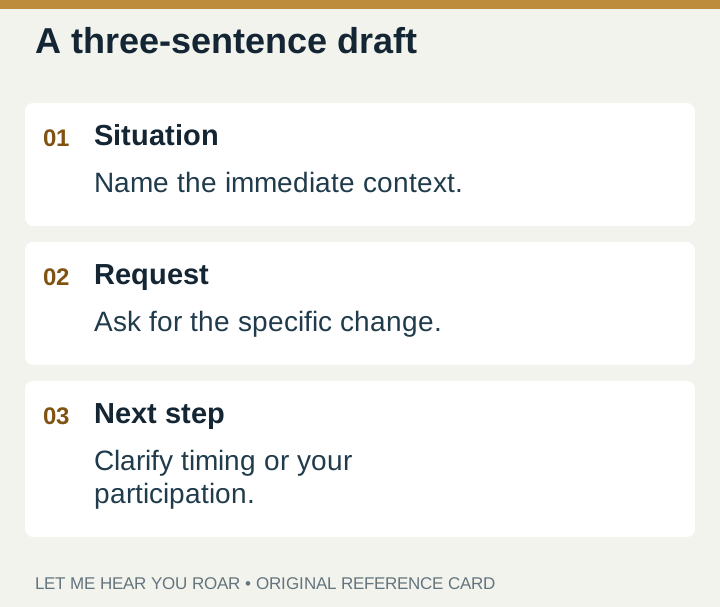
Use a short structure: name the situation, make the request, and state the next step if needed. An illustrative example is, “I am deciding how to spend the holiday. Please give me until Friday. I will let you know then.” This says enough for the listener to understand the action.
Read the draft once for unnecessary defenses. You may keep warmth and courtesy while removing a paragraph that argues against every possible objection. A request does not become stronger merely because it anticipates every criticism.
Prepare an ending too. “That is my decision for this week,” or, “I am going to leave this conversation here,” may fit some situations. These scripts are not guaranteed to be safe. If ending an exchange could bring retaliation, seek advice that accounts for your circumstances.
5. Use the message, or choose a smaller alternative
If the setting is appropriate, communicate the request in the method you selected. You do not have to sound completely certain. A careful sentence can still convey a real decision. If you lose your words, use the draft or arrange to respond later.
If sending feels too large today, choose a smaller action with a clear purpose. You could read the sentence privately, ask a trusted person whether the request is understandable, or save it for a planned conversation. Rehearsal should serve a decision, not become endless polishing.
You may also decide the request is unnecessary. Perhaps you were preparing to explain a choice that is entirely yours to make. In that case, making the choice privately may be the relevant action. Reclaiming voice includes recognizing when no announcement is required.
6. Review without reopening the whole relationship
Afterward, write what happened in simple terms. Did you communicate the need? Did the listener understand? Is any practical follow-up required? Avoid using one exchange to decide whether you are fully healed or permanently unable to trust.
If the listener declined, separate the refusal from disrespect. A person can be unable to meet a request and still treat you considerately. Conversely, agreeing while mocking you is not the same as respectful support. Both the outcome and the manner of response matter.
If guilt arrives, give it some time before changing your decision. You can reconsider a choice based on new information. You do not have to reverse it solely because making a choice feels unfamiliar.
Troubleshooting and your next action
If every message becomes a long defense, try limiting the draft to the action the listener needs to understand. If you keep asking several people whether your preference is acceptable, choose one trusted source of perspective and then return to your own decision.
If the exercise brings persistent distress or repeatedly disrupts daily life, seek qualified mental health support. A broken relationship can involve grief, practical losses, and trauma-related concerns; no single communication method addresses all of them.
For today, choose one current need and write a message of no more than three sentences. You may keep it, revise it, or use it. The useful outcome is a clearer choice about your present life, not a perfect account of the past.
Connect the ideas
For a conversation that needs a clear limit, adapt one of these scripts for saying no to your own circumstances.
Rebuilding connection can also mean finding your people without losing yourself, rather than returning to familiar expectations.
What to take with you
- Work with a current need rather than a final confrontation.
- Distinguish old expectations from present observations.
- A short request can carry warmth without a long defense.
Questions readers ask
Do I need closure from my former partner first?
This process does not depend on contacting them. You can make current decisions and seek support without a final conversation.
What if my request is refused?
Consider both the practical answer and the way you were treated. A refusal may call for another plan; disrespect may call for a different audience.
Can I use writing instead of speaking?
Yes. Writing may be the most workable final form of communication for the task.
PUT ONE IDEA INTO PRACTICE
Your next step
Clarify one present communication goal with appropriate support.
Explore coaching with Joshua ↗Sources & further reading
AI-assisted educational writing based on Joshua’s project direction. How this content is created. Original coaching reflection. Examples are illustrative unless identified as Joshua’s personal story. This article is not a clinical assessment or individualized treatment advice. Research and Scripture are linked for context; no independent clinical review is claimed.

Father, Marine Corps veteran, Christian counselor, coach, and the founder of Let Me Hear You Roar.
Read the story behind the project ↗