
Finding your voice after trauma means developing more choice about what you communicate, how you communicate it, and who receives it. It does not require a loud voice, a public testimony, or a detailed account of painful events. A written preference, a signed request, and a decision to keep something private can all express a voice.
This guide offers everyday communication practice, not a trauma treatment. You can start with something ordinary: asking for a different appointment time, choosing a quieter seat, or saying that you need to think. The first useful question is not how fearless you can become. It is which small choice you would like to make available.
Why a small beginning matters
A person may know exactly what they think and still struggle to say it in a particular relationship. Someone else may have spent so long accommodating other people that noticing a preference takes time. Neither situation is solved by demanding a more confident performance. Begin with the task you actually have: finding words, selecting a setting, or deciding whether communication is appropriate at all.
The VA describes a range of emotional and physical reactions after trauma and emphasizes that these reactions are not weakness. A difficult speaking moment alone does not establish a diagnosis. This guide therefore avoids interpreting every silence as a symptom or every successful conversation as recovery.
Try choosing a goal that belongs to your daily life. “I want to ask for time before agreeing” gives you something specific to rehearse. “I must never feel afraid again” sets a standard no conversation can reliably deliver. Small goals make it easier to distinguish a useful adjustment from a disappointing but ordinary interaction.
Notice a preference before explaining it
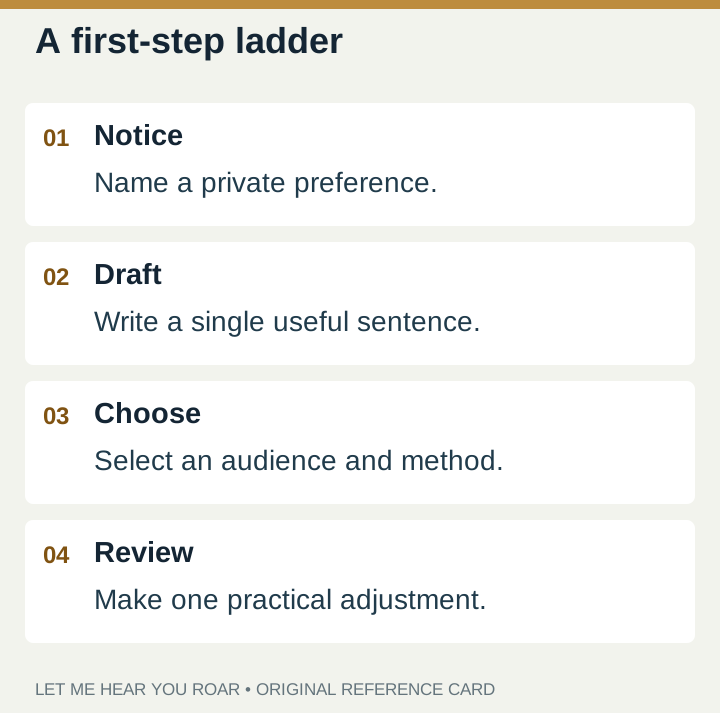
Take a neutral decision you expect to make today. Would you prefer tea or water, a phone call or a message, company or an hour alone? Write the answer without adding an explanation. You are collecting information about yourself; you are not preparing a case for approval.
If nothing comes to mind, compare two concrete options. “Would an earlier appointment or a later appointment work better?” is often easier to answer than “What do I want from my life?” You may also discover that you genuinely have no preference. That is a valid answer when it reflects your choice rather than an automatic obligation to disappear.
Keep the practice private if that is what works today. The ability to recognize a preference and the ability to express it to another person are related tasks, but you can work on them separately. There is no requirement to turn every observation into a conversation.
Choose a sentence you can actually use
Translate one preference into ordinary language. An illustrative sentence might be, “Please send the details in writing,” or, “I can answer tomorrow.” These examples are not guaranteed to be safe or effective in every relationship. Adapt them to the setting, the other person’s behavior, and the consequences of speaking.
Make the sentence shorter than your first draft. If you write, “I am so sorry, and I know you are very busy, and this is probably inconvenient, but perhaps I could think about it,” try, “I need time to think about it.” Courtesy is welcome. Repeated apologies are optional.
Prepare a second version for a moment when speech is difficult. Save the words on your phone, carry a note, or arrange to follow up by email. Your message does not become less meaningful because you use a tool. Communication can be designed around your needs.
Match the audience to the size of the step
Start by thinking about behavior you have actually observed. Who lets you finish a sentence? Who accepts a small difference of opinion? Who respects a request not to share personal information? These observations are more useful than deciding that someone must be trustworthy because of their job, family role, or confident manner.
A low-stakes practice might be asking a considerate friend to choose a quieter café. It need not involve a person who harmed you. If speaking could lead to threats, retaliation, or loss of essential support, do not use this guide as a reason to confront that person. A qualified professional or specialist support service can help you consider your circumstances.
You may choose a listener who can agree to a clear task: “Would you listen for two minutes without giving advice?” That request turns vague support into something observable. If they cannot offer it, you have learned about the fit of that conversation, not the worth of your voice.
Try, pause, and make a practical adjustment
Use the sentence once in an appropriate setting, or rehearse it privately if that is your chosen step. You do not need to repeat it until it sounds polished. Notice whether the wording is clear and whether you have a reasonable way to end the interaction.
Afterward, record three plain facts: what you intended to communicate, what you actually communicated, and what you would change next time. For example: “I asked for the agenda. I received it the morning of the meeting. Next time I will specify the previous day.” This keeps reflection connected to the task rather than turning it into a verdict on your personality.
If you became quiet, your next adjustment might be a shorter sentence or a written message. If the listener argued, your next adjustment might be a different audience. More effort from you is not always the missing ingredient.
Troubleshooting the first attempts
If you feel guilty after stating a preference, leave room for that feeling without immediately withdrawing the request. Ask whether you were unkind or simply unfamiliar with making the request. Those are different questions. You can correct a sharp tone while keeping a reasonable need intact.
If your mind goes blank, use a prepared pause such as, “I want to come back to this.” You do not owe an immediate explanation for needing a moment. If practicing becomes distressing, stop and choose a neutral activity. The exercise is optional; enduring distress is not its purpose.
If difficult reactions are persistent, worsening, or interfering with life, consider qualified mental health support. Coaching may help with a practical communication goal, but it should not be presented as a substitute for assessment or trauma treatment.
Your next small choice
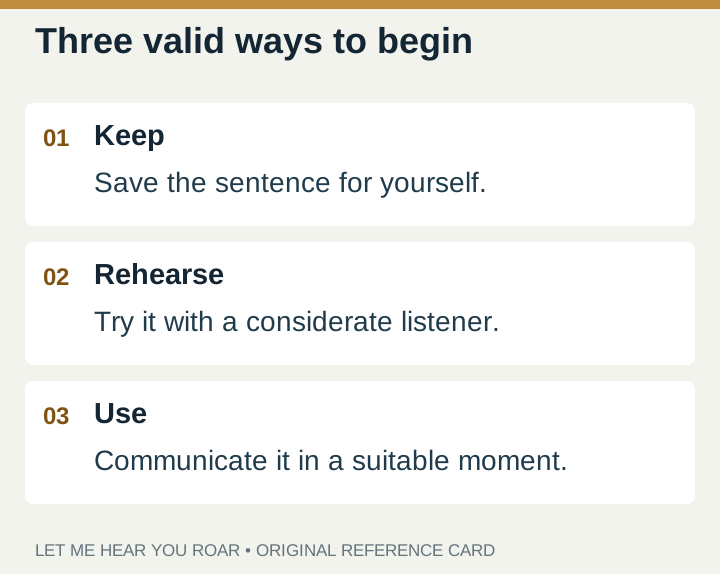
Write one sentence beginning, “I would like…” Keep the subject ordinary and the action specific. Then choose one of three next steps: keep it private, rehearse it with someone considerate, or use it in a suitable conversation. A choice to wait can be deliberate rather than a failure.
The aim is to make your communication more available to you. You do not have to become a different sort of person to begin. Quiet, careful, direct, playful, and written expression all leave room for a voice that belongs to you.
Connect the ideas
A first sentence becomes easier to plan when you have a concrete example of setting a boundary without a speech.
If you are reading alongside someone you trust, share the guide to supporting someone finding their voice so they can follow your pace.
What to take with you
- Start with an ordinary preference rather than a major disclosure.
- Choose a communication method and audience that fit the situation.
- Review the task, not your worth as a person.
Questions readers ask
Do I have to tell my trauma story first?
No. A preference or practical request can be a complete beginning. Disclosure is a separate decision.
Does a shaky voice mean I am not ready?
A shaky voice does not decide readiness. Consider your choice, the setting, and your ability to pause or get support.
PUT ONE IDEA INTO PRACTICE
Your next step
Choose one low-pressure communication practice.
Explore gentle voice practices ↗Sources & further reading
AI-assisted educational writing based on Joshua’s project direction. How this content is created. Original coaching reflection. Examples are illustrative unless identified as Joshua’s personal story. This article is not a clinical assessment or individualized treatment advice. Research and Scripture are linked for context; no independent clinical review is claimed.

Father, Marine Corps veteran, Christian counselor, coach, and the founder of Let Me Hear You Roar.
Read the story behind the project ↗