
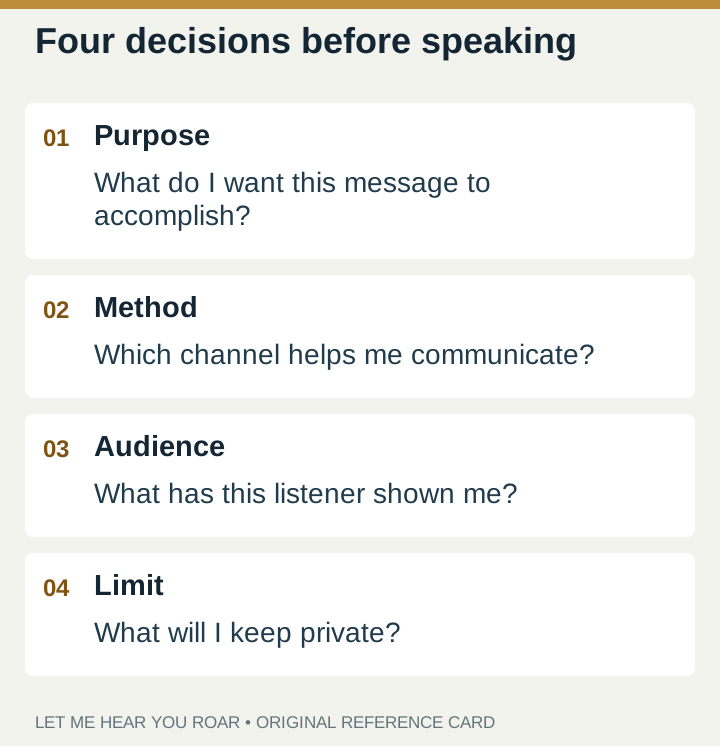
Finding your voice after being silenced is a process of reclaiming decisions about expression. What do you want to say? What do you want to keep private? Which people can hear you with respect? Which method lets you communicate most clearly? These questions allow for speech, writing, signing, assistive communication, and chosen silence.
This guide gathers the practical pieces into one place. It covers ordinary preferences, difficult conversations, relationship changes, personal storytelling, and the difference between communication coaching and clinical care. You can use one section without committing to a complete program. A voice is not an examination you pass once and then possess forever.
What voice means in this guide
Voice includes the content of a message and the conditions under which it is expressed. Someone may speak frequently while rarely saying what they need. Another person may use few spoken words and communicate their decisions very clearly. Counting words or measuring volume misses the point.
Agency is the useful thread: having a meaningful say in whether, when, and how you participate. Agency is never unlimited. Workplaces have procedures, relationships involve negotiation, and some settings are unsafe. The goal is to identify the choices you actually have and strengthen support where your choices are constrained.
Being heard also depends on listeners. You can improve a sentence and still meet dismissal. You can speak respectfully and still be misunderstood. A communication practice should help you express yourself; it should not make you responsible for another person’s willingness to listen.
Expression
Expression is putting a preference, experience, question, or boundary into a form another person can receive. A message can be brief and still be complete.
Privacy
Privacy is deciding what information belongs in this interaction. Keeping details private does not make a practical request dishonest.
Participation
Participation includes asking for conditions that let you contribute: a written agenda, time to think, a quieter space, or a different communication channel.
Why speaking can become complicated
There may be many reasons a person finds a conversation difficult: past experiences, current power differences, language demands, sensory conditions, uncertainty, or a listener who routinely interrupts. Avoid choosing a single explanation before you have examined the actual setting.
The VA notes that trauma reminders can include situations and sensations, and that avoidance can become part of PTSD. That clinical description does not mean every reluctance to speak is PTSD, or that confronting a harmful person is a suitable exercise. Assessing symptoms and planning treatment belong with qualified clinicians.
For everyday reflection, ask three narrower questions. Do I know what I want to communicate? Is this a workable way to communicate it? Is this person likely to respect the message? Each answer points toward a different adjustment. You may need a draft, an accommodation, or a different source of support.
This distinction matters because “be more confident” is too broad to guide action. If the meeting moves faster than you process information, confidence alone will not supply an agenda. If someone punishes disagreement, a stronger speaking voice will not create goodwill. Name the obstacle as specifically as possible.
Build from preferences to requests
Begin where the stakes are manageable. A preference names what suits you: “I would rather meet in the morning.” A request asks another person to do something: “Could we move the meeting to ten?” A boundary states how you will participate: “I am not available for evening calls.” These are related but distinct forms of communication.
Separating them can prevent confusion. You may share a preference without expecting an immediate change. You may make a request that another person is free to decline. You may decide what you will do if a boundary cannot be respected. The wording should match the actual decision you are making.
For practice, take one event from the coming week. Write your preference first, then decide whether a request is necessary. If the issue requires a boundary, describe your own participation rather than trying to control another person’s feelings. “I will discuss this when we can take turns” is different from demanding that someone never become frustrated.
These are illustrative scripts, not guarantees of safety. In a coercive or threatening setting, seek situation-specific support instead of using a communication formula as a confrontation plan. Your circumstances matter more than the elegance of the sentence.
Choose methods that reduce unnecessary work
Spoken conversation is only one channel. Writing can let you organize a message without interruption. A short voice note may communicate tone when typing is difficult. Signing or an assistive device may be your primary language of expression. A support person may help you prepare or participate with your permission.
Choose the method according to the job. If you need a record of an agreement, a written follow-up may help. If a topic contains several moving parts, a brief agenda can keep the conversation focused. If the relationship is important and misunderstandings multiply by text, a planned conversation may fit better, provided it is appropriate for you.
Think about access as part of communication, not an apology attached to it. “Please send the questions beforehand” tells the listener what would help. “I may answer in writing afterward” sets an expectation. You do not have to disclose a diagnosis or painful history merely to explain an ordinary preference.
For a first step, remove one avoidable demand. You might stop trying to maintain eye contact while finding words, allow yourself notes, or request a little more time. The aim is to make your message easier to deliver without requiring a performance of confidence.
Understand the listener’s part
A suitable listener does not have to agree with every conclusion. They do need to respect your ability to finish, to correct your meaning, and to decline unnecessary disclosure. Someone can ask a clarifying question without turning the conversation into an interrogation.
Observe small interactions before choosing a major disclosure. Does the person gossip about other people’s private information? Can they hear “no” without punishment? Do they make room for your words, or immediately replace them with their own story? These observations offer practical information about what this audience can hold.
You can also state the kind of listening you want. “I would like help deciding what to ask for” differs from “I would like you to hear this without solving it.” A listener cannot always provide what you request, but asking helps reveal the fit.
If someone responds poorly, separate their response from your right to communicate. You may still revise the timing or wording. You may also decide the audience was unsuitable. Reflection should leave room for both possibilities rather than assuming you caused every difficult outcome.
When relationships have changed
After a broken relationship, familiar roles may continue to shape your expectations. You might find yourself preparing a defense before a new person has questioned you, or agreeing to arrangements you no longer want. Notice the pattern without treating it as a permanent identity.
Choose one current relationship and one current decision. Ask what is happening here, now. What has this person actually done? What agreement exists? What do you want to request? Keeping the question specific can stop an entire relationship history from becoming the subject of every conversation.
You do not need to reconcile, forgive on demand, or contact a former partner to practice communication. A new routine, a private journal entry, or a practical conversation with a supportive person may be the more relevant next step. Where abuse, threats, or stalking are concerns, specialist support is more appropriate than a generic script.
It is also reasonable to grieve a relationship while recognizing that its communication patterns were harmful. You do not have to settle every emotional question before deciding how you want to be treated today.
Tell your story at the level you choose
Personal stories have layers. One layer might be a simple fact: “I had a difficult experience.” Another might name its effect: “I need more time with this topic.” A deeper layer might include details reserved for a trusted professional or a chosen confidant. You can select the layer that serves the present purpose.
Before sharing, ask why you want this person to know. Seeking practical support calls for different information from creating a public testimony. A social media audience does not offer the same boundaries as a private conversation. Even a caring listener may not understand that you expect information to remain private unless you discuss it.
Prepare an ending as carefully as an opening. “That is all I want to share today” is a complete ending. So is, “I am not taking questions about the details.” You may change your mind during a conversation. An earlier willingness to speak is not a promise to continue indefinitely.
If Christian faith is part of your life, prayer may accompany this decision. It need not require a dramatic testimony or public disclosure. A private prayer for discernment can sit alongside practical planning and professional care.
What progress can look like
Progress may mean recognizing a preference sooner, asking for a pause, choosing a different audience, or ending an unproductive exchange. None of those requires feeling completely calm. Avoid measuring your week by whether you sounded impressive.
Use a short review with three columns: intention, action, adjustment. For an illustrative example, the intention might be to request clearer project priorities. The action might be sending two questions before a meeting. The adjustment might be asking which task can move when a new task is added. This produces a next step instead of a personality score.
Leave ordinary life outside the review. You do not need to analyze every conversation, meal choice, or silence. Practice should serve your life rather than turning your life into continuous homework. Choose a small number of moments that matter to you.
When a step becomes too demanding, reduce its size or change the method. A private draft may be useful preparation. A written response may be the final form, not merely a stepping stone toward speech. The measure is whether the approach helps you communicate what matters.
Know which kind of support you are seeking
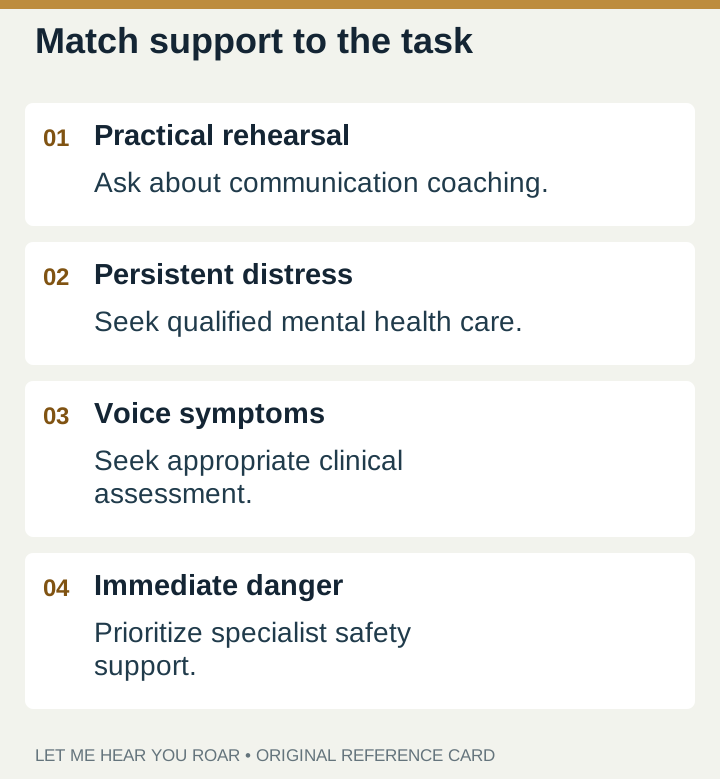
A coach may help you rehearse a presentation, clarify a practical goal, or prepare a boundary statement. A qualified mental health clinician can assess persistent distress and discuss treatment. A speech-language pathologist or relevant medical professional may help with a voice or communication condition. These roles can complement each other when their limits are clear.
The VA identifies trauma-focused psychotherapies as the treatments with the strongest support for PTSD and describes approaches such as Prolonged Exposure. An informal speaking exercise is not the same as a structured clinical treatment, even when both involve words about a difficult experience.
Ask a potential helper about qualifications, confidentiality, fees, scope, and how they respond if you become overwhelmed. A clear answer should help you understand what the service does and does not offer. You should not have to accept a promise of transformation to obtain practical support.
If your immediate environment is dangerous, prioritize appropriate safety support. If voice symptoms are persistent, seek medical assessment rather than assuming they express an emotional blockage. Different problems deserve different forms of attention.
Continue with the question that fits today
For a first practical step, read “Finding Your Voice After Trauma: A Beginner’s Guide to Small Choices.” For a moment when words disappear, explore “What Does Freezing in a Conversation Mean?” For a changed relationship, use “How to Reclaim Your Voice After a Broken Relationship.” For decisions about disclosure, read “7 Ways to Tell Your Story Without Sharing More Than You Want.” Together, these companion articles turn the broad idea of voice into specific choices.
Choose one question to carry into the next week: What do I want to say? Which method will help? Who can receive it? What will remain private? You do not need to answer all four at once. A deliberate answer to one can be enough to make the next conversation more your own.
Connect the ideas
If fear of disappointing people keeps shaping your choices, explore the connection between people-pleasing and boundaries.
For readers whose needs include processing time or a different communication format, the guide to neurodivergence and communication offers another route into expression.
What to take with you
- Voice includes expression, privacy, and meaningful participation.
- Match the communication method to the task and the audience.
- Support should fit the actual problem, with clear professional boundaries.
Questions readers ask
Can choosing silence be part of finding my voice?
Yes, when silence is a choice you want to make. If you feel unable to communicate what matters, support can help you explore more options.
Should I practice with the person who silenced me?
There is no such requirement. A considerate person, private rehearsal, or qualified helper may be a more appropriate starting point.
Is this guide a PTSD treatment?
No. It offers practical communication reflection. Clinical assessment and treatment require qualified care.
PUT ONE IDEA INTO PRACTICE
Your next step
Identify the communication goal that matters most to you.
Take the private voice reflection ↗Sources & further reading
AI-assisted educational writing based on Joshua’s project direction. How this content is created. Original coaching reflection. Examples are illustrative unless identified as Joshua’s personal story. This article is not a clinical assessment or individualized treatment advice. Research and Scripture are linked for context; no independent clinical review is claimed.

Father, Marine Corps veteran, Christian counselor, coach, and the founder of Let Me Hear You Roar.
Read the story behind the project ↗