
A boundary is a limit on your participation, availability, privacy, or access to something you are responsible for. Speaking up means making that limit understandable. It does not require a forceful personality, a perfect explanation, or agreement from everyone involved.
For a first attempt, choose a modest situation where the likely consequence is ordinary disappointment rather than danger. This guide offers a way to prepare one clear sentence, decide what you can actually do, and learn from the result. Every script is an illustrative coaching example, not a guarantee of a safe response.
Why a shorter boundary can help
Long explanations sometimes bury the actual message. A person may hear five reasons you are tired and conclude that you are still considering the invitation. “I’m not available on Saturday” is easier to understand. You can add warmth without making your decision sound unfinished: “Thank you for including me. I’m not available on Saturday.”
Clarity is useful to both people. You have less material to defend, and the other person has a definite answer with which to plan. This does not mean explanations are always wrong. In a shared household, a team, or a close relationship, relevant context can help people coordinate. The aim is enough information for the situation, rather than a performance that earns permission to have a limit.
Start by noticing the difference between a preference and a boundary. You might prefer that friends never arrive late, but you cannot arrange their behavior by wishing harder. You can say how long you can wait and what you will do afterward. Your sentence should make your available choice visible.
Check the situation before choosing the sentence
Ask who is involved, what power they hold, and what has happened when you have disagreed before. A conversation with a considerate friend differs from one with someone who threatens, monitors, or controls you. A useful practice situation leaves room for you to say no without risking basic safety.
The National Domestic Violence Hotline describes safety planning as individualized practical preparation during abuse, when preparing to leave, and after leaving. If intimidation or violence is present, seek specialist support for your situation instead of treating confrontation as a courage exercise. Internet use may be monitored; consider how you can access help safely.
You can also postpone an ordinary conversation because you are exhausted, rushed, or unsure what you need. “I need to check before I answer” is a complete first step. A delay works best when you name when you will respond, if you can realistically commit to that time.
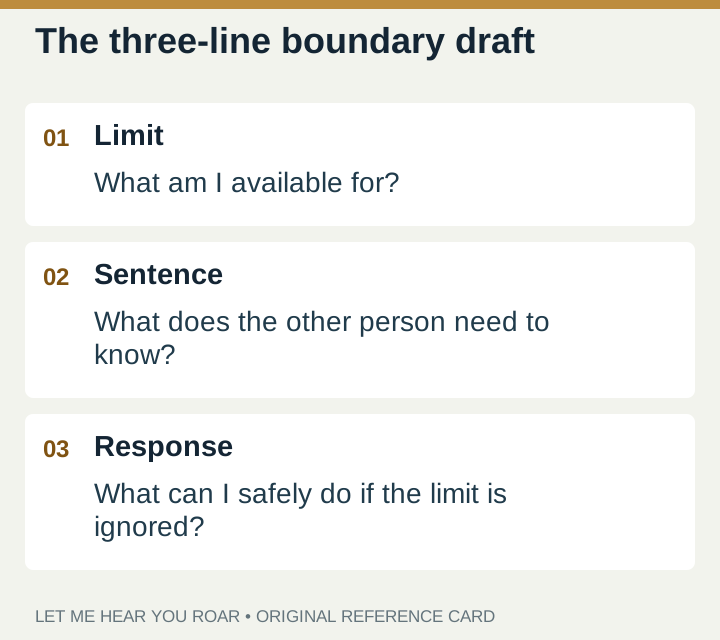
Build a sentence from the actual limit
Complete this private sentence first: “The thing I am not available for is…” Be concrete. “Being treated badly” may describe your frustration, but “discussing this while being called names” identifies what needs to change. “Doing everything” may become “taking responsibility for another event this month.”
Next, remove the accusation and keep the practical information. An illustrative version is: “I can help for an hour, but I cannot organize the event.” Another is: “I’m keeping the details of that experience private.” Neither asks the listener to agree with your entire interpretation of the relationship.
If a response is necessary, choose one that is yours to make and proportionate to the situation. “If we start insulting each other, I will pause this discussion” describes participation. “If you disagree, I will make everyone turn against you” threatens punishment. A boundary should not become a respectable label for coercion.
Finally, check whether the sentence is true. Do not promise to leave a room when you cannot safely leave, or offer an hour when you have no hour available. A smaller honest limit is more useful than a dramatic statement that you do not have the resources to carry out.
Rehearse without turning it into a performance
Write the sentence as you would naturally say it. Read it silently, then decide whether saying it aloud would help. Ordinary volume is enough. You do not need a powerful voice or special posture to make the words valid. If speaking is difficult, consider a message or a note, provided the medium fits the situation and your privacy needs.
Try two versions: one for opening the conversation and one for repetition. Your opening might be, “I can attend the first half, then I need to leave.” Your repeat might be, “Yes, I understand the timing is inconvenient; I still need to leave at three.” Having a repeat ready can stop you from creating new explanations each time someone asks.
A rehearsal partner should agree to the exercise and keep it within an ordinary level of pushback. Ask them to respond once with disappointment, then stop and discuss the wording. The aim is familiarity. You are not asking someone to recreate intimidating behavior so you can prove your strength.
Apply the limit in one realistic conversation
Illustrative example: a relative asks you to take on a last-minute task while you already have plans. Your draft is, “I’ve been doing too much for everyone, and no one seems to notice.” That may express a real feeling, but it leaves the immediate task unresolved. Your revised sentence is, “I cannot do that tomorrow. Please arrange another option.”
The relative says, “But it will only take a little while.” You do not need to establish the exact number of minutes. You can reply, “I understand. I’m still unavailable.” If you want to offer another option, offer only something you freely choose: “I can send you the number for the service we used.” An alternative is optional, not a fee you must pay for saying no.
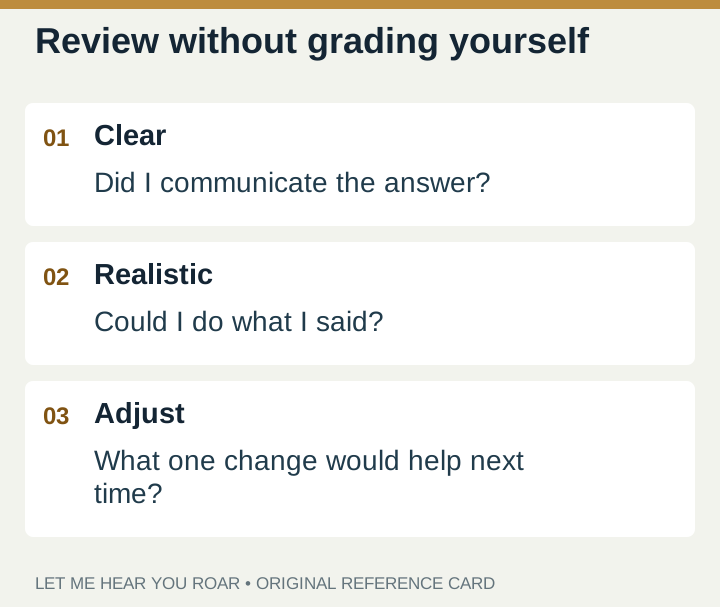
Afterward, observe behavior rather than searching for a perfect feeling. Was your answer clear? Did you change it because new information mattered, or because the silence felt uncomfortable? Either answer can teach you something. You can revise your method without condemning yourself.
Troubleshoot the common sticking points
If you apologize repeatedly, keep one courteous opening and remove the rest. “Sorry, I can’t make it” may fit your voice. Four apologies can make a finished decision sound negotiable. If you explain too much, underline the actual answer and say that part first.
If the other person is disappointed, give that feeling room without automatically undoing the limit. “I know you hoped I could help” acknowledges the situation. It does not commit you to helping. If you discover that you misunderstood the request, changing your decision is also allowed; consistency does not require ignoring relevant facts.
If you did not speak, choose a smaller opportunity next time. You could practice asking for ten minutes to think, declining an optional activity, or requesting written details. Progress is not measured by the intensity of the confrontation you can withstand.
Your next action: make one sentence usable
Choose one low-risk situation that is likely to occur this week. Write your opening, your repeat, and the action you can realistically take. Keep the wording somewhere private and accessible. After the conversation, write a single sentence about what helped and one adjustment for next time.
If you cannot identify a low-risk situation, begin with private reflection or supportive coaching rather than forcing a live experiment. The first useful boundary may be giving yourself time to decide what you want to say.
Connect the ideas
When you want examples to rehearse, choose from these scripts for difficult conversations.
If your words disappear under pressure, the discussion of freezing during a conversation may help you plan a pause or a written alternative.
What to take with you
- Name a concrete limit before explaining it.
- Choose actions you can realistically control.
- Disappointment does not automatically require a changed answer.
Questions readers ask
Does a boundary always need a consequence?
No. A clear statement of availability or privacy may be enough. If you describe a response, keep it realistic, proportionate, and within your control.
Can I set a boundary by text?
Yes, when that medium suits the situation. Consider privacy, the chance of misunderstanding, and whether a written record could create risk.
PUT ONE IDEA INTO PRACTICE
Your next step
Prepare one short boundary in the practice space.
Explore gentle voice practices ↗Sources & further reading
AI-assisted educational writing based on Joshua’s project direction. How this content is created. Original coaching reflection. Examples are illustrative unless identified as Joshua’s personal story. This article is not a clinical assessment or individualized treatment advice. Research and Scripture are linked for context; no independent clinical review is claimed.

Father, Marine Corps veteran, Christian counselor, coach, and the founder of Let Me Hear You Roar.
Read the story behind the project ↗