
Speaking life means using words in ways that honor God and the dignity of people: encouraging honestly, naming harm clearly, asking for help, and refusing cruelty. In this guide, it is a Christian practice of responsible communication, not a method for controlling events through the right declaration.
You can begin without becoming a confident public speaker. A private prayer, a carefully written message, or a short request may be enough for today. The question is what your words serve, rather than how impressive they sound.
Begin with Scripture in its setting
Proverbs 18:21 connects the tongue with life and death. James 3 describes the outsized consequences of speech and the contradiction of praising God while cursing people made in God's likeness. Together, these passages invite careful responsibility; neither offers a volume-based technique for preventing suffering.
Our devotional application is simple: pause long enough to ask what a sentence may do to the person who receives it. Will it offer truthful support? Will it pass along something private? Will it make a need easier to understand? This is a question about stewardship, not a demand that you predict every consequence or avoid every mistake.
It is possible to care deeply about Scripture and still need help interpreting a passage. Read a whole paragraph or chapter, notice who is addressed, and distinguish an observation from your application. If a teacher's claim sounds much larger than the passage, you are allowed to ask how that conclusion was reached.
Why the practice matters in ordinary conversations
Many important conversations do not announce themselves as spiritual moments. A child makes an error, a friend cancels plans, a colleague offers an idea, or someone tells you they are exhausted. Your response can make room for a person to be honest, or make honesty feel costly. Speaking life belongs in these small exchanges as much as in a church service.
Consider this illustrative exchange. A friend says, 'I cannot do everything I agreed to this week.' A quick answer might be, 'Just declare strength and keep going.' A more useful response could be, 'Which commitment needs attention first, and would practical help make a difference?' The second response does not dismiss faith. It connects concern with a situation the friend can actually describe.
Encouragement is most credible when it is specific. Instead of praising someone as endlessly strong, notice a real choice: 'You asked for clarification even though the meeting was difficult.' Specificity leaves space for the person to have limitations. It does not assign them a role they must keep performing to receive your affection.
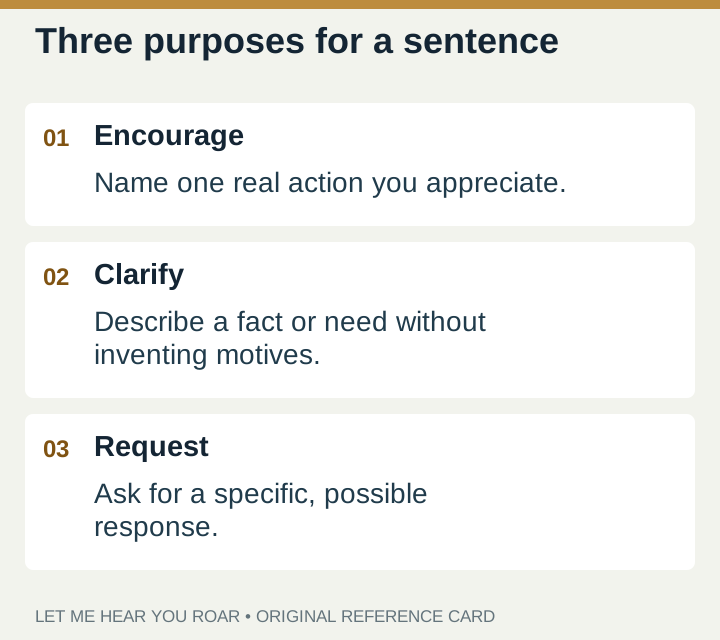
Learn three kinds of life-giving speech
First, encouragement names something good without making a promise you cannot keep. 'I appreciate how carefully you listened' is different from 'Nothing bad will happen now.' You can express hope for an outcome while admitting that you do not know what will happen. Honesty makes encouragement more trustworthy.
Second, truth-telling brings an important reality into view. 'That joke hurt me' or 'I need this decision in writing' can serve dignity. These sentences may feel less uplifting than a compliment, but they can make a conversation more accountable. A pleasant tone is not the only measure of whether words are good.
Third, a request invites an actionable response. 'Could you listen for five minutes before offering advice?' gives the other person a clear task. The request can be declined or negotiated; it does not guarantee cooperation. These are illustrative scripts to adapt, not promises that a difficult relationship will become safe if you phrase everything correctly.
A small practice you can use today
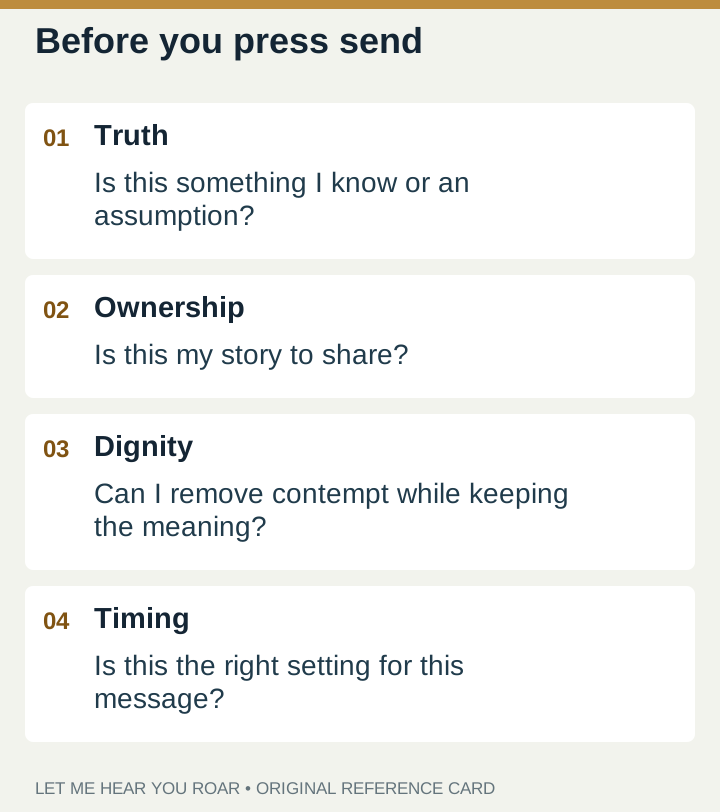
Choose one low-stakes conversation. Write what you want to communicate in a single sentence, then underline the part that contains your actual meaning. If most of the sentence apologizes for existing, try a shorter version. You may still be polite: 'Thank you for asking; I am not available this time.' There is no need to rehearse your most painful conversation first.
Next, ask whether the sentence is yours to say. You can describe your own experience and choices. Someone else's private story may require permission. You can express concern about a behavior without diagnosing a person's character, motives, or spiritual condition. Keep the message close to what you actually know.
Finally, choose a form that fits. Writing may help when you want to consider your words. Speaking may fit a simple clarification. A trusted person may help communicate if that is what you prefer. Faithfulness is not measured by spontaneous verbal fluency, and a communication aid does not make a message less personal.
Applying the idea when truth is uncomfortable
Suppose you have agreed to volunteer again, but you cannot manage the commitment. An illustrative sentence is, 'I need to step back from the next two events; please arrange another person.' You need not present exhaustion as a spiritual failure. If you want to offer a smaller contribution, decide what you can realistically do before promising it.
Or suppose someone makes a dismissive remark during a discussion. You might ask, 'Could we discuss the idea without commenting on the person?' That invitation names a behavior and a preferred direction. If the setting is threatening or the person uses intimidation, choosing support or leaving the discussion may be wiser than making a public correction.
Troubleshooting without condemning yourself
If you cannot find words, begin with a note that says only what kind of conversation you need. 'There is something important I would like to discuss, but I need time to write it.' This can be a complete first step. You do not owe a polished explanation on demand.
If your words were unkind, a concrete repair is more helpful than spiritual language that evades responsibility. Try, 'I mocked your question. That was wrong, and I am sorry.' Then leave room for the person's response. They do not have to reassure you or immediately resume the discussion. An apology starts a repair; it does not purchase forgiveness.
If nothing seems to change, review the goal. You can become clearer without controlling another person's response. A person continuing to dismiss you does not prove that you failed to speak with enough faith. It may tell you that the relationship needs limits, outside support, or a different way of communicating.
Your next step: choose one useful sentence
Complete this prompt privately: 'A truthful, caring sentence I want available this week is…' Keep it short enough to remember and change it until it sounds like you. You may pray, 'Lord Jesus, help me use these words with care and courage.' This is an original prayer invitation, not a biblical quotation.
After the conversation, reflect on one question: did the message express what mattered without denying anyone's dignity? Keep what worked, revise what did not, and allow yourself to be a learner. Christian hope can support that learning without turning every conversation into a test of your spiritual worth.
Connect the ideas
Words of faith do not have to sound cheerful all the time; praise, lament, and honest prayer make room for a wider emotional vocabulary.
When beliefs differ, compassionate conviction offers a way to hold your position while respecting another person’s voice.
What to take with you
- Speaking life includes honest limits and requests, as well as encouragement.
- Read verses in context before turning them into a technique.
- Choose one truthful sentence and a communication form that fits.
Questions readers ask
Does speaking life mean avoiding negative words?
No. Naming grief, wrongdoing, fatigue, or a need can be an honest and caring use of words. The aim is responsible speech, not compulsory positivity.
Must I pray out loud?
No. You may pray silently, write, use assistive communication, or choose not to use this optional practice.
PUT ONE IDEA INTO PRACTICE
Your next step
Explore optional Christian reflection and prayer.
Explore faith and speaking life ↗Sources & further reading
AI-assisted educational writing based on Joshua’s project direction. How this content is created. Original coaching reflection. Examples are illustrative unless identified as Joshua’s personal story. This article is not a clinical assessment or individualized treatment advice. Research and Scripture are linked for context; no independent clinical review is claimed.

Father, Marine Corps veteran, Christian counselor, coach, and the founder of Let Me Hear You Roar.
Read the story behind the project ↗