
Being talked over, having an idea overlooked, or receiving a dismissive response can make the next contribution feel harder. The next step does not have to be a dramatic confrontation. You can prepare a focused conversation about one observable behavior and the work it affects.
This guide is a communication exercise, not advice about your legal rights or your employer’s procedures. Before using it, identify your goal, any relevant workplace process, and a person you could consult if the situation involves a serious concern. The illustrative scripts assume ordinary workplace disagreement; they are not guaranteed safe in a retaliatory environment.
Before you begin: gather three useful things
You need a specific example, a practical outcome, and an appropriate channel. A specific example is something you can describe without guessing intent: “In Tuesday’s meeting, I began explaining the schedule risk, and the discussion moved on before I finished.” A practical outcome might be two minutes to present the risk at the next meeting. The channel could be a conversation with the chair, a written agenda note, or a relevant internal process.
You do not need a complete history of every frustrating interaction. Too much material can obscure the immediate request. If there is a repeated pattern, choose a few representative examples and keep private notes factual. Follow applicable rules about confidential workplace information. Do not secretly record, move protected data, or share colleagues’ personal details merely to strengthen your case.
If the issue concerns harassment, discrimination, threats, or another serious matter, consult an appropriate qualified adviser or the relevant reporting process. A coaching script should not replace a process designed for those concerns.
1. Decide what you want to make possible
Ask, “What would be different after a useful conversation?” Avoid goals that depend on reading someone’s mind, such as making a manager finally respect you. Choose something observable: a chance to finish a point, clearer feedback, acknowledgment of an idea’s contribution, or an agreed route for raising a project concern.
Illustrative example: you were dismissed while discussing a customer handover. Your first goal is “prove I was right.” Your revised goal is “have the team review the handover gap before Friday.” The second goal gives you a concrete request and a way to assess the response.
You may have more than one concern. Separate the work decision from the relationship issue when that makes the conversation easier to follow. “We need a decision on the handover” and “I need room to finish my explanation” can both matter without being presented as one enormous complaint.
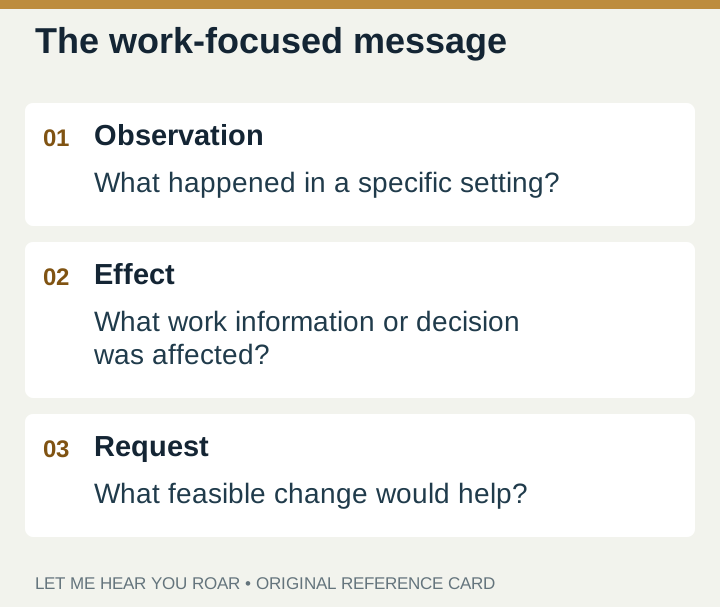
2. Write observation, effect, and request
Use three short parts. Observation describes what happened. Effect explains the relevant consequence. Request identifies what would help. For example: “When the agenda moved on before I finished the risk summary, the team did not hear the unresolved deadline issue. Could we give that item five minutes at tomorrow’s meeting?”
Read the draft for words that imply motives: always, deliberately, obviously, or because you do not care. Replace them with evidence or remove them. This does not mean your interpretation is impossible. It means the opening is more useful when it starts with something the other person can identify.
Keep the request small enough to answer. “Take me seriously” is understandable but vague. “Please let me finish the two-minute summary before questions” gives the listener a behavior to try. If you need feedback, ask what specific part of your proposal did not meet the requirement.
3. Choose timing and medium with care
A public interruption may need a brief public response: “I have one remaining point about the deadline.” A broader discussion about the pattern may fit better in a scheduled conversation. Consider who needs to be present and whether the person you plan to approach has authority to change the process.
Writing can help when you need time to organize your thoughts or want the request to be clear. Keep the message proportionate. A short note with an example and a question is often easier to answer than a long account of every related frustration. Check recipients carefully and share only information they need for the issue.
If you are worried about retaliation, pause before sending. Seek advice about the relevant options and protections in your setting. Do not assume that copying a large group, confronting a senior person publicly, or sending a strongly worded email will make the situation safer.
4. Deliver the point and leave room for an answer
Say the prepared observation, effect, and request. Then stop long enough for a response. Filling every silence with more detail may unintentionally change a clear question into a speech. If you feel rushed, refer to your notes; using notes is a practical support, not a sign that your concern lacks merit.
The other person may offer context you did not know. Listen for information relevant to the request. “The meeting was cut short because of an urgent issue” may explain the event without resolving how your concern will be heard. You can reply, “Understood. Where should we review the risk now?”
If the response focuses on your tone rather than the issue, consider whether a wording adjustment would help while keeping the substance visible: “I can restate it more briefly. My request is for a decision on the deadline risk.” Do not spend the whole conversation proving that you are calm enough to have a concern.
5. Confirm the practical next step
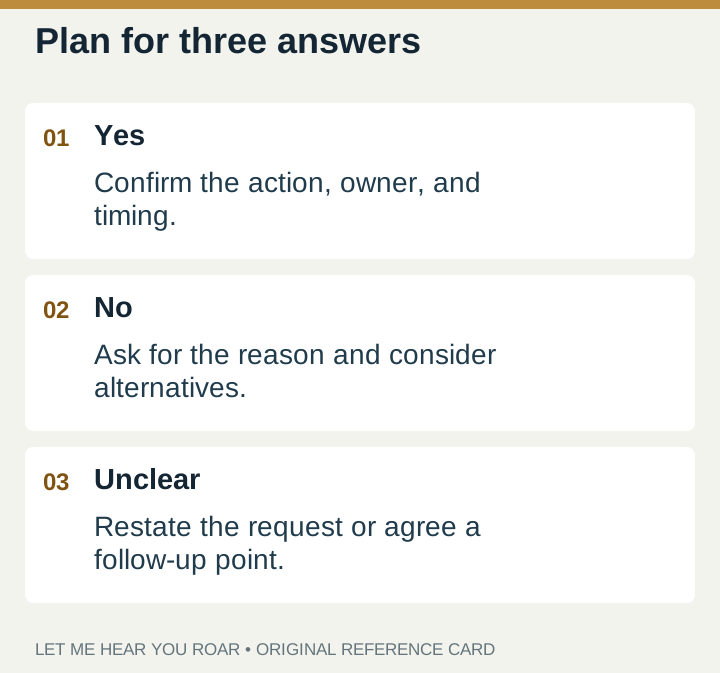
Before ending, identify who will do what and when. “We will discuss it later” may be too vague to act on. “I will send the summary by noon, and you will add it to Thursday’s agenda” creates a clearer shared understanding, provided both people actually agree.
A brief follow-up can record that understanding: “Thanks for discussing the handover. I’ll send the summary today for Thursday’s review.” Avoid rewriting the conversation to include promises that were never made. If the response was no, record that accurately and decide what alternatives are available.
Afterward, review the action as well as the tone. A warm conversation without any follow-through may leave the problem unresolved. A somewhat awkward conversation that produces a workable process can still be useful. Give yourself credit for making the request understandable without declaring the whole workplace fixed.
Alternatives and troubleshooting
If speaking in meetings remains difficult, ask whether you can contribute a written pre-read, use a shared document, or submit a question before the meeting. These are participation options, not admissions that you have nothing to say aloud. Choose what fits the work and your communication needs.
If your request is repeatedly ignored, revisit the goal and consult the appropriate person or process. Another rehearsal will not necessarily solve an organizational problem. If someone disagrees with the idea on its merits, ask for the reasons and assess them. Having a voice includes receiving substantive criticism; it does not mean every proposal must be accepted.
If you become upset, you can pause where feasible: “I want to address this clearly. Can we return to it this afternoon?” You do not need to apologize for having feelings, but you may want time to decide what information to share and how to keep the practical issue visible.
Your next action: prepare one work-focused request
Choose one recent event, write its observable effect on the work, and ask for one feasible change. Check the draft with a trusted person if that would help and confidentiality allows. Decide in advance what you will do if the answer is yes, no, or unclear.
Your next contribution does not need to repair every past dismissal. It can establish one useful opening: a question answered, a risk considered, a turn to speak, or a clearer way to participate.
Connect the ideas
If the issue involves an access need, the guide to asking for support with ADHD shows how to make a specific request without disclosing everything.
If automatic agreement is part of the pattern, explore people-pleasing and the fear of disappointing others.
What to take with you
- Use a specific event and a practical work outcome.
- Ask for a behavior or process change the listener can answer.
- Serious concerns may need formal or qualified support.
Questions readers ask
What if I freeze in the meeting?
Use a written note, ask to return to the point, or follow up through a suitable channel. You can plan participation in more than one format.
Should I confront the person publicly?
Consider the purpose and risks first. A short request to finish may fit the moment; a larger discussion may need another setting or an appropriate workplace process.
Does speaking up mean my idea must be accepted?
No. The aim is a fair opportunity to contribute and receive a meaningful response. A proposal can be heard and still be declined.
PUT ONE IDEA INTO PRACTICE
Your next step
Use coaching to rehearse a specific workplace request.
Explore coaching with Joshua ↗AI-assisted educational writing based on Joshua’s project direction. How this content is created. Original coaching reflection. Examples are illustrative unless identified as Joshua’s personal story. This article is not a clinical assessment or individualized treatment advice. Research and Scripture are linked for context; no independent clinical review is claimed.

Father, Marine Corps veteran, Christian counselor, coach, and the founder of Let Me Hear You Roar.
Read the story behind the project ↗