
A prayer for finding your voice is a personal request for God's help with honest expression, wise choices, and courage. It can name a need, a fear, a hope, or an uncertainty. It does not have to produce audible speech, a dramatic experience, or an immediate change in another person.
In this Christian reflection, voice includes the ability to express something that matters through words, writing, signs, communication aids, or a chosen silence. Prayer can accompany that process. It is not a test you must pass before your needs become legitimate.
The parts of the prayer
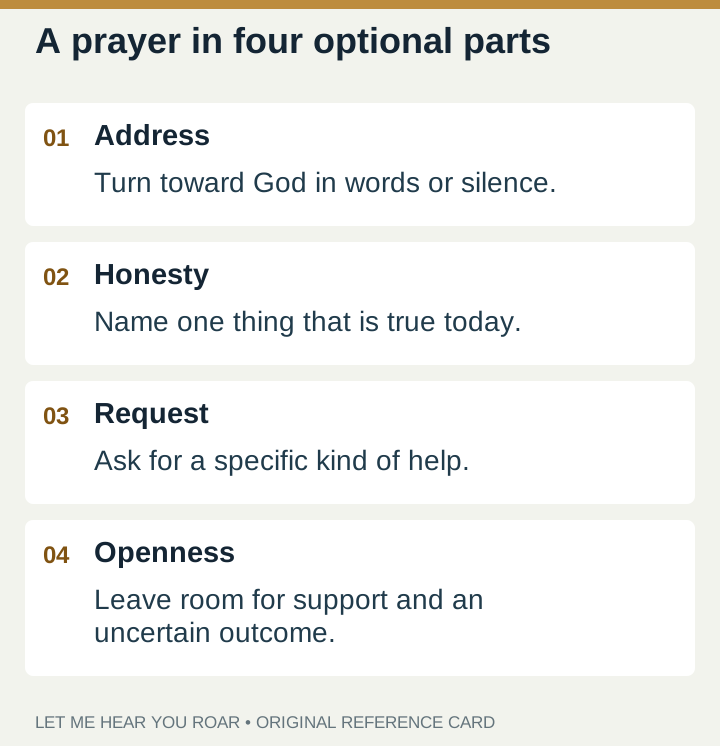
The first part is address: you intentionally bring your attention toward God. The words may be familiar, such as 'Lord Jesus,' or you may begin without a spoken introduction. There is no special phrase in this article that unlocks a response. Use language you can choose freely and understand.
The second part is honesty. Name what is true enough to name today: 'I am afraid of being dismissed,' 'I do not know what to ask for,' or 'I want to tell the truth without being cruel.' You do not have to explain everything that led to the moment. A prayer can hold a small piece of a larger story.
The third part is a request. It might be for wisdom, courage, patience, support, or rest. A specific request can help you notice the next practical question. 'Help me ask for time' is narrower than 'Make me fearless forever.' Narrower does not mean less faithful; it means you have identified something you can actually consider.
A final part may be openness: leaving room for support, further reflection, and a different outcome from the one you imagined. You may close with 'Amen,' or simply stop. The structure is an optional writing aid, not a formula that establishes whether God hears you.
A biblical place for unfinished honesty
Psalm 13 brings a painful question before God and moves through petition toward trust. Its presence in Scripture gives Christian readers a resource for honest prayer in difficulty. The following exercises are our devotional applications, not a claim that everyone must follow the psalm's emotional movement on the same timetable.
You may be ready to name pain and not ready to write a hopeful ending. Rather than composing a conclusion you do not mean, you can ask for help with that very difficulty. 'I cannot see the way forward today' can be the start of a conversation with God and, if you choose, with a supportive person.
Examples for different moments
Before an ordinary conversation, an original prayer might be: 'Lord Jesus, help me notice what I need to say. Give me patience to listen and courage to be clear. Help me choose a wise time and the right support.' Nothing in this example requires disclosing your whole history or making a confrontation happen today.
When you have been silenced, you might write: 'God, I have learned to hide what matters to me. I want room to express one true thing. Help me find people who can hear it with care.' This is a possible prayer, not an interpretation of what every quiet person has experienced.
When words are unavailable, a brief version may be enough: 'Help me with this.' You can also place a question mark on a page, choose a picture that represents the situation, or sit quietly. Those options describe ways a person might participate; they are not promises that a particular form will feel comforting.
Prayer, a script, and a declaration are different
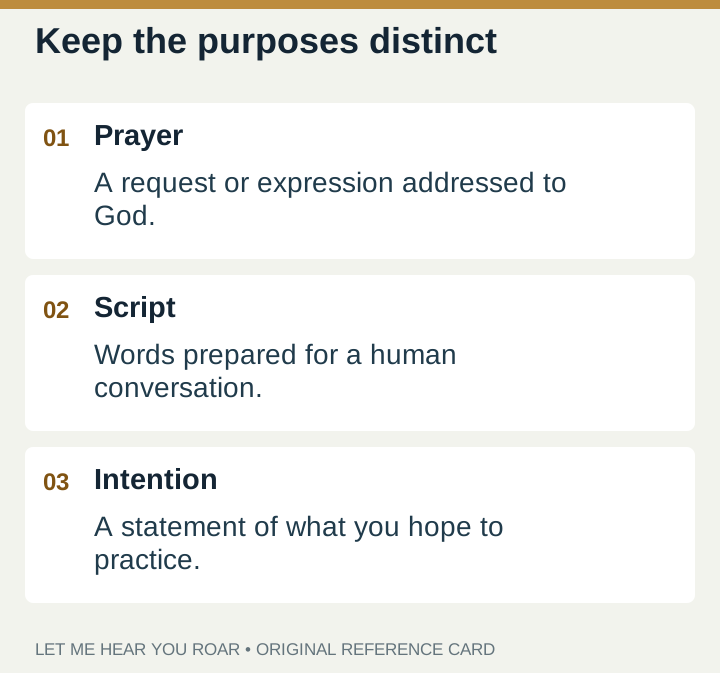
Prayer addresses God. A conversation script prepares something you might communicate to another person. A declaration states a belief, intention, or hope. They may sit beside each other, but their jobs differ. Confusing them can make a person think that repeating a statement privately has already resolved a practical problem with someone else.
For example, you might pray for courage, rehearse 'I need the instructions in writing,' and then decide whether to make that request. The prayer can matter even if the request is declined. The script may need revision even if you prayed sincerely. Neither result gives a complete verdict on your faith or your value.
A statement such as 'I hope to speak more honestly' names an intention. It does not guarantee that fear, illness, disability, or difficult circumstances will disappear. You do not need to deny those realities to make room for Christian hope. Honest limits can be part of the prayer itself.
Common misunderstandings
One misunderstanding is that prayer must be intense to be sincere. Another is that a person must forgive, disclose, reconcile, and feel peaceful in a single sitting. This article sets no such requirement. Those are distinct and often complicated questions; a short devotional exercise cannot resolve them by instruction.
Another misunderstanding is that struggling to speak necessarily reveals spiritual opposition. There can be many personal, relational, practical, or health-related reasons communication is difficult. Prayer does not identify the cause. Persistent difficulties may deserve qualified support, and seeking that support can sit alongside spiritual practice.
A final misunderstanding is that someone else can decide the correct words for your experience. A leader may offer a prayer, but you can adapt it or decline. If language makes you feel blamed for what happened to you, you do not have to repeat it to show cooperation. Ask for wording that respects what you actually mean.
Your next step: write an honest request
Divide a page into three short prompts: what I want to express, what makes it difficult, and what kind of help I need. Fill in only what you want. Turn one answer into a prayer if that fits your faith today; keep the page private unless you choose otherwise.
A prayer for finding your voice is ultimately an invitation to bring the work of expression before God. It can support reflection and a chosen next step. It is neither a demand to become louder nor a guarantee that others will listen. Its useful beginning is an honest request you can make your own.
Connect the ideas
Alongside prayer, small choices after trauma may help you identify a next step that does not require telling your whole story.
If you do not know what to say to God, the guide to honest prayer and lament offers several starting forms.
What to take with you
- A prayer for voice asks for help with expression and discernment.
- A prayer and a practical communication request have different purposes.
- You may adapt, shorten, write, or decline the suggested prayers.
Questions readers ask
Can I use a prayer someone else wrote?
Yes, if the words fit what you mean. Change any wording that feels inaccurate or pressured.
What if I feel nothing afterward?
You do not need to treat an immediate feeling as the measure of a prayer. Consider whether a practical next step or supportive conversation would be useful.
PUT ONE IDEA INTO PRACTICE
Your next step
Find optional faith reflections for your own words and pace.
Explore faith and speaking life ↗Sources & further reading
AI-assisted educational writing based on Joshua’s project direction. How this content is created. Original coaching reflection. Examples are illustrative unless identified as Joshua’s personal story. This article is not a clinical assessment or individualized treatment advice. Research and Scripture are linked for context; no independent clinical review is claimed.

Father, Marine Corps veteran, Christian counselor, coach, and the founder of Let Me Hear You Roar.
Read the story behind the project ↗