
“Trauma stored in the diaphragm” is not an established anatomical explanation. The phrase is often used as a metaphor for feeling restricted, tense, or unable to breathe freely during distress. A metaphor can describe an experience without demonstrating that traumatic memories sit inside a muscle and can be pushed out.
The diaphragm is a major breathing muscle. That role is real and important. The claim that it stores trauma is a separate claim requiring separate evidence. Understanding the difference lets you respect a physical sensation without accepting an unsupported explanation of what it means.
What the diaphragm actually does
The National Heart, Lung, and Blood Institute describes the diaphragm as a dome-shaped muscle below the lungs that separates the chest and abdominal cavities. During inhalation it contracts and moves downward, helping create space for the lungs to expand. Other muscles also contribute to breathing.
This anatomy explains why a breathing practice might mention the diaphragm. It does not establish a trauma-storage mechanism. An exercise can involve a body structure without showing that the structure holds a psychological history.
Be careful with the phrase “breathing into the diaphragm.” In ordinary coaching language, it may be intended as an image for a comfortable breathing pattern. Air goes into the lungs, not into the diaphragm itself. You can ask an instructor what physical action they mean rather than trying to make a metaphor happen literally.
The three parts of the storage claim
The claim usually contains three ideas: a difficult experience remains in the body, a particular tissue contains it, and a technique can release it. Those ideas should not be treated as one package. The first may be a broad way of speaking about lasting effects; the second and third make more specific assertions.
Ask what “stored” means in the explanation. Does the speaker mean a remembered pattern, a present sensation, or a physical substance? If the meaning shifts whenever you ask a question, the phrase is not giving you a clear mechanism.
Then ask what would demonstrate release. Feeling different after an exercise is an observation. It does not identify what changed or establish that a memory left a muscle. A convincing explanation must do more than rename a pleasant sensation as proof.
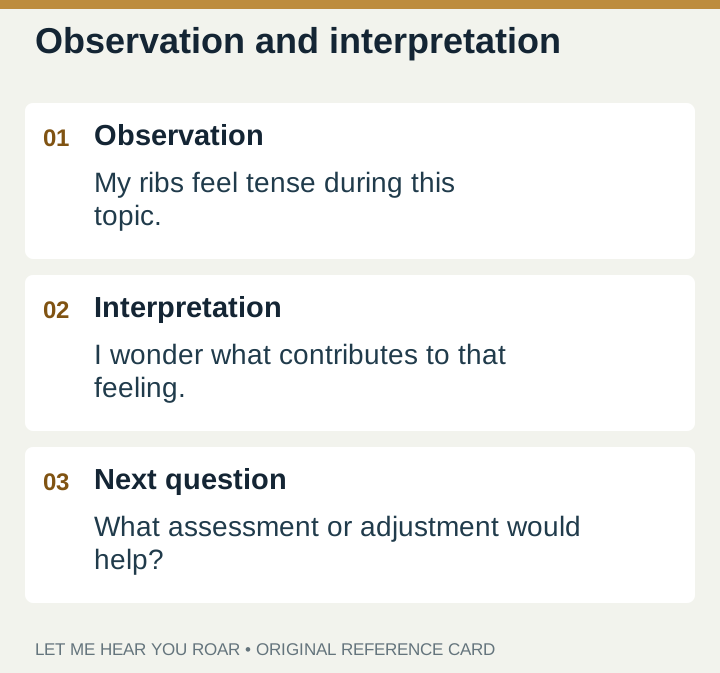
Examples of clearer language
Instead of saying, “My diaphragm is full of trauma,” you might say, “I notice tension around my ribs when this topic comes up.” The second sentence stays close to what you can observe. It also gives a clinician or instructor more useful information.
Instead of saying, “The exercise released childhood trauma,” you might say, “I felt more comfortable afterward, and I do not yet know why.” That wording leaves room for the experience without making it carry a conclusion it cannot establish.
Instead of saying, “I need to break through the blockage,” you might say, “I would like to find a comfortable way to breathe and speak.” The revised goal is practical. It does not require force, a dramatic reaction, or a belief that pain is the doorway to progress.
How metaphor differs from diagnosis and treatment
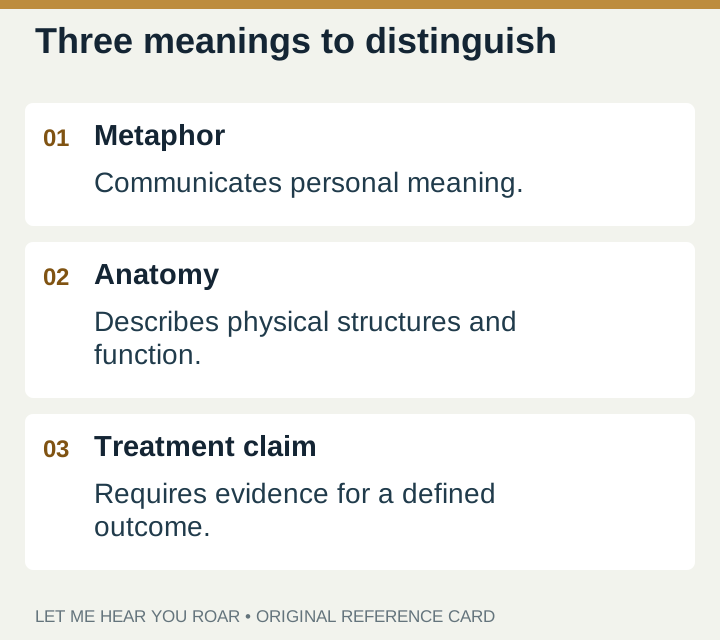
A metaphor helps someone communicate meaning. A diagnosis identifies a condition through an appropriate assessment. A treatment recommendation proposes an intervention for a defined problem. These uses of language have different responsibilities.
You can choose a metaphor privately because it resonates with you. A provider making a diagnosis or promising treatment needs a stronger basis. Their confidence, your emotional response, or a diagram of the nervous system does not replace evidence relevant to the claim.
For example, a person may find “making room to breathe” a helpful description of setting a boundary. That does not mean the boundary mechanically removes a memory from the diaphragm. The phrase works as an image because it connects an experience with a familiar feeling, not because it supplies anatomy.
Misconceptions to leave behind
One misconception is that questioning the storage explanation dismisses trauma. It does not. You can take distress, bodily sensations, and the need for care seriously while asking for accurate language about mechanisms.
Another is that a strong physical reaction proves an exercise is working. A reaction may be unpleasant, unexpected, or unrelated to the promised outcome. You do not have to reinterpret discomfort as a breakthrough to satisfy an instructor’s theory.
A third is that a quiet or uneventful session means you are blocked. No emotional performance is required to make your experience valid. If a method only recognizes dramatic responses as progress, it may be asking you to serve the method rather than helping the method serve you.
A useful definition and a next question
The most defensible use of “trauma stored in the diaphragm” is as a personal metaphor, clearly labeled as such. It should not be presented as established anatomy or as proof that a particular breathing or vocal exercise treats trauma.
If you have persistent pain, breathlessness, or voice symptoms, seek appropriate medical assessment instead of assuming they are emotional storage. If you want help with distress related to past events, discuss that with a qualified mental health professional. Different concerns can coexist and deserve their own attention.
For your next step, rewrite one body-related statement using three parts: what you notice, when you notice it, and what help you want. “My breathing feels uncomfortable before meetings, and I want advice about it” is a useful beginning. You do not need a complete theory before asking for support.
Connect the ideas
For the wider debate about emotional release through sound, read the guide asking does scream therapy work.
The same evidence-reading habits are useful when considering claims about gut health and mental health.
What to take with you
- The diaphragm is a breathing muscle, not an established container for traumatic memories.
- A metaphor can be meaningful without functioning as anatomy.
- Describe sensations and seek appropriate help without forcing a release story.
Questions readers ask
Does this mean trauma has no physical effects?
No. Rejecting one unsupported storage claim does not deny physical experiences or the need for care.
Can I still use the phrase as a metaphor?
Yes, if you make clear that it expresses your experience rather than an established mechanism.
Should I force a deeper breath to release tension?
Do not force breathing or treat discomfort as a requirement. Ask a qualified clinician about persistent or concerning symptoms.
PUT ONE IDEA INTO PRACTICE
Your next step
Use clear observations to decide what kind of support you need.
Understand care and coaching options ↗Sources & further reading
AI-assisted educational writing based on Joshua’s project direction. How this content is created. Original coaching reflection. Examples are illustrative unless identified as Joshua’s personal story. This article is not a clinical assessment or individualized treatment advice. Research and Scripture are linked for context; no independent clinical review is claimed.

Father, Marine Corps veteran, Christian counselor, coach, and the founder of Let Me Hear You Roar.
Read the story behind the project ↗