
Gentle breathing and humming, as used in this guide, means a brief optional exploration of ordinary breath and easy sound. It is not a technique for forcing emotion out of the body. You can participate without humming, without changing your breathing, and without making any sound at all.
The purpose is modest: to notice what feels workable and to make a simple expression available. That expression might be a comfortable hum, a sentence spoken at an ordinary volume, or a written statement of preference. This is an original practice menu, not a validated trauma-treatment protocol or a substitute for voice therapy.
What belongs in a gentle practice
A gentle practice leaves you free to stop, change the activity, or decide that it is not useful. It does not ask for maximum breath, prolonged sound, emotional intensity, or a performance for an observer. The easiest option is the starting point rather than something you must quickly outgrow.
The NHS breathing guidance emphasizes comfortable, unforced breathing. That principle matters more here than achieving a count or imitating someone else’s chest movement. If a breathing instruction makes you work harder to breathe, return to your ordinary pattern and stop the exercise.
For humming, “easy” means you do not try to make the sound impressive. There is no required pitch, duration, resonance sensation, or loudness. If sound feels strained or uncomfortable, leave it out. A practice that respects your choice can end before the sound begins.
Why someone might choose to try it
You may want a transition between a busy activity and a conversation. You may be curious about saying a simple sentence without rushing. You may enjoy a little quiet sound in private. Those are sufficient reasons to explore an optional activity; you do not need a dramatic theory of healing to justify them.
A useful goal could be, “I want to notice whether I prefer quiet or sound today.” Another could be, “I want to rehearse one sentence I will use in a meeting.” These goals concern your choices and communication. They do not promise a particular biological change.
Avoid making calmness the admission ticket. If you do not feel relaxed afterward, you have not failed. You may have learned that breath-focused practice is not your preference, that this setting is distracting, or that a practical problem needs a practical solution.
Prepare the setting and the exit
Choose a place where you can comfortably sit or stand and stop without explanation. You do not need special equipment, music, darkness, or a private retreat. Keep your eyes open if you prefer. A neutral everyday setting may be easier to use than an elaborate ritual.
Before beginning, decide on an exit: put the exercise down and return to an ordinary activity. You might read a short message, look around the room, or get on with the task you had planned. An exit is not a failure plan; it is part of making participation voluntary.
If you have a breathing or voice condition, follow your clinician’s advice and ask whether a new practice is appropriate. If you are currently hoarse, in pain, or ill, do not use a wellness exercise to test your limits. NIDCD advises resting a tired or hoarse voice and avoiding vocal extremes.
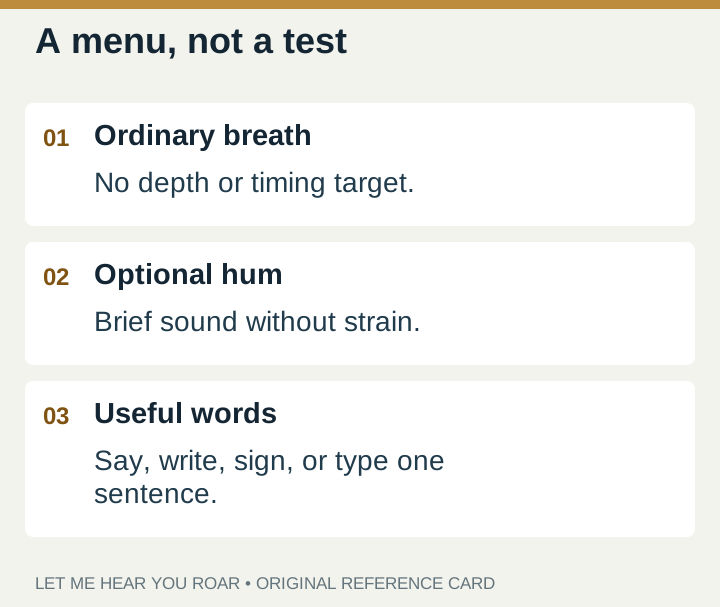
Try the three options in any order
Option one is ordinary breathing. Let your breath continue without trying to make it deeper. Notice the room or the support beneath you if focusing inside your body is unhelpful. You can stop here; attention to breathing is not required either.
Option two is a brief, comfortable hum on an ordinary exhale, only if your voice feels well. End the sound before you need to work for it. Then return to normal breathing. There is no repetition target. Do not keep going to create a special sensation or to match a recording.
Option three is a practical sentence. Try, “I would like a moment to think,” or choose your own words. You can speak at an ordinary conversational volume, write the sentence, sign it, or use an assistive communication method. The message is the useful part; the method should serve it.
You do not have to combine the options. Someone might prefer quiet and writing. Someone else might enjoy one hum and then move on. A menu offers choices, while a test would demand a correct sequence.
Apply it to a real communication task
Pick a small situation where having words ready would help. Perhaps you want to ask a colleague to send instructions in writing. Draft that request before practicing. Otherwise, the exercise can become detached from the thing you actually want to do.
After your chosen quiet or sound option, read the request once. Notice whether the wording is clear. If it feels awkward, edit the sentence rather than increasing the intensity of the vocal activity. Communication often improves through a practical revision, not through a bigger emotional experience.
In an illustrative example, “I just wondered if maybe you could possibly explain that again” becomes, “Please send the steps in writing.” The second version is easier to remember because it names the action. No claim about nervous-system change is needed to explain why a shorter request may be useful.
Troubleshooting: discomfort, distraction, and expectations
Stop if you feel dizzy, short of breath, strained, or distressed. Do not treat discomfort as evidence that a hidden blockage is leaving. NCCIH notes that relaxation techniques can sometimes produce unwelcome experiences, including increased anxiety. A practice being described as gentle does not mean it suits everyone.
If focusing on your body makes things harder, choose an external task or skip the practice. If humming feels awkward because someone may hear, choose writing. If you are distracted, you may simply need a different time or no exercise at all.
If you feel pressure to produce tears, release, or a powerful sound, return to the stated purpose: an optional communication experiment. You do not owe a facilitator an emotional result. Persistent symptoms or significant distress deserve appropriate professional attention, not repeated attempts to push through.
Your next step: keep only what serves you
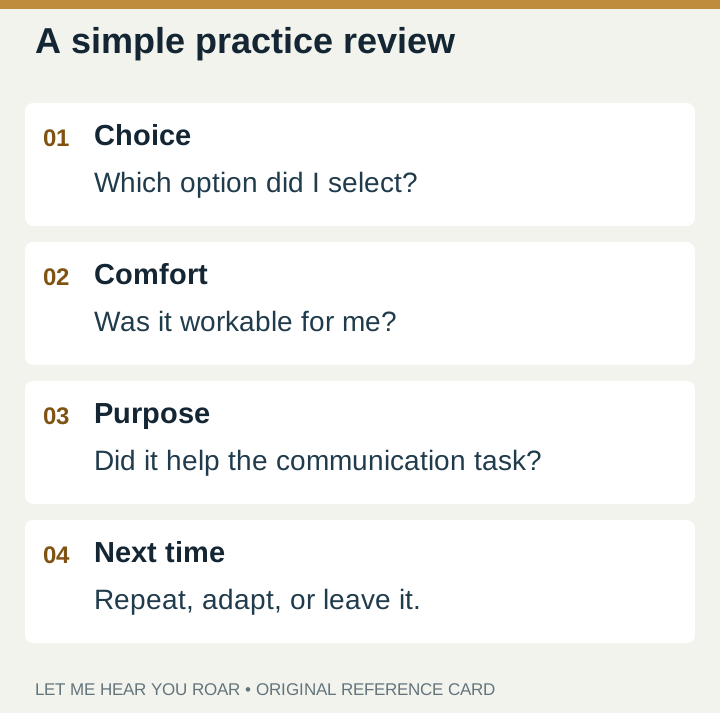
Write a short note after trying an option: what you chose, whether it was comfortable, and whether it helped the task you had in mind. Use ordinary words. “I preferred writing” is more informative than a score that pretends to measure healing.
Choose whether to repeat, adapt, or leave the activity. If you repeat it, keep the purpose small and the stopping point clear. Finding a usable sentence, recognizing a preference for quiet, or deciding to ask a professional about symptoms can each be a worthwhile outcome.
Connect the ideas
Before adding more sound, review voice care for speaking and singing so practice stays within a comfortable range.
If the difficult part is losing your words rather than making sound, explore freezing in a conversation as a separate question.
What to take with you
- The practice is optional and does not require sound.
- Comfort and choice matter more than duration or intensity.
- Use a practical communication goal to decide whether it helps.
Questions readers ask
How long should I hum?
There is no target in this informal practice. If you choose sound, keep it brief and easy, and stop before effort or discomfort.
Does humming release trauma?
This guide does not make that claim. A pleasant or meaningful experience does not establish a trauma-treatment effect.
What if breathing exercises make me anxious?
Stop the exercise and choose another activity. Seek qualified support if anxiety is persistent or significantly affects your life.
PUT ONE IDEA INTO PRACTICE
Your next step
Choose quiet, writing, or easy sound for one practical sentence.
Explore gentle voice practices ↗Sources & further reading
AI-assisted educational writing based on Joshua’s project direction. How this content is created. Original coaching reflection. Examples are illustrative unless identified as Joshua’s personal story. This article is not a clinical assessment or individualized treatment advice. Research and Scripture are linked for context; no independent clinical review is claimed.

Father, Marine Corps veteran, Christian counselor, coach, and the founder of Let Me Hear You Roar.
Read the story behind the project ↗