
Protecting your voice includes planning the situations in which you use it. A teacher, singer, group leader, parent, or frequent caller may face very different demands, but each can ask the same practical question: which parts of this task truly require my voice, and which can be handled another way?
The seven ideas below focus on everyday planning. They do not replace individual advice for a voice condition or provide a treatment exercise. NIDCD recommends avoiding vocal overuse and extremes, resting a tired or hoarse voice, and considering amplification when appropriate. The planning examples translate that brief guidance into choices you can discuss in your own setting.
1. Map the demanding parts of your day
Look at your calendar and identify the activities that require sustained speaking or singing. Include informal demands such as long calls, a noisy commute conversation, or leading a social event after work. The point is to see the whole day rather than treating each activity as if it begins with a fresh voice.
Mark which demands are fixed and which can change. A presentation may be fixed, while a follow-up discussion could move to email. A rehearsal may be planned, while an extra call could wait. This is a scheduling exercise, not a formula for a medically safe number of minutes.
Choose one adjustment before the busiest day arrives. A plan made in advance is easier to communicate than an improvised change when you are already uncomfortable.
2. Make the room and equipment do their share
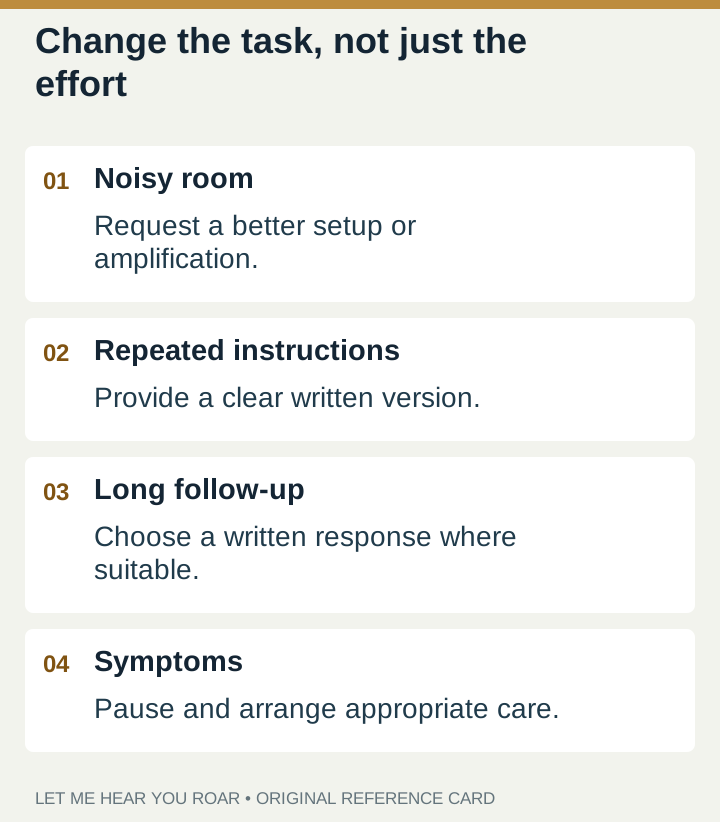
Before a talk or group session, ask about the microphone, seating, and background noise. Test the equipment during setup rather than discovering a problem in front of the audience. Assign someone to help with technical issues so you are not simultaneously managing sound and content.
Prepare a simple contingency. If amplification fails, could the group move closer, could the session pause, or could part of the material be shared in writing? A larger venue does not create an obligation to compensate with ever more effort.
For online meetings, check that your microphone is positioned sensibly and that listeners can hear you at a comfortable speaking level. Ask for a technical adjustment before assuming that the solution is to speak louder.
4. Keep a non-vocal way to communicate
Prepare a few practical alternatives: a typed message, a shared document, a visual cue, or an assistive communication option that fits your needs. These can be ordinary parts of your workflow rather than emergency measures that require an apology.
For an illustrative group-leadership example, the agenda can state when participants should begin, pause, or return from a break. For a family example, a message can communicate a change of plan without calling across a noisy house. Choose methods that the people involved can access.
If you develop discomfort, having the alternative ready makes it easier to stop forcing the original format. The purpose is successful communication, not proving that you can deliver every message aloud.
5. Separate expressive goals from volume goals
A song can communicate tenderness, anger, grief, or joy without every emotion being represented by greater loudness. A speech can be clear and compelling through wording, pacing, and structure. If you work with a singing teacher or speaking coach, explain your goal in those terms and ask about appropriate technique within their scope.
For a personal expression practice, choose a sentence whose meaning matters to you. You might write it first, then decide whether to say it. A metaphor such as “finding my roar” can refer to courage or honesty without becoming an instruction to scream.
Avoid comparing your expression with someone else’s dramatic performance. A powerful recording may be edited, amplified, or produced under conditions you cannot see. It is not a personal target for your throat.
6. Make changes easy to request
Prepare language for the practical adjustment you might need. Illustrative examples include, “Please turn on the microphone,” “I will answer the remaining questions in writing,” or, “We need to pause while the sound is fixed.” The wording should tell others what to do.
If your role makes adjustments difficult, discuss the issue before a major event. A manager, organizer, or co-leader may be able to change the schedule or provide equipment. Be specific about the task rather than relying on a general request to be more considerate.
You can also ask a clinician for guidance when voice demands are part of your job. ASHA’s clinical guidance emphasizes assessment of voice concerns and their impact; a workplace plan should fit the individual rather than assume the same advice works for everyone.
7. Treat symptoms as information for care
Do not explain persistent symptoms solely through emotion or effort. A change in voice may need assessment even when it began during a stressful week. Keep a short note of onset, relevant activities, and how the problem affects communication.
NIDCD advises seeing a doctor for hoarseness lasting more than three weeks, particularly without a cold or flu, and sooner for concerning symptoms such as pain, swallowing difficulty, or breathing difficulty. Sudden voice loss with strenuous use needs prompt attention. Do not wait for a calendar threshold when symptoms are urgent.
When you arrange care, bring the practical picture: what your voice has to do, what has changed, and which adjustments you have tried. That information can help make the appointment relevant to your daily life.
Bonus: prepare a one-page event plan
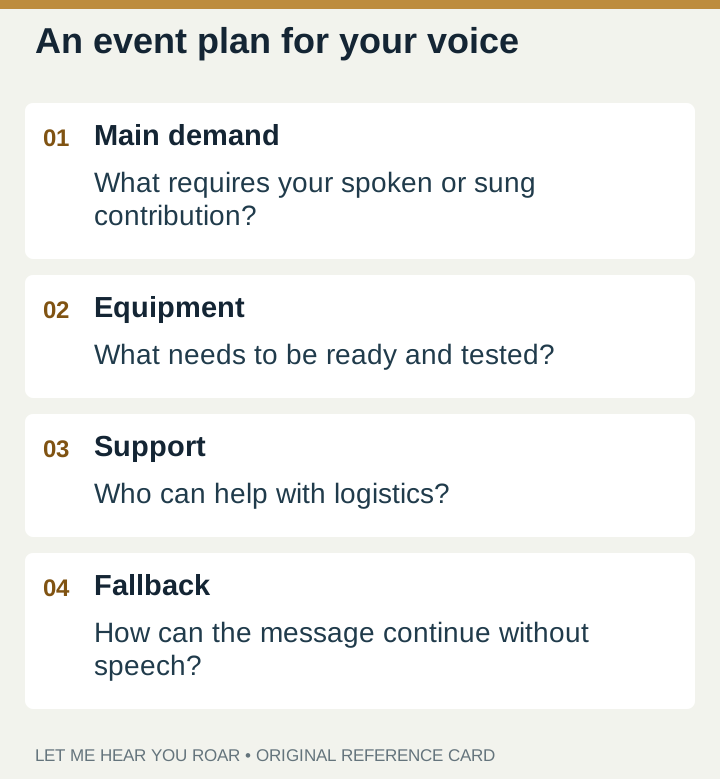
For your next demanding speaking day, write down the main vocal task, the equipment needed, a person who can help, and a non-vocal fallback. Keep the plan short enough that you will actually use it. You do not need to quantify every minute or turn preparation into another source of pressure.
Choose one change from this list to arrange today. Perhaps it is booking a microphone, rewriting instructions, or moving a follow-up to email. Protecting your voice becomes more practical when it is built into the task rather than left as a reminder to try harder afterward.
Connect the ideas
When comfortable practice is appropriate, gentle breathing and humming offers a small place to begin.
Adults leading a family or group can also explore helping children express themselves without performing, so participation stays optional.
What to take with you
- Plan the whole day’s communication demands.
- Use equipment, structure, and alternative channels to support participation.
- Persistent or concerning symptoms deserve appropriate assessment.
Questions readers ask
Is whispering a good substitute when my voice is tired?
NIDCD includes whispering among vocal extremes to avoid. A written or other non-vocal alternative may be more appropriate while you seek advice if needed.
Can I still use a roar as a metaphor?
Yes. It can mean courage, clarity, or expression without requiring loud sound.
How much voice use is too much?
There is no universal limit supplied here. Individual needs, symptoms, tasks, and clinical guidance matter.
PUT ONE IDEA INTO PRACTICE
Your next step
Plan one practical change that makes your next speaking task easier.
Explore gentle voice practices ↗Sources & further reading
AI-assisted educational writing based on Joshua’s project direction. How this content is created. Original coaching reflection. Examples are illustrative unless identified as Joshua’s personal story. This article is not a clinical assessment or individualized treatment advice. Research and Scripture are linked for context; no independent clinical review is claimed.

Father, Marine Corps veteran, Christian counselor, coach, and the founder of Let Me Hear You Roar.
Read the story behind the project ↗