
Scream therapy evidence does not justify promising that shouting will release stored trauma or treat PTSD. The phrase “scream therapy” is used for very different activities, from an informal shout to a group event or a treatment claim. Before deciding whether it works, ask what activity is being proposed and what “works” is supposed to mean.
Someone may honestly report feeling relief after making a sound. That experience deserves respectful listening. It does not, by itself, show that the activity treats a condition, is suitable for another person, or is safe to intensify. This guide separates those questions so you can make a more informed choice.
Start by defining the activity
A spontaneous shout, a theatrical vocal exercise, an anger-venting event, and psychotherapy are not interchangeable. They differ in purpose, structure, training, setting, and the outcomes they claim. A label that groups them together can make the evidence seem clearer than it is.
Ask the provider to describe exactly what you would do. Would you be asked to recall painful events? How loud would the sound be? Could you choose silence? Would the activity be recorded? What qualifications does the facilitator hold? A concrete description is more useful than a promise to unlock your authentic self.
The word “therapy” also needs clarification. A service can use therapeutic language without providing regulated clinical treatment. Ask what professional role the provider is acting in and what their service is qualified to address. You should be able to understand that before deciding to participate.
Expression
An expressive activity may offer a way to make sound or communicate emotion. That purpose does not automatically include treating a mental health condition.
Relief
Relief is an experience someone may report afterward. Its duration, meaning, and relationship to the activity require separate questions.
Treatment
A treatment claim requires evidence about a defined condition, a defined intervention, and meaningful outcomes, with attention to possible harms.
Relief and treatment answer different questions
Imagine an illustrative participant who says, “I felt lighter afterward.” You can accept the report without deciding why it happened. Perhaps the social setting mattered, perhaps permission to express emotion mattered, or perhaps the person liked doing something unusual. One account cannot separate those possibilities.
A treatment study asks a more structured question. What changed, compared with what alternative, in which participants, over what period? Did the change persist? Were people who had a difficult experience included in the results? These questions do not diminish personal experience; they prevent an individual experience from being stretched into a general guarantee.
The reverse error also matters. A practice lacking evidence as a trauma treatment does not mean every person who enjoyed it is mistaken. Enjoyment, personal meaning, and clinical effectiveness are different categories. You can keep a meaningful memory while remaining cautious about the explanation attached to it.
For a purchasing decision, write the exact promise in plain language. “A chance to explore expression” is different from “heals trauma held in the throat.” The second claim carries a much larger evidentiary burden, even if both appear on the same attractive webpage.
What anger research can and cannot tell us
A 2024 meta-analysis by Kjærvik and Bushman found that activities decreasing arousal reduced anger and aggression overall, while activities increasing arousal were not effective overall. This challenges the idea that intensifying anger reliably drains it away. It is not a direct trial of every vocal practice, nor proof about treating PTSD through sound.
The practical lesson is to resist the simple pressure-cooker story: emotion builds, a louder outlet empties it, and the problem is solved. That story may feel intuitive, but intuition is not enough to establish a mechanism. A vivid metaphor can be memorable while still being a poor basis for a treatment claim.
It is equally unhelpful to turn the research into a rule that people must never express anger. Naming harm, requesting change, and setting a boundary are communication acts. They need not involve deliberately increasing intensity. The question is what the expression is doing and whether the approach supports the next useful action.
An illustrative alternative to rehearsing an angry monologue is drafting a specific request: “I need the deadline confirmed before I can agree.” This does not deny anger. It translates a practical concern into information another person can respond to. Whether that conversation is appropriate still depends on the relationship and setting.
What breathing research adds
A 2023 randomized study by Balban and colleagues reported benefits for mood and breathing rate from brief structured breathing, with exhale-focused cyclic sighing showing particular promise. The study examined specific practices and outcomes. It did not establish that screaming, humming, or a branded roar exercise releases trauma or cures PTSD.
This is a common evidence-reading problem: one technique is studied, then a different technique borrows the result because both involve breathing. The shared word does not make the interventions equivalent. A recipe containing flour is not the same recipe as every other food containing flour; the actual instructions matter.
When a provider cites research, compare the practice in the paper with the practice being sold. Check the participants, the duration, the outcome, and the degree of supervision. You do not need advanced statistical training to notice that a study of mood does not directly establish treatment for a diagnosed condition.
You can also choose not to adopt a studied technique. Research describes patterns in groups; it does not override your health needs, preferences, or clinician’s advice. An approach can be promising and still be unsuitable for a particular person or moment.
Why body-storage claims need careful language
Statements such as “my throat holds everything I never said” may express an experience powerfully. They become a different kind of statement when someone claims that trauma memories are literally stored in the vocal folds or diaphragm and can be expelled by sound.
The diaphragm is a breathing muscle. Vocal folds help produce voice. Naming those structures does not demonstrate that they contain a removable store of traumatic memories. A credible explanation needs evidence for its specific mechanism, not only an anatomical word and an emotionally resonant story.
You can describe an observation without adopting the stronger claim. “My throat felt tight during the conversation” is clear. “Afterward I felt less tense” is also clear. Neither requires a conclusion about where memories live or what has left the body.
This distinction is especially important when symptoms persist. If a person is told that every throat problem reflects unspoken emotion, they may overlook the need for medical assessment. Respect for emotional experience and respect for physical health belong together.
Consider the voice as part of the decision
NIDCD recommends avoiding vocal extremes such as screaming and whispering. The implication for a wellness activity is straightforward: louder is not a reliable measure of benefit. A facilitator should not require vocal strain as proof of courage or progress.
Ask whether the activity has a genuine no-sound option. An alternative is meaningful only if you can choose it without being shamed, singled out, or told you are resisting healing. Permission should be visible in the structure, not merely mentioned before the group begins.
Think through ordinary logistics too. Could a shout alarm others nearby? Is the space shared with people who have not agreed to participate? Are you being asked to use your voice after a demanding workday? These practical questions matter even when no clinical treatment is claimed.
If you develop pain, hoarseness, or another concerning symptom, stop and seek appropriate advice. Do not interpret a physical warning sign as evidence that the exercise is reaching a deeper layer. The goal of expression does not require overriding your ability to stop.
Evaluate the provider, not only the promise
A useful provider can explain what happens before, during, and after the activity. They can describe their training without implying expertise they do not hold. They can distinguish a personal story from evidence, and they can tell you how they handle distress or a request to leave.
Look closely at the consent conditions. Can you decline touch, recording, personal disclosure, prayer, or group participation separately? Is payment tied to a clear service rather than an escalating promise that more intensity will finally produce a breakthrough? Are the limits of the work stated plainly?
You can ask, “What would make this unsuitable for someone?” A thoughtful answer is more informative than a claim that the practice is natural and therefore universally safe. You can also ask how the provider would respond if you said the session did not help.
Be cautious about an explanation that makes every possible result confirm the method. If relief proves it worked, distress proves it went deep, and no change proves you resisted, there is no clear way to evaluate the claim. You are entitled to a service whose claims can be questioned.
Choose an alternative that matches your purpose
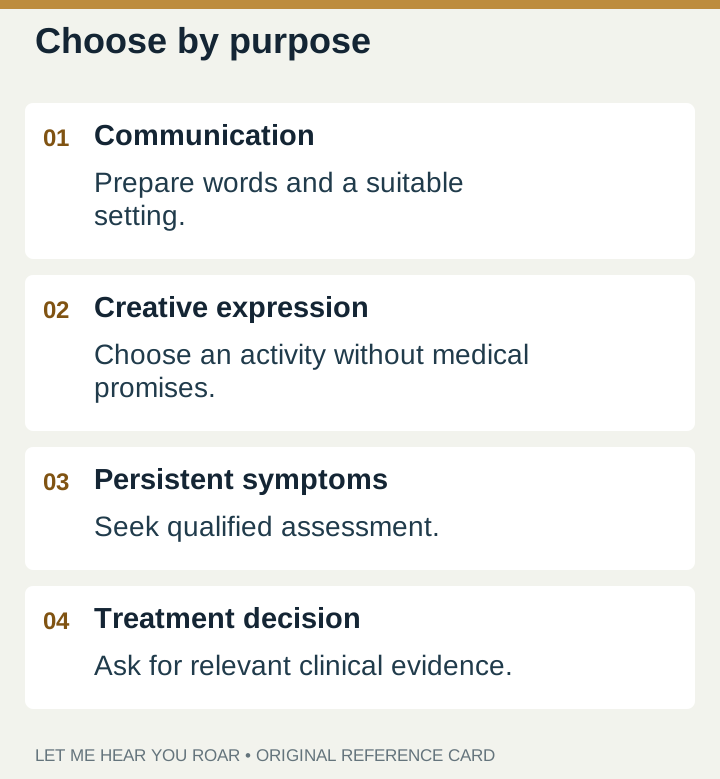
If your purpose is communication, work on a sentence, a listener, and a setting. If your purpose is creative expression, consider an activity you enjoy without attaching medical promises. If your purpose is treatment for persistent distress, seek a qualified clinician who can discuss evidence-based options.
For a low-pressure communication experiment, write one thing you want to say and choose how to express it. Ordinary speech, typing, signing, and assistive communication all count. You can use a lion or roar as a personal metaphor for courage without imitating an animal’s sound or making a claim about human physiology.
If you want a quiet transition before a conversation, you may choose ordinary breathing or an unrelated neutral activity. Breath-focused practices are optional. NCCIH notes that relaxation methods can sometimes bring unwelcome reactions, so discomfort is a reason to stop and reconsider rather than a challenge to overcome.
If Christian faith matters to you, prayer can be part of your reflection. It should not become a demand to shout, a test of belief, or a substitute for care. A quiet prayer and a practical appointment can coexist.
A simple claim-checking exercise
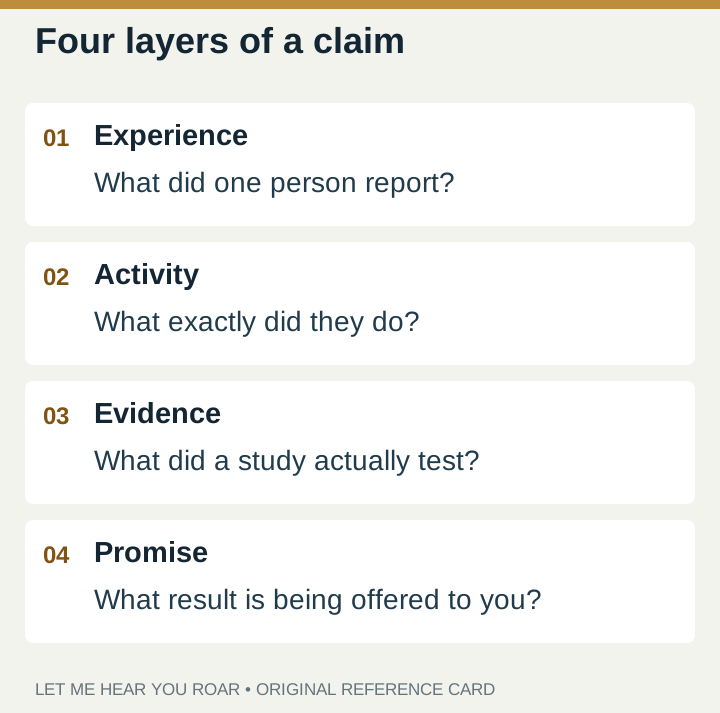
Take one wellness claim and rewrite it in four parts: activity, audience, promised result, and supporting evidence. For example, an advertisement might propose a group vocal exercise for trauma survivors and promise lasting release. Ask what study tested that exact combination and how lasting release was defined.
Then write what remains uncertain. You may know that a participant liked the session but not whether symptoms changed. You may find a breathing study but no study of the proposed sound. You may understand the activity but not the provider’s qualifications. Uncertainty is useful information for a decision.
Finally, compare the claim with your own purpose. You may decide that an optional expressive activity interests you while rejecting its medical explanation. You may decide the unanswered questions are enough to decline. You do not need to prove that every version of the activity is harmful before choosing another route.
Where to go next
For an accessible practice menu, read “Gentle Breathing and Humming: A Beginner’s Guide to Voice Practice.” For the anatomy claim, read “Is Trauma Stored in the Diaphragm? What the Phrase Means.” For a practical response to a difficult speaking moment, use “How to Respond to a Tight Throat Before a Conversation.” For everyday planning, explore “7 Ways to Protect Your Voice When Speaking, Singing, or Leading.”
Choose the next step according to the problem you want to address. A communication goal calls for a communication plan. A persistent symptom calls for appropriate assessment. A treatment claim calls for evidence that matches it. You can value expression while keeping those distinctions clear.
Connect the ideas
One recurring claim needs its own examination: whether trauma is stored in the diaphragm. That discussion separates felt tension from an anatomical conclusion.
For a lower-intensity starting point, explore gentle breathing and humming as optional practice rather than trauma treatment.
What to take with you
- A report of relief is different from evidence of treatment.
- Evidence must match the actual activity, population, and claimed outcome.
- Expression should preserve your ability to stop, choose quiet, and seek care.
Questions readers ask
Does the anger research prove that all vocal expression is harmful?
No. The reviewed activities and outcomes do not justify that broad conclusion. The findings challenge arousal-increasing venting as a general anger-management strategy.
Can I enjoy an expressive activity without treating it as therapy?
Yes. Personal meaning and enjoyment can be valid reasons for an activity, provided you consider its practical risks and do not mistake enjoyment for a proven treatment effect.
Is a roar required on this site?
No. Here, a roar can be a metaphor for courage and expression. Ordinary speech, writing, and silence remain options.
What should I ask before joining a session?
Ask about the exact activity, qualifications, evidence for claims, options to decline, privacy, and the response to distress or physical symptoms.
PUT ONE IDEA INTO PRACTICE
Your next step
Review the care guidance before choosing a practice or provider.
Understand care and coaching options ↗Sources & further reading
- Kjærvik and Bushman: A meta-analytic review of anger management activities that increase or decrease arousal (2024) ↗
- Balban and colleagues: Brief structured respiration practices enhance mood and reduce physiological arousal (2023) ↗
- NIDCD: Taking Care of Your Voice ↗
- NCCIH: Relaxation Techniques—What You Need To Know ↗
- NHLBI: How Your Body Controls Breathing ↗
AI-assisted educational writing based on Joshua’s project direction. How this content is created. Original coaching reflection. Examples are illustrative unless identified as Joshua’s personal story. This article is not a clinical assessment or individualized treatment advice. Research and Scripture are linked for context; no independent clinical review is claimed.

Father, Marine Corps veteran, Christian counselor, coach, and the founder of Let Me Hear You Roar.
Read the story behind the project ↗